














![The market-builder who restrained the market [Part 2]](https://muslimviews.co.za/wp-content/uploads/2026/08/PHOTO-2026-08-25-17-16-32-360x180.jpg)
![The merchant preceding the Prophetic mission [Part 1]](https://muslimviews.co.za/wp-content/uploads/2026/08/01-360x180.jpg)






By SHAYKH SA’DULLAH KHAN
It is hoped that this conference will emulate Bilal (RA) and continue to echo the call of truth, of justice, and goodwill to humanity through Africa, and beyond Africa, to the world at large.
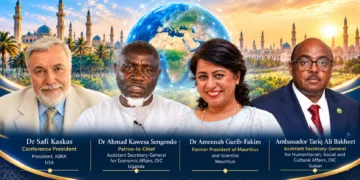
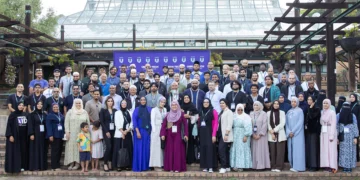
This is the text of the opening remarks by SHAYKH SA’DULLAH KHAN at the 4th International Conference on Islamic Civilisation in Southern Africa, held at Kirstenbosch, Cape Town from September 12 to 14, 2025.
It is my privilege to present the opening remarks to this august gathering at this international conference which will engage the theme of the Prophet Muhammad ﷺ in Islamic Scholarship and Literature in Africa.
We are doing so in the month of Rabi’-ul-Awwal 1447, marking 1500 lunar years since the advent of Prophet Muhammad ﷺ, and thus this conference is a manifestation of the celebration of the Prophet’s noble legacy; that lasting impact of the life of the greatest of creation, who transformed the world, changed the course of history, and remains the ultimate mortal benefactor to humanity.
History bears testimony to the inextricable link between Islam and Africa:
You may also want to read


- Haajar, the mother of Prophet Ismai’il, is the foremother of the Prophet Muhammad as Prophet Ibrahim is his forefather.
- Luqman, the Wise African, has an entire chapter titled after him in the Quran and highlights the rich moral and ethical contribution of African figures.
- Um Ayman Barakah, from Abyssinia (present day Ethiopia), was a most unique companion of the Prophet ﷺ. She was the only person who was with him from the day he took his first breath till the day he breathed his last, and whom the Prophet lovingly referred to as ‘my mother after my mother’.
- When Makkah refused Islam and Muslims were persecuted by the Makkans, it was Africa, under King Negus of Aksum, that gave refuge to the emigrant Muslims in Abyssinia.
- The first martyr in Islam was the brave and resilient Sumayyah, an African companion of the Prophet ﷺ.
It was Africa that gave the world:
- The remarkable traveller and explorer, Ibn Battuta;
- The outstanding historiography and sociologist, Ibn Khaldun;
- The writer, political provocateur and mujaddid (reformer), Aḥmad Bābā of Timbuktu;
- A leader of the resistance against colonialism, Shaykh Ahmadou Bamba;
- A trailblazer of economic empowerment and ruler, Mansa Musa;
- A pioneer in education, Fatima al-Fihri, who contributed towards the establishment of University of Al Qarawiynn in Morocco, the world’s first university. It was founded in 895 CE, 230 years before University of Bologna – considered the first European university – which was founded in 1088;
- Sufi orders, among them the Qadiriyya and Tijaniyya which played – and continues to play – a crucial role in the moral guidance and spiritual rejuvenation of people throughout the world;
- Scholar, jurists, ascetic, reformer and revolutionary, Shehu Usman Don Fodio;
- Historian, educator and poetess, Nana Asmau;
- Martyred freedom fighters, Umar Mukhtar and Imam Abdallah Haron.
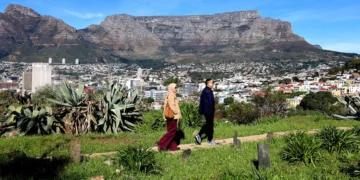
These are but part of the African bouquet of Islamic beauty in the garden of the ummah. And quite aptly we are assembled in the spirit of sharing and empowering at this iconic, breath-taking, world-famous Kirstenbosch Garden, a botanical wonderland at the foot of the iconic Table Mountain, one of the seven new wonders of the natural world. This was the area where the Khoikhoi people ventured to collect medicinal plants and food from these well-watered mountain slopes.
So, here we are, 1500 years since the advent of the Prophet ﷺ, delegates from all parts of Africa, members of his ummah, gathering at the southernmost tip of Africa; reflecting on a legacy that has had a profound impact on Africa, shaping the continent’s spirituality, culture, politics, and society for well over a millennium.
Five times a day there is a spiritual memorial remembering the call to prayer of the African companion (sahabi), Bilal (RA). Every day, from every minaret of every mosque in the world, we hear the adhan that he first gave, so much so that at this end of the world when people hear the adhaan they say, Die Bilal bang (‘Bilal is calling’).
It is hoped that this conference will emulate Bilal (RA) and continue to echo the call of truth, of justice, and goodwill to humanity through Africa, and beyond Africa, to the world at large.
- The 4th International Conference on Islamic Civilisation in Southern Africa was jointly organised by Awqaf SA, the Organisation of Islamic Cooperation (OIC), Research Centre for Islamic History, Art and Culture (IRCICA), and the organising committee for the Commemoration of the 1500 Years of the Prophetic Legacy.