








![Does ta’wīl mean interpretation or fulfilment? A Quranic reassessment [+video]](https://muslimviews.co.za/wp-content/uploads/2026/10/Tawil-Kaskas-360x180.webp)














![Why becoming a wealthy Muslim is commendable in Islam [+videos]](https://muslimviews.co.za/wp-content/uploads/2026/09/Muslim-Trade-Business-1-360x180.webp)









A Western Cape High Court order has changed what Palestine Solidarity Campaign protesters may say about Cape Union Mart, but the group says its boycott campaign will continue within the new legal limits while it considers further action.
By ANWAR OMAR
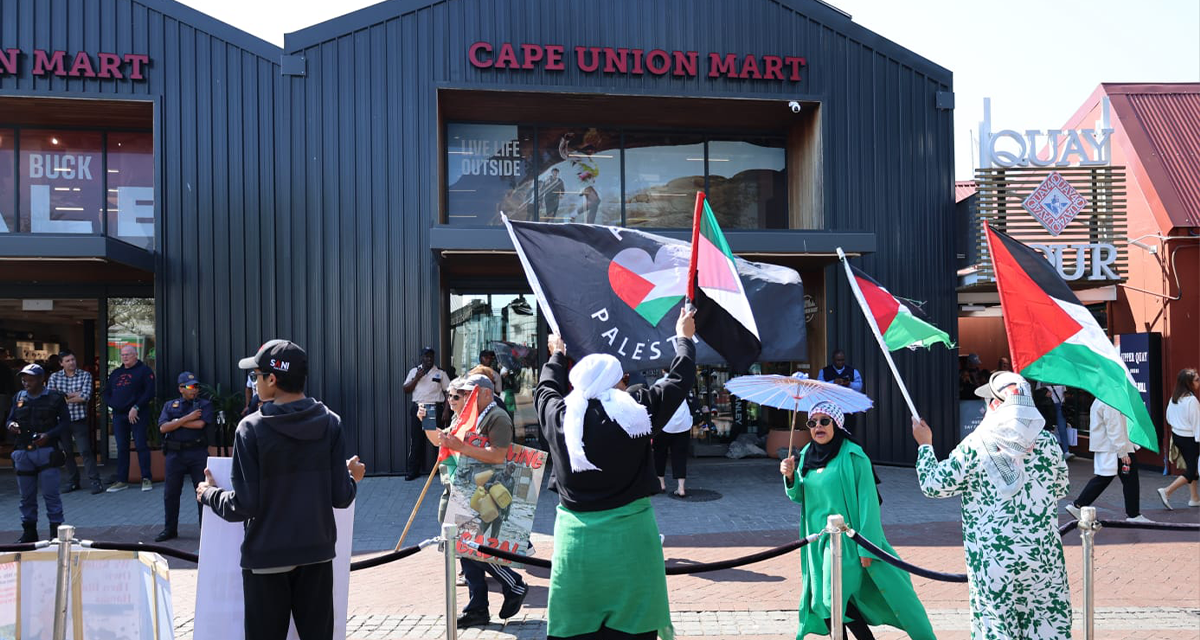
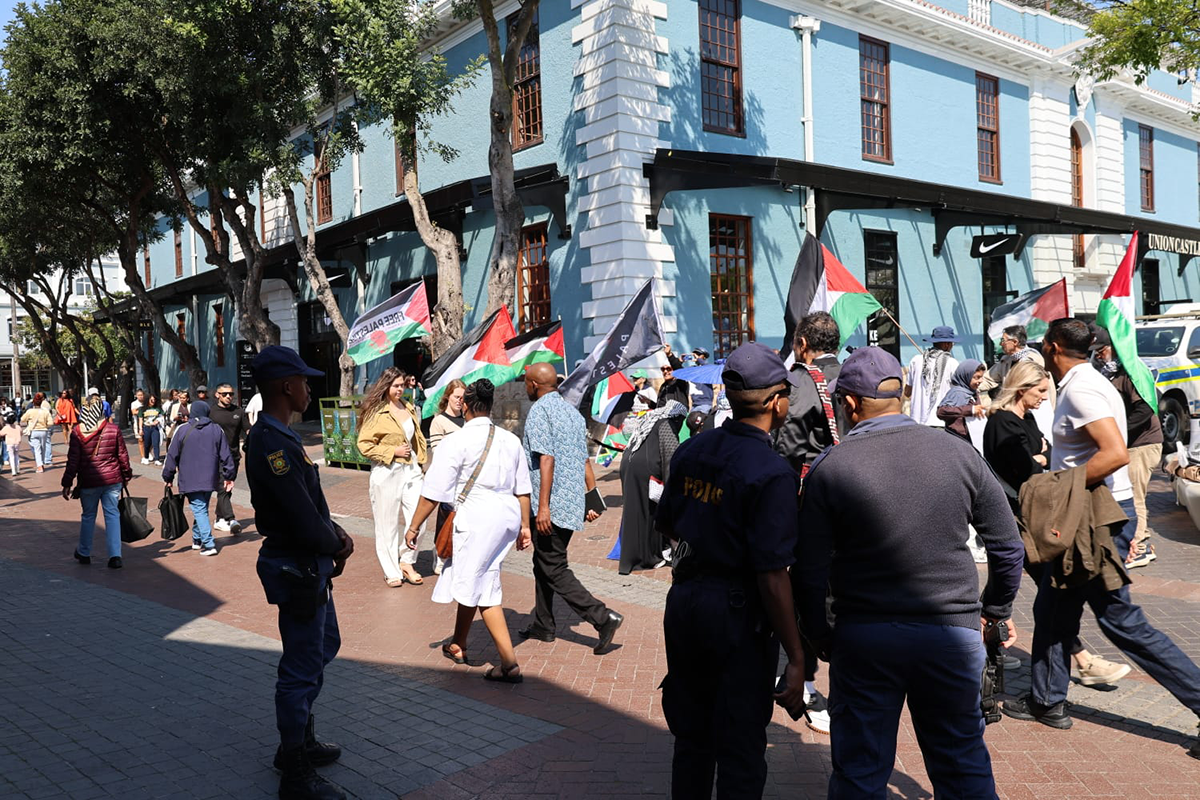
About 30 Palestine Solidarity Campaign (PSC) activists gathered outside the Cape Union Mart store at the V&A Waterfront on Saturday, September 5, 2026, demonstrating for the first time under the constraints of a binding court order handed down less than 24 hours earlier.
Among thousands of shoppers and Springbok fans converging on the popular venue ahead of the third Springbok versus All Blacks test match at FNB Stadium in Soweto, Johannesburg, the group chanted pro-Palestinian slogans and displayed posters visibly adapted to stay within the boundaries of the interdict, an emphatic demonstration of the campaign’s determination to continue despite the current legal developments.
The gathering doubled as a press conference, addressed by PSC executive member Martin Jansen, and was the organisation’s first public response to Friday’s unanimous full bench judgment by Judges Cloete, Nziweni and Barendse.
The adapted protest
The discipline on display was deliberate.
PSC coordinator Professor Usuf Chikte issued a practical guidance document outlining how protests would continue within the court order’s boundaries.
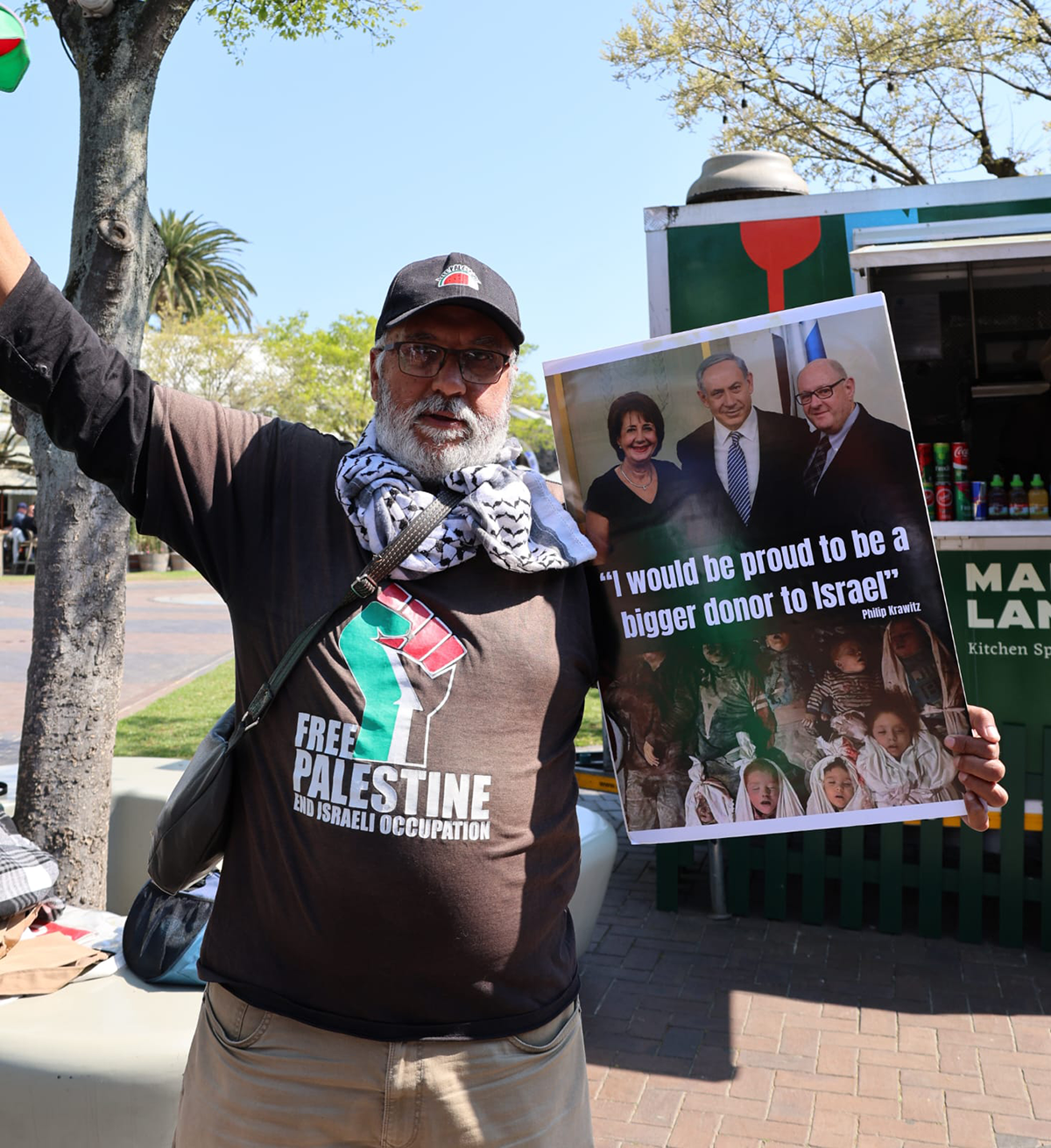
Permissible slogans include “Boycott Cape Union Mart,” “Israel is an Apartheid State,” and “Philip Krawitz supports Israel.”
Prohibited messaging includes any claim that Cape Union Mart or Krawitz personally fund genocide or kill children. The PSC document indicated protesters could still state that Israel itself kills children and commits genocide, characterising these as statements of fact rather than claims of complicity. Chikte confirmed the organisation is currently in discussions with its legal team and will exercise its discretion in terms of the legal advice received.
You may also want to read




The press statement outside Cape Union Mart Waterfront
Executive member Martin Jansen read the PSC’s formal media statement, acknowledging the court order while emphasising that the BDS campaign against Cape Union Mart remains constitutionally protected. The PSC noted the court’s finding that there was no basis to conclude that the applicants had funded the Israeli Defence Force, although the PSC’s case reflected a different view of this. Jansen also highlighted the judge’s observation that Krawitz had “probably stoked the proverbial fire” himself and stressed that the organisation’s campaign would continue until Cape Union Mart and Krawitz renounce support for Zionism and Israel, publicly condemn the occupation of Palestine, and support an immediate end to the conflict in Gaza.
Background
From November 2023, the PSC began weekly protests outside Cape Union Mart stores, targeting the retailer because of Krawitz’s leadership roles in organisations linked to Israel — most significantly as South African chairperson of Keren Hayesod, the United Israel Appeal. Protest placards included “K-Way Killers Way,” “Phillip Krawitz Genocide Funder,” a swastika superimposed on an Israeli flag, and a manipulated photograph of Krawitz with devil’s horns. The PSC admitted all of this conduct but argued it was lawful. Krawitz denied all allegations, testifying that his ties to Israel are spiritual, not political, and that Cape Union Mart has never donated to any organisation outside Southern Africa.
The court order
The Western Cape High Court handed down its final interdict on September 4, 2026. Authored by Justice JI Cloete, with Justices CN Nziweni and R Barendse concurring, the unanimous full bench decision concluded the litigation that began on June 19, 2025. The PSC, its named members and unidentified protesters are permanently interdicted from claiming that Cape Union Mart or its brands — Poetry, Old Khaki and K-Way — are associated with Israel in any way, or that the company or Krawitz funds genocide, the Israeli army or the killing of children. Protesters must not block customer access to stores and must comply with the Regulation of Gatherings Act, including its prohibition on masks and face coverings. Despite the applicants’ substantial success, each party was ordered to bear its own costs.
The PSC admitted the conduct but argued it was justified on grounds of truth and public benefit, and alternatively as protected commentary. Both defences failed comprehensively.
The court found that the PSC relied on internet articles and downloaded reports, without properly introducing this material under the Law of Evidence Amendment Act. The admissible evidence established that neither Krawitz nor Cape Union Mart funds genocide. The concept of “derivative complicity” — that the company is tainted by Krawitz’s personal affiliations — was found to have no basis in South African law and was abandoned during the argument.
The court also noted that many utterances were presented as factual statements rather than opinion, leaving no basis for a fair comment defence. The Centre for Applied Legal Studies, admitted as amicus curiae, advanced arguments on freedom of expression and the mask prohibition — both of which the court rejected as addressing a case that was not before it.
The costs rebuke
Despite the verdict, Cape Union Mart was denied costs. Justice Cloete noted that Krawitz “regrettably did himself no favours” during an October 2024 interview, that he “could, and should, have been more sensitive and restrained,” and that he “probably stoked the proverbial fire for the respondents.” The judge also cautioned that the amended relief “is too broad for comfort and may well open up another round of litigation.”
Reactions
The Cape Town Ulama Board expressed full solidarity with all named activists, noting that the judgment confirms that peaceful assembly and consumer boycotts remain fully protected under South African law.
The Cape South African Jewish Board of Deputies welcomed the ruling as an affirmation that the right to protest does not extend to harassment or the targeting of individuals because of their religion or beliefs.
The SA Zionist Federation Cape Council said the judgment confirmed the claims against Cape Union Mart were untrue, and drew attention to the swastika imagery and anti-Jewish signage admitted by protesters, stating it “has no place on a Cape Town pavement.”
Implications
The order fundamentally changes what PSC protests against Cape Union Mart may say but does not ban protests or boycotts outright. The PSC retains the right to assemble outside Cape Union Mart stores and call for a consumer boycott; it simply cannot repeat the specific claims the court found to be defamatory and unsupported by evidence. Breaching the order would constitute contempt of court. The PSC has 15 court days from September 4, 2026, to apply for leave to appeal, and given the constitutional dimensions of the case, a further challenge cannot be ruled out.