























![The market-builder who restrained the market [Part 2]](https://muslimviews.co.za/wp-content/uploads/2026/08/PHOTO-2026-08-25-17-16-32-360x180.jpg)
![The merchant preceding the Prophetic mission [Part 1]](https://muslimviews.co.za/wp-content/uploads/2026/08/01-360x180.jpg)








This reflection examines how heritage and human rights intersect in the Cape Floral Region, revealing indigenous erasure, contested histories and the urgent need for decolonial justice.
By ANWAR OMAR
International Human Rights Day, commemorated annually on December 10, offers a moment for reflection on the universal rights, freedoms and dignities to which all people are entitled. In South Africa, with its legacy of colonialism, slavery and apartheid, the day invites renewed consideration of how these rights are experienced, safeguarded or violated within our society.
The relationship between heritage and human rights remains poorly understood, with limited agreement on whether heritage itself constitutes a fundamental human right and, if so, how it should be protected. Heritage is often perceived as something static from the past, while human rights are associated with law, advocacy and social justice. Yet the two are deeply intertwined: while heritage shapes people’s identities, memories, dignity and sense of belonging, human rights protect their ability to access, participate in and contribute to that heritage.

The Cape Floral Region, recognised by UNESCO in 2004 as one of South Africa’s eight World Heritage Sites for its exceptional biodiversity, offers a compelling lens through which to examine this relationship. Viewed from a decolonial perspective, the region embodies both the promise and paradox of heritage as a human right. It is celebrated for its natural beauty and scientific value but simultaneously represents dispossession, exclusion and contested histories.
Despite its ecological significance, the criteria used to determine its ‘outstanding universal value’ reflect a predominantly Western approach to heritage. This framework privileges tangible physical features and often overlooks indigenous understandings of heritage, which encompass not only material evidence but also intangible practices, beliefs, rituals, songs and knowledge systems transmitted across generations.

Nature without its indigenous people
The criteria used to inscribe the Cape Floral Region as a World Heritage Site do not acknowledge the heritage of the region’s indigenous inhabitants, whose ancestral presence is supported by archaeological evidence spanning thousands of years. The San relied on the landscape for hunting, foraging and gathering edible plants, roots and honey. Around two thousand years ago, Khoekhoe pastoralists entered the region, leading to integration and cultural exchange. Both communities survived from the land that now forms the Cape Floral Region.
The arrival of Europeans in the 17th century disrupted these systems and severely threatened the survival of indigenous communities. Colonisation restricted access to land, eroded traditional lifeways and contributed to the near-decimation of these groups.
You may also want to read




UNESCO’s designation does not account for these profound indigenous connections to the land, which hold spiritual, cultural and existential significance. Issues of land rights and cultural rights were excluded from the heritage narrative, effectively erasing indigenous presence.

Peer’s Cave
Peer’s Cave, located above Fish Hoek within the Cape Floral Region, contains evidence of human occupation dating back 12 000 years. Once home to San rock paintings — destroyed in 1927 during careless archaeological excavations — the site has yielded human remains thought to be among the oldest found within 100 km of Cape Town. These remains now lie in cardboard boxes in the Iziko Museum’s archaeological collection, receiving minimal curatorial attention.
Today, the cave is in poor condition, damaged by smoke, graffiti and neglect. Restrictions on access to sacred sites and the erasure of indigenous cultural heritage constitute serious human-rights concerns. Such exclusions contribute to alienation, discrimination and social conflict, illustrating how the colonial distortion of indigenous history has been perpetuated in the Cape Floral Region’s heritage narrative.

Kirstenbosch National Botanical Garden
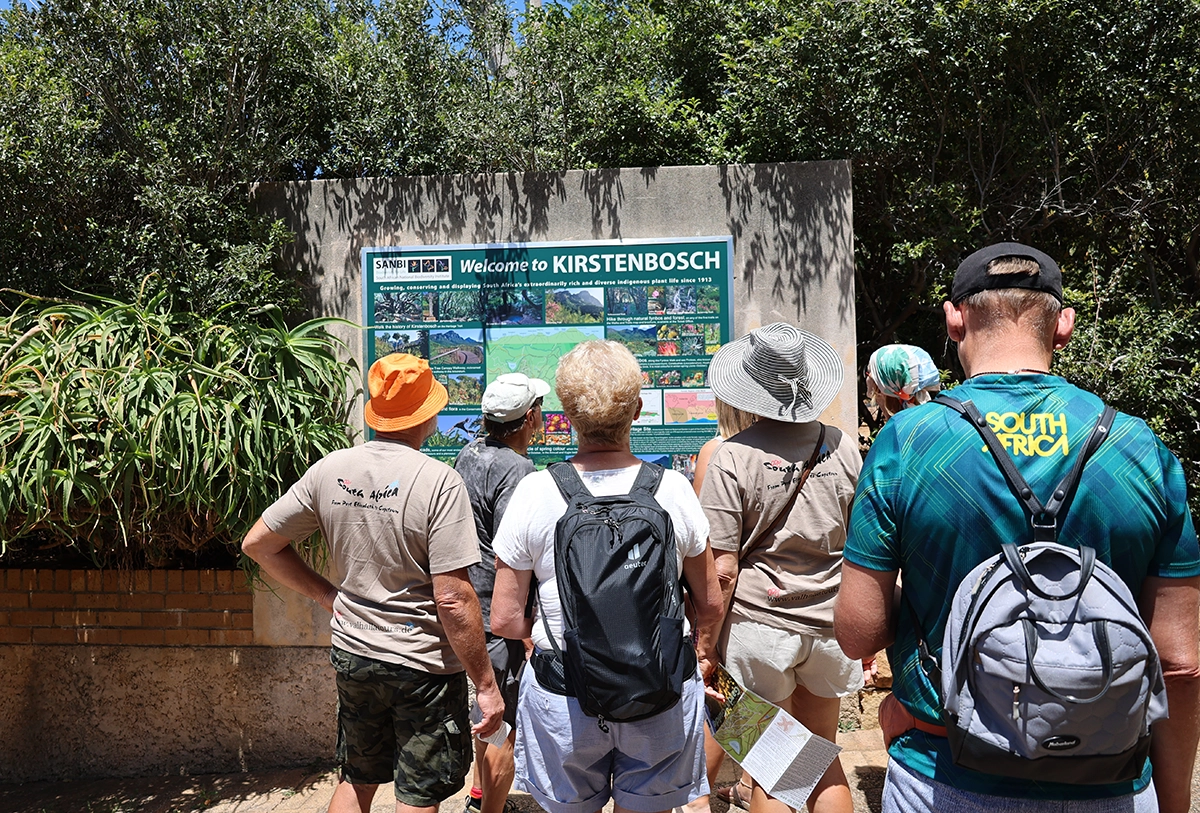
Among the nine clusters of the Cape Floral Region, Kirstenbosch National Botanical Garden is a striking example of how heritage and human rights are entangled. Before its establishment as a botanical garden in 1913, the area was inhabited and shaped by Khoekhoe and San communities who lived along the mountain slopes, practised seasonal grazing and gathered plants. Their ecological knowledge forms part of the very ‘outstanding universal value’ UNESCO recognised.
The creation of Kirstenbosch as a colonial scientific garden disrupted these relationships and reframed the landscape as a pristine conservation space. This perceived ‘purity’ was achieved through the exclusion of indigenous communities and the elevation of European botanical science as the dominant narrative.
Kirstenbosch illustrates a central principle of decolonial heritage: heritage is never neutral. It can reinforce inequality and erasure just as readily as it can enable restoration and reconciliation.

Van Riebeeck’s Hedge
Planted in 1660 to restrict the movement of indigenous people, Van Riebeeck’s hedge represents an early tool of segregation that foreshadowed apartheid. A surviving portion stands within Kirstenbosch today. Its cultural significance demands contextualisation, particularly in relation to the human-rights violations it symbolises.
Yet UNESCO and SANParks have not sufficiently addressed the hedge’s historical meaning, reducing its heritage value to a botanical curiosity. This sanitised narrative perpetuates colonial and apartheid legacies and undermines efforts to build a shared and truthful national memory. The ‘right to truth’ is a human right rooted in transitional justice, underscoring the need for honest representation of South Africa’s past.
Racism is not Kiff
The recent public dispute involving musician David Scott, known as The Kiffness, and the Palestinian Solidarity Campaign (PSC), which called for his exclusion from the Kirstenbosch Summer Festival, further highlights the intersection of heritage and human rights. Concerns were raised over racially insensitive remarks related to the International Court of Justice’s genocide case against Israel, the removal of a Palestinian mural in Lavender Hill, and derogatory comments directed at the humanitarian organisation Gift of the Givers and its founder, Imtiaz Sooliman.
South Africa’s anti-apartheid struggle and its commitment to justice form an important part of the nation’s intangible heritage. When these values are undermined, communities experience it as an affront to their cultural rights and dignity. Safeguarding cultural heritage and human rights in public spaces remains essential to ensuring that marginalised voices are heard and respected.
It will be important to observe how the PSC responds should Kirstenbosch ultimately decide not to exclude Scott and The Kiffness from the festival line-up on December 28, 2025.
Conclusion
The human rights dimensions of cultural heritage were largely overlooked when the Cape Floral Region was declared a World Heritage Site. By prioritising natural features alone, the designation concealed critical human-rights issues and reinforced distorted narratives rooted in colonialism and apartheid. More than twenty-five years into democracy, these omissions continue to shape public understanding and management of heritage.
Anwar Omar is a founding member of the Salt River Heritage Society. He holds a master’s degree in Conservation and the Built Environment from the University of Cape Town (UCT) and has recently been appointed as a South African Heritage Resources Agency (SAHRA) councillor.
- This essay forms part of the series, ‘Decolonial Heritage Reflections and Dialogues’, a national conversation on heritage, exploring how our shared history shapes our identity. Through regular engagements on various heritage themes, we reflect, reimagine and inspire dialogue on what it means to build an inclusive and transformative future together.