















![The market-builder who restrained the market [Part 2]](https://muslimviews.co.za/wp-content/uploads/2026/08/PHOTO-2026-08-25-17-16-32-360x180.jpg)
![The merchant preceding the Prophetic mission [Part 1]](https://muslimviews.co.za/wp-content/uploads/2026/08/01-360x180.jpg)






In honouring Farid Sayed, Awqaf SA affirmed the enduring importance of community journalism. It also acknowledged the ways in which South African Muslim voices have contributed to global conversations about identity, heritage and justice.
By NONTOBEKO AISHA MKHWANAZI
Awqaf SA honoured veteran journalist Farid Sayed, editor of Muslim Views, for his five decades of service to journalism and cultural preservation with the presentation of the Imam Abdullah Haron Leadership Commendation Award.
It was conferred under the Awqaf SA Leaders and Legacies Project in partnership with the Imam Haron Foundation.
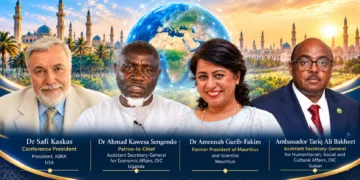
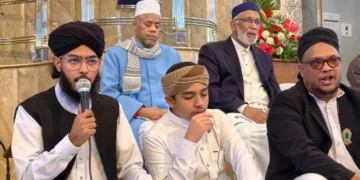
The award was presented in the presence of international scholars and community leaders at the 4th International Conference on Islamic Civilisation in Southern Africa on Saturday September 13 at Kirstenbosch, Cape Town.
The award was handed over by Professor Aboubacar Senghore, Assistant Director General of the Research Centre of Islamic History, Art and Culture (IRCICA), one of the joint organisers of the Conference. Also present were Professor Usman Bugaje, who served as a presidential adviser and legislator in Nigeria, and Mickaeel Collier, the CEO of Awqaf SA.
Speaking on behalf of the Imam Haron Foundation, respected Islamic scholar Professor Muhammed Haron praised Sayed for his commitment to truth and his role in protecting the integrity of journalism in a changing world.
‘Farid Sayed has proven that ethical journalism can be upheld in an era of distortion and fake news,’ Haron said. ‘His work is a true reflection of dedication and service.’
Sayed, who has been a journalist for 50 years, received a standing ovation from African scholars who had travelled from across the continent to attend the conference on Islamic civilisation. The applause acknowledged not only Sayed’s personal achievement but also the recognition of South Africa’s contribution to Muslim journalism in Africa.
Sayed used the occasion to reflect on the journey that led to this recognition. He paid tribute to his mentors, singling out the late James Matthews, the poet and journalist known for his fearless writing during the Apartheid era. He acknowledged the role of Abdul Quayum Sayed for his guidance from the time he joined Muslim News as a trainee reporter in September 1975.
The citation was read by fellow journalist, Shafiq Morton, himself a veteran in the profession for 49 years.
The citation noted that the award was ‘in recognition of the leading role of Farid Sayed for 50 years of commitment to independent journalism, professional excellence and media activism.’
Sayed, in thanking Morton, said: ‘For me, Shafiq has been a dear colleague from whom I have learnt much. He is steadfast, courageous and committed to truth and I am grateful to him.’
Sayed also expressed gratitude to the community for supporting Muslim Views through all its challenges.
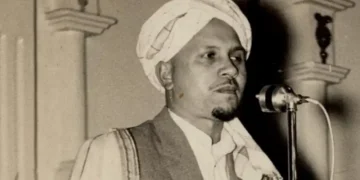
The award carried with it the weight of a history that stretches back over 60 years to the founding of Muslim News in December 1960. The newspaper was established at the height of Apartheid by Sayed Muhammad Zubayr Osmany, under the editorship of Imam Abdullah Haron, a cleric whose life was defined by moral courage.
For Muslims excluded from mainstream media the publication provided a crucial platform. It carried not only religious and community news but also political commentary that exposed injustice and articulated the role of Muslims in the anti-Apartheid struggle.
Imam Haron’s stewardship was short but decisive. He was detained without trial by the Apartheid regime and killed in police custody on September 27, 1969, at the age of 45. His death cemented his place in South African history as both a martyr of the struggle and a pioneer of Muslim journalism.
Muslim News continued for nearly two decades becoming a forum for critical thought and a training ground for community voices. By the mid-1980s, when Muslim News ceased publication, the absence of a dedicated Muslim newspaper was felt deeply. It was in this context that Muslim Views emerged in 1986 with Sayed as founding editor.
You may also want to read



Fatiema Haron-Masoet, the daughter of the late Imam Haron, also congratulated Sayed for his remarkable dedication to journalism and preserving the legacy of Imam Haron.
She also encouraged everyone to preserve Imam Haron’s legacy through telling the story of the brutal death of her father as it encourages social justice.
From its inception Muslim Views sought to preserve the legacy of Muslim News while responding to the shifting political landscape of South Africa in the final years of Apartheid.
Under Sayed’s leadership the publication grew into a paper with national reach and international recognition. It covered the community’s involvement in the anti-Apartheid struggle, documented debates on faith and identity and gave a platform to diverse voices within the Muslim community. Its pages carried the echoes of resistance while also helping readers navigate the transition into democracy.
Sayed’s approach to editing has always been anchored in independence and ethics. He resisted pressures to make the newspaper an instrument of political or commercial agendas, instead maintaining its character as a community publication committed to honest and fair reporting.
For readers at home and abroad Muslim Views has been a trusted source and a point of connection to the Muslim community of South Africa.
Over the years Muslim Views has become both a record of Muslim life and a reflection of South Africa’s broader transformation. Its archives now stand as a chronicle of more than six decades, covering the growth of mosques and madrasas, the fight against Islamophobia, debates on gender justice and the evolving role of Muslim youth. For readers at home and abroad it has been a trusted source and a point of connection to the Muslim community of South Africa.
That is why the recognition at Kirstenbosch was more than symbolic. In honouring Sayed, Awqaf SA affirmed the enduring importance of community journalism. It also acknowledged the ways in which South African Muslim voices have contributed to global conversations about identity, heritage and justice.