










![Does ta’wīl mean interpretation or fulfilment? A Quranic reassessment [+video]](https://muslimviews.co.za/wp-content/uploads/2026/10/Tawil-Kaskas-360x180.webp)



















![Why becoming a wealthy Muslim is commendable in Islam [+videos]](https://muslimviews.co.za/wp-content/uploads/2026/09/Muslim-Trade-Business-1-360x180.webp)





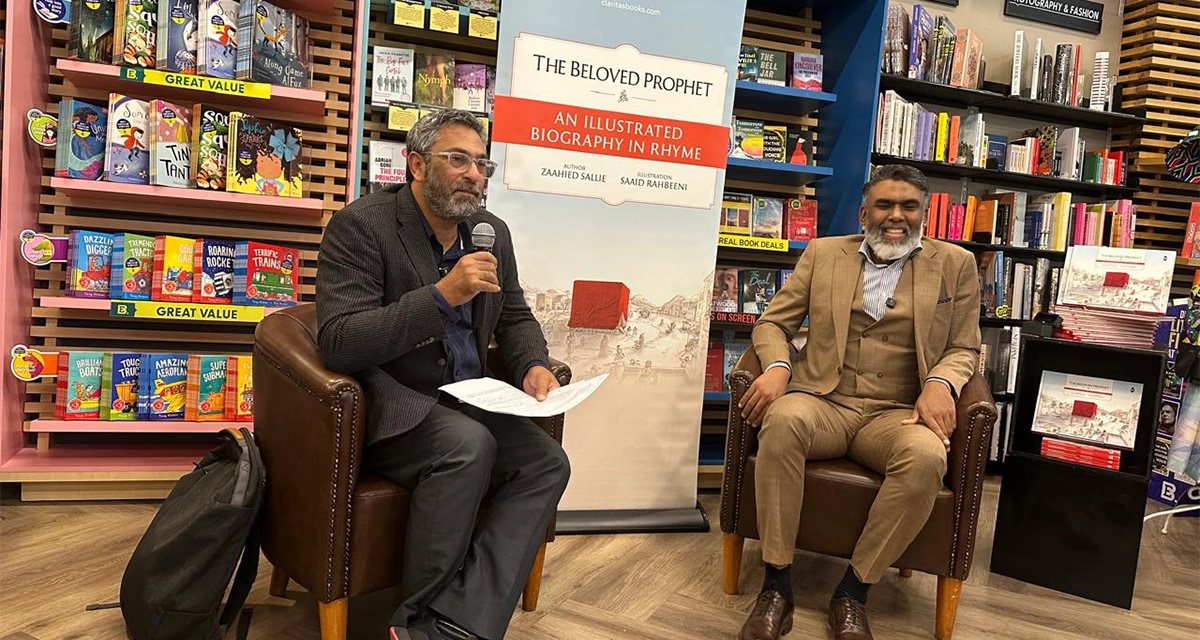

A conversation around Zaahied Sallie’s illustrated sīrah becomes a deeper reflection on Prophetic literacy: not merely knowing the story, but allowing its moral vision to shape Muslim homes, character, compassion and responsibility.
By ADNAAN ADAMS
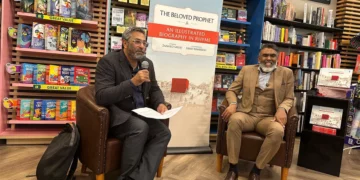
On August 18, I had the honour of being in conversation with author Zaahied Sallie at Exclusive Books, Canal Walk, for the launch of The Beloved Prophet: An Illustrated Biography in Rhyme. With Fatima Allie as master of ceremonies (MC), the launch brought together a select audience of Zaahied’s family, close friends and supporters for an intimate conversation around the book and its deeper invitation.

One idea from our conversation stayed with me: audacity.
There is a certain audacity in attempting another biography of the Prophet Muhammad ﷺ. Thousands of works on the sīrah already exist, written across centuries, languages and cultures. What, then, can another book possibly add? Perhaps the answer lies not in telling a different story, but in finding new ways of encountering the Prophet ﷺ.
Zaahied’s decision to tell the sīrah through rhyme and illustration reflects precisely this impulse. He drew attention to enduring works such as Homer’s Odyssey, a story that has captured imaginations across centuries. His central point was clear: as Muslims, we need not look elsewhere for our ultimate example of courage, character and moral excellence. We already have this in the life of the Beloved Prophet ﷺ.
The Qur’an describes him as “a mercy to the worlds” (raḥmatan lil-ʿa’lamin) and as an “excellent example” (uswatun ḥasanah). We therefore do not need to search elsewhere for our ultimate model of human character. But this presents us with a more difficult question. Do we really know the Prophet ﷺ?
Knowing the Prophet cannot be reduced to knowing dates, battles, journeys and historical facts. Nor can our relationship with him be confined to increased ṣalawat during Rabiʿ al-Awwal, the month of his birth. These practices have their place, but love of the Prophet ﷺ must reach further into the formation of our lives. What did he stand for? How did he respond to injustice? How did he exercise compassion, responsibility, courage and restraint? How did he treat the vulnerable, the stranger, the neighbour and even those who opposed him? And, possibly most importantly, where are these Prophetic qualities being cultivated in us and in our children?
This led our conversation towards the home. What would it mean for every Muslim household to have a deliberate programme of connecting with the Prophet ﷺ? Not necessarily something elaborate. A family might read a portion of the sīrah together, discuss a Prophetic quality, practise a Sunnah consciously, or ask: “What aspect of the Prophet’s character are we trying to embody this month?”
Zaahied’s own story gives this question particular resonance. He recalled growing up in a home permeated by the recitation of the Qur’an, hearing its verses from early morning and witnessing faith not simply being taught, but lived through the example of his parents. He is the son of the late Shaykh Abdurraghiem Hasan Sallie, a respected scholar and author whose intellectual and religious legacy formed part of that environment.
It brought to mind the celebrated description attributed to ʿAʾishah, the wife of the Prophet ﷺ, when she was asked about the character of the Prophet ﷺ: “His character was the Qur’an.” The Prophet ﷺ did not merely transmit revelation; he embodied its ethical and spiritual meaning in human life.
Another striking part of our conversation concerned silence. Zaahied invited us to reconsider its value. We live in an increasingly noisy age, surrounded by screens, notifications, opinions and the constant demand to speak and respond. Reflection requires silence. Perhaps reconnecting with the Prophet ﷺ also requires recovering spaces in which we can listen, contemplate and allow his example to interrogate our own lives. Ultimately, The Beloved Prophet is more than another retelling of the sīrah. Its deeper invitation is to relook, rethink and renew our relationship with the Messenger ﷺ.
The challenge, then, is not simply whether we honour the Prophet ﷺ, but whether that love shapes how we live, how we raise our children, confront injustice, practise compassion and fulfil our responsibilities to others.
This is perhaps the deeper meaning of Prophetic literacy: not merely knowing or reading the sīrah, but learning to read ourselves and our world through the moral vision of the Prophet ﷺ. Perchance this is the audacity Zaahied Sallie’s book asks of us: to move from knowing the Prophetic story to allowing it to shape the stories we ourselves are living.
You may also want to read






Finally, The Beloved Prophet: An Illustrated Biography in Rhyme deserves a place in our homes and on our bookshelves. Through rhyme and illustration, it offers a distinctive way to encounter the sīrah with fresh eyes, inviting us to reflect more deeply on what it means to know, love and follow our Beloved Prophet Muhammad ﷺ. The book is obtainable through www.redkufi.co.za
Adnaan Adams is the founder of the Muslim Thinker. He can be reached on 083 687 0559.