









![Does ta’wīl mean interpretation or fulfilment? A Quranic reassessment [+video]](https://muslimviews.co.za/wp-content/uploads/2026/10/Tawil-Kaskas-360x180.webp)













![Why becoming a wealthy Muslim is commendable in Islam [+videos]](https://muslimviews.co.za/wp-content/uploads/2026/09/Muslim-Trade-Business-1-360x180.webp)



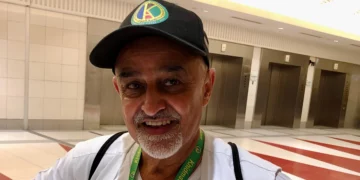
Ebrahim Abed spent a lifetime in the service of the guests of Allah. Thousands of pilgrims knew his face. Almost none of them knew how much it cost him.
By YASEEN KHAN
There is a particular kind of man the Hajj produces, and you only meet him if you have stood in the back corridors of the season, far from the photographs. He is not the one on the poster. He is the one at two in the morning with a pilgrim who has lost her bag, or her group, or her nerve. Ebrahim Abed was that man for the better part of a lifetime, and just over week ago (August 15) we lost him.
The tributes have not stopped since. They arrive from Johannesburg, Cape Town, Durban, from Makkah, from people who met him once for twenty minutes in a hotel lobby fifteen years ago and have not forgotten it. That says something about him. It also says something about how rare he was.
He was the smallest man in most rooms he entered, and somehow the largest. You did not meet Uncle Ebrahim so much as you were received by him. The salaam came first, then the smile, then the hug, and all of it before you had finished walking towards him. We talk about the salaam as if it were a formality. He handed it to you like a gift.
I cannot count the number of Hujaaj he guided. His energy embarrassed men a fraction of his age. Where the rest of us spoke about needing sleep, he was already moving, and he did it without a word of complaint, year after year, in heat that breaks people half his age. He never said no. I am not being generous with his memory. I mean that literally. In all the years I knew him, I never once heard the man refuse a request.
And when he spoke about the Hujaaj, his whole face changed. The nur came through with every word. He was not describing clients. He was describing the guests of Allah, and he treated them accordingly.
The Prophet ﷺ told us that whoever relieves a believer of a hardship in this world, Allah will relieve him of a hardship on the Day of Qiyamah. Consider what a khadim of the Hujaaj actually does with his days. Nobody photographs those moments. There is no record of them anywhere except with Allah. Ebrahim Abed spent decades quietly collecting them.
He was also, and this is the part many will miss, a teacher.
How many of us sat at his feet in Makkah and learnt seerah from him? He had a story he loved about the heat and the dates of Makkah, and he would tell it with such delight that you would only realise halfway through that he was not entertaining you at all. He was teaching you something. That is what we mourn most sharply. Not only the man, but the library that went with him.
There is a hadith in Bukhari that has been sitting with me all week. Allah does not remove knowledge by erasing it from the hearts of people. He removes it by taking away those who carry it. The early generations said that the death of a man of knowledge leaves a breach in the ummah that nothing repairs. We understood that as a line in a book. This week we understood it as a fact.
His nature was contemplation before action. He listened first. He thought, and then he moved, and he put every other person in the room ahead of himself. Everyone. At every function, every jalsa, every Hajj programme, he arrived before the organisers and left after the cleaners, and he never mentioned it to a soul. That is the whole difference between a man who serves and a man who wants to be seen serving.
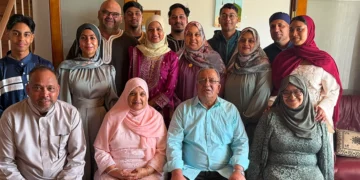
His children have shared something that has stayed with me, and I think the community should hear it. To us he was Ebrahim Abed the khadim. To them he was simply Dad. A father who never raised his hand and rarely raised his voice. A father who treated every childhood scrape with a little Zambuk, as though there was nothing it could not cure. A father who drove them to libraries across Johannesburg every weekend and gave them a love of reading that they carry to this day, and who drove them and their friends to cricket, to karate, to campus, and safely home again.
Then, every year, they gave him to us.
You may also want to read


They watched him leave for the season and they were proud to share him, because they understood where that service came from. It was not a role he performed. It was simply who he was. But we should be honest about what it costs a family to lend a man like that to a nation, and we should be grateful to them for it.
The Prophet ﷺ said that three things continue after a person dies: sadaqah that keeps flowing, knowledge that keeps benefiting, and a righteous child who makes du’a for them. Hold that against this man’s life. Decades of service to the guests of Allah. Seerah that people are still living by tonight. Children who are, right now, making du’a for their father. He did not leave with one of the three. He left with all three. His account did not close last week. It is still open, and it is still growing.
Labid said the line the Prophet ﷺ called the truest word a poet ever spoke: everything other than Allah passes away.
So we do not ask for him back. We ask to be gathered with him.
May Allah accept every step he took in the service of the Hujaaj, every kindness he showed and every sacrifice he made in His path. May He forgive him completely, grant him the loftiest ranks of Jannatul Firdaus, fill his qabr with noor and make it a garden from the gardens of Jannah. May He grant his family sabr jameel. And may every person whose life he touched stand as a witness for him on the Day he needs witnesses.
Ameen.