








![Does ta’wīl mean interpretation or fulfilment? A Quranic reassessment [+video]](https://muslimviews.co.za/wp-content/uploads/2026/10/Tawil-Kaskas-360x180.webp)


















![Why becoming a wealthy Muslim is commendable in Islam [+videos]](https://muslimviews.co.za/wp-content/uploads/2026/09/Muslim-Trade-Business-1-360x180.webp)





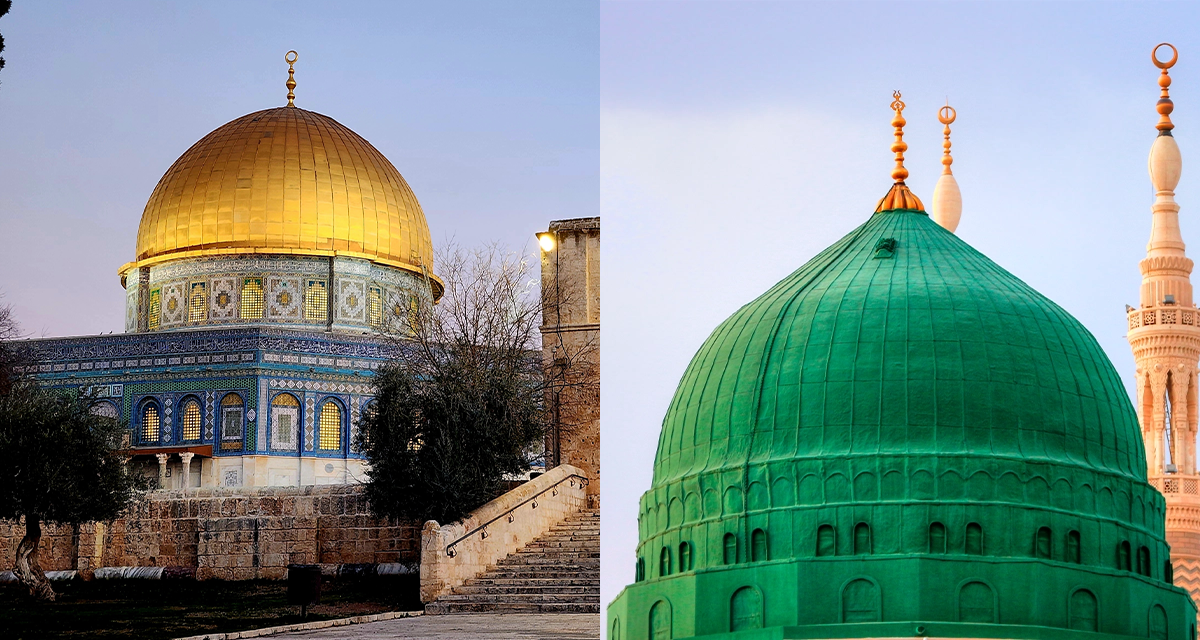

The siege of Madinah under Fahreddin Pasha offers a haunting historical echo for Palestine today. As Jerusalem faces displacement, occupation and political abandonment, the writer asks whether the Ummah has learnt from the cost of division.
By SHABODIEN ROOMANAY
Salim Mohamed Badat’s excellent piece, “The Last Defender of the Prophet’s City: Omer Fehruddin Pasha and the Tragedy of Medina”, has haunting parallels as we watch the destruction and possible complete capture of Palestine. In the final, fading years of the Ottoman Caliphate, as empire, intrigue and betrayal converged upon the Muslim world, Badat argues that one man became a symbol of resistance against overwhelming odds.
Omer Fahreddin Pasha defended the City of the Prophet ﷺ which was under siege from June 1916 until January 1919. For more than two and a half years, he and those around him endured hunger, disease, isolation, bombardment and the steady collapse of the world that had once sustained them.
Madinah survived as long as it did not because the defenders possessed overwhelming military strength. They did not. It survived because there remained men who believed that some places, some trusts and some principles were too sacred to surrender merely because surrender appeared inevitable.
Today, more than a century later, the Palestinian people stand before a different but hauntingly familiar history. Their struggle is not the same as Fahreddin Pasha’s. Jerusalem is not Madinah, and the Palestinians are not the Ottoman garrison. But there is an unmistakable historical echo in the loneliness of resistance, in the destruction of the land, in the hunger of civilians, in the pressure to surrender political rights and, above all, in the widening gulf between the rhetoric of regional, captured rulers and the suffering of the people on the ground. The Palestinian struggle for Jerusalem may yet prove to be this generation’s Madinah moment.
A city is never merely a city
For Fahreddin Pasha, according to Badat, Madinah was not a strategic point on a military map. It was the city of the Prophet Muhammad (ﷺ). Its defence was inseparable from his understanding of duty, faith and honour. For Palestinians, Jerusalem is likewise not simply territory. Al-Quds is a spiritual, political, historical and civilisational centre. For Muslims, it is bound to the Isra and Mi’raj, to the earliest direction of prayer and to the religious memory of the Ummah. For Palestinian Muslims and Christians, Jerusalem is also the living centre of a people whose presence in the city is now increasingly threatened by settlement expansion, demolitions, evictions, restrictions and attempts to impose irreversible facts on the ground.
There is continued and accelerating displacement and territorial occupation by settlers in and around East Jerusalem. The great fear is therefore not simply that Palestinians may lose buildings or neighbourhoods. It is that they may be pushed gradually out of the very surrounds that define their historical identity. And this is where the comparison with Madinah becomes most powerful. A sacred place can be surrounded by a military siege long before it is formally surrendered. It can be weakened economically, isolated politically, starved administratively and emptied demographically.
Sometimes the siege is made of permits, checkpoints, demolitions, settlements, land seizures, restrictions on worship and laws designed to make one people permanent strangers in their own homeland. And sniper assassinations.
The two-and-a-half-year mirror
Fahreddin Pasha defended Madinah for approximately two and a half years. It was a period of hunger, death and isolation. Supplies were cut. The Hejaz Railway, the lifeline to the city, was attacked and destroyed. Disease and famine took their toll. His soldiers endured conditions that would have broken armies many times larger. The siege of Madinah was ultimately a struggle against exhaustion. That is perhaps the most important lesson for understanding Palestine. Modern Palestine has experienced its own prolonged attempt to force exhaustion upon an entire population. It is now year three…
In Gaza, the destruction of homes, hospitals, schools, infrastructure and livelihoods has created a catastrophe whose consequences will last long beyond any formal ceasefire.
The comparison should not be made carelessly. Fahreddin Pasha was a military commander defending a besieged city during the collapse of an empire. Palestinians are an entire people living under occupation, siege, displacement and military domination.
But the timescale is significant. More than two and a half years is long enough for hunger to become normal. Long enough for children to grow up knowing little except fear.
That is the true horror of a prolonged siege. The intention is not always to defeat a people in one decisive battle. Sometimes it is to make continued existence so unbearable that survival itself becomes a political struggle.
And yet the Palestinians remain amid destruction. In the West Bank, they remain despite raids, settlement expansion and settler violence. It seems their greatest act of resistance may ultimately not be a military one. It may simply be sumud: steadfastness.
Then and now: the recurring pattern of betrayal
The story of Madinah cannot be separated from the political intrigues surrounding the collapse of the Ottoman Empire. The British cultivated the Arab Revolt, made promises to Arab leaders and simultaneously negotiated arrangements that served European colonial interests. The future of the Arab world was discussed in imperial capitals while its people were encouraged to believe that foreign powers had come as liberators.
The tragedy was not simply that foreign powers acted dishonestly. The deeper tragedy was that local rulers placed their trust in those interests even when the historical evidence suggested that they would ultimately be used and discarded.
The concurrences between then and now are striking:
• Foreign powers, many toeing the Zionist agenda, speak the language of freedom while pursuing strategic interests.
• Regional rulers condemn publicly but often calculate privately.
You may also want to read





• Palestine is too often treated as a diplomatic issue rather than the lived reality of a people.
• Division remains the greatest gift given to external power.
• The people bear the cost while rulers negotiate the outcome.
This may be the most painful concurrence of all. In 1919, Fahreddin Pasha was ultimately overcome not because his faith disappeared, but because starvation, political collapse and the decisions of others made continued resistance impossible. Palestinians today fear precisely this: that after they have borne the deaths, hunger, displacement and destruction, others may sit around a table and decide their future without granting them genuine sovereignty, dignity or control over their own land.
The loneliness of the Palestinians
The image of Fahreddin Pasha standing in Madinah while the Ottoman world collapsed around him has become a symbol of abandonment. That is also one of the defining emotions of the Palestinian struggle. The Palestinians are not literally alone. Millions around the world march for them, speak for them, donate to them and refuse to accept their erasure. International civil society has become one of the most important sources of political pressure in the modern history of the Palestinian cause.
But politically and militarily, Palestinians have often experienced a profound loneliness.
They have discovered the limits of international law when law is not enforced.
There is something profoundly troubling about a world that admires Palestinian steadfastness while repeatedly failing to create the conditions in which Palestinians can live normal lives.
What outcome is now possible?
The temptation is to predict a final and decisive outcome: either the Palestinians will be crushed or Palestine will suddenly be liberated. History is rarely that simple.
The more likely immediate future is a prolonged and bitter struggle over what remains of Palestinian political and territorial space.
The first possible outcome (and most likely?) is the most dangerous: the normalisation of permanent Palestinian fragmentation and the complete de-Arabisation of Palestine as recorded by Ben Gurion in his Plan Dalet. Gaza could remain devastated and dependent. The West Bank could become increasingly fragmented by settlements, military control and restricted movement. In this scenario, there would be no formal announcement that Palestine has disappeared. Instead, Palestine would be slowly rendered impossible as a political entity. That is why the struggle over Jerusalem is so critical.
The second possible outcome is a new international realignment. The scale of Palestinian suffering has transformed public opinion across the world. The moral authority of those who once claimed to speak exclusively for international law has been deeply damaged by the gap between their principles and their actions.
A new generation, particularly in the West, increasingly refuses to accept the old assumptions about Palestine and Israel. Social media has exposed the lies.
The third possibility is the most hopeful: Palestinian endurance may eventually make the existing political arrangement impossible to sustain.
Empires and systems of domination are often strongest at the moment they appear least vulnerable. Remember Ian Smith’s “never in a 100 years” in then-Rhodesia, and how the apartheid system in South Africa once appeared permanent. History teaches us that no political system survives forever merely because it possesses superior military power.
What comes next?
The next phase will almost certainly be a struggle not only for territory, but for definition.
What will Palestine be allowed to become? Will Palestinians be offered a truncated state without sovereignty? Or will the sheer persistence of the Palestinian people force the world to confront the central question it has postponed for generations:
Can there be peace without justice and genuine Palestinian self-determination?
The coming struggle will therefore be fought on several fronts simultaneously. There will be a struggle for Jerusalem. And there should be a struggle within the Muslim and Arab world to determine whether Palestine remains merely an emotional cause or becomes the catalyst for genuine political courage.
Which brings us back to the lesson of Fahreddin Pasha
The lesson of Omer Fahreddin Pasha should not be reduced to nostalgia for a vanished empire. Its deeper lesson is about the terrible cost of abandonment. Fahreddin Pasha could hold Madinah for more than two and a half years. But one man, one garrison and one besieged city could not indefinitely compensate for the collapse, betrayal and division surrounding them. That is the warning for Palestine. No people, however courageous, should be expected to resist forever while those who claim to support them remain divided, calculating or passive. The Palestinians have already demonstrated a degree of endurance that few peoples in modern history have been asked to display.
Perhaps that is where the story of Madinah and the story of Palestine finally meet.
Fahreddin Pasha was defeated militarily, but his refusal to abandon Madinah ensured that his story outlived the empire that had ordered him to surrender. Palestinians, too, may yet lose battles, homes and territory. They may face years of further suffering. But the greatest failure of those seeking to erase them has been the repeated discovery that the Palestinian people refuse to disappear.
History will record what the Arab and Muslim world did while Palestine was being destroyed before its eyes. Fahreddin Pasha could look at Madinah and believe that he had done his duty, even when those around him failed. The Palestinians deserve more than admiration for their courage.
They deserve a world that finally ensures that courage is no longer their only protection.
The question for the Ummah today is therefore painfully simple: Will Jerusalem one day be remembered as another Madinah, a sacred trust abandoned through division, foreign manipulation and political betrayal, or will the Palestinian people’s steadfastness finally awaken a world that has watched too long?
The answer may determine not only the future of Palestine.
It may determine the moral future of the entire region.
Shabodien Roomanay is a retired teacher and the former headmaster of Islamia College in Cape Town. He is also the founder member of the Salt River Heritage Society and a committee member of the Academia Library and Resource Centre.