





Muslim Views
No Result
View All Result
  • News
    • All
    • Local
    • National
    • World
    HPCSA backs down as Dr Mofokeng is cleared and Zionist complaint is dismissed

    HPCSA backs down as Dr Mofokeng is cleared and Zionist complaint is dismissed

    South Africa and Saudi Arabia strengthen ties on Hajj, Umrah and tourism

    South Africa and Saudi Arabia strengthen ties on Hajj, Umrah and tourism

    PHASA targeted at global health congress for silence on Gaza and xenophobia

    PHASA targeted at global health congress for silence on Gaza and xenophobia

    PSC adapts Cape Union Mart protests after Western Cape High Court ruling

    PSC adapts Cape Union Mart protests after Western Cape High Court ruling

    Scholars at Masjidul-Quds Moulood call for everyday integrity

    Scholars at Masjidul-Quds Moulood call for everyday integrity

    Rooted in his faith, Ruiters says his book has a message for all South Africans

    Rooted in his faith, Ruiters says his book has a message for all South Africans

    Mowbray Muslim Cemetery Board election results announced

    Mowbray Muslim Cemetery Board election results announced

    Residents turn to community action amid Salt River, Woodstock violence

    Residents turn to community action amid Salt River, Woodstock violence

    Cape Town faith leaders unite for peace ahead of 2026 local elections

    Cape Town faith leaders unite for peace ahead of 2026 local elections

    Women in AI to host Women’s Month hike

    Women in AI to host Women’s Month hike

    • National
    • World
    • Local
  • Opinion
    • All
    • Columnists
    • Discussions with Dangor
    • Editorial
    • Guest Writer
    The ‘stemme’ rise: how Cape Mawlid nurtures listening, love and community

    The ‘stemme’ rise: how Cape Mawlid nurtures listening, love and community

    G20 contradictions deepen as US debt rises and Global South agenda recedes

    G20 contradictions deepen as US debt rises and Global South agenda recedes

    Too many politicians, too little political work

    Too many politicians, too little political work

    A new chapter for Mowbray cemetery as board takes office

    A new chapter for Mowbray cemetery as board takes office

    Zionism at its most reviled: why Israel needs the “extremist settler”

    Zionism at its most reviled: why Israel needs the “extremist settler”

    Don’t hide your skirt, Kgwadi: Palestine, justice and Johannesburg services

    Don’t hide your skirt, Kgwadi: Palestine, justice and Johannesburg services

    From Madinah to Jerusalem: The cost of abandonment and political betrayal

    From Madinah to Jerusalem: The cost of abandonment and political betrayal

    MCB election outcome: Cape Muslim sentiment and the Board’s next test

    MCB election outcome: Cape Muslim sentiment and the Board’s next test

    Prophetic legacy for a world on fire: Iḥsān, adab and agency

    Prophetic legacy for a world on fire: Iḥsān, adab and agency

    The mask slips: when “civic concern” turns into blatant Islamophobia

    The mask slips: when “civic concern” turns into blatant Islamophobia

  • Features
    • All
    • 1500 Years of Prophetic Legacy
    • AWQAF SA
    • General Features
    • Imam Haron
    • Tributes
    UWC’s honorary doctorates are a triumph over petty tribalism

    UWC’s honorary doctorates are a triumph over petty tribalism

    UWC honour fully reclaims Charlotte Maxeke from apartheid-era erasure

    UWC honour fully reclaims Charlotte Maxeke from apartheid-era erasure

    Those who cheer from the sidelines and carry us through life’s journey

    Those who cheer from the sidelines and carry us through life’s journey

    Hijra Cycle Tour 2026: Why I chose to ride

    Hijra Cycle Tour 2026: Why I chose to ride

    Ebrahim Abed’s life of service to Hujaaj

    Ebrahim Abed’s life of service to Hujaaj

    Reading the Prophet: knowing the sīrah, reading ourselves

    Reading the Prophet: knowing the sīrah, reading ourselves

    The living heritage of Moulood traditions at Zandvliet

    The living heritage of Moulood traditions at Zandvliet

    Ummah bids farewell to global luminary Pir Sayed Hasin ud Deen Shah (RA)

    Ummah bids farewell to global luminary Pir Sayed Hasin ud Deen Shah (RA)

    Marking 140 years since the closure of the Tana Baru

    Marking 140 years since the closure of the Tana Baru

    Abbas Rumaney remembered for his faith, wisdom, humour and generosity

    Abbas Rumaney remembered for his faith, wisdom, humour and generosity

    Grappling with Apartheid labels

    Grappling with Apartheid labels

    The scholar who refused to turn Islam into an enemy: The legacy of John Esposito

    The scholar who refused to turn Islam into an enemy: The legacy of John Esposito

    The greatest monuments are not in stone, but in lives transformed

    The greatest monuments are not in stone, but in lives transformed

    Legacy of educator Haji Mogamat Rashad Jedaar lives on

    Legacy of educator Haji Mogamat Rashad Jedaar lives on

    Reclaiming agency: From ritual to action Part 3

    Reclaiming agency: From ritual to action Part 3

  • Lifestyle
    • All
    • Arts
    • Books
    • Education
    • Food
    • Health
    • Motoring
    • Sport
    • Technology
    Islamic thought meets modern cosmology in a compelling new book

    Islamic thought meets modern cosmology in a compelling new book

    Breaking the stigma surrounding mental health in the Muslim community

    Breaking the stigma surrounding mental health in the Muslim community

    Rooted in his faith, Ruiters says his book has a message for all South Africans

    Rooted in his faith, Ruiters says his book has a message for all South Africans

    Nabil Yasien Mohamed explores Ghazali’s enduring search for certainty

    Nabil Yasien Mohamed explores Ghazali’s enduring search for certainty

    Reading the Prophet: knowing the sīrah, reading ourselves

    Reading the Prophet: knowing the sīrah, reading ourselves

    Cape Town art exhibition explores untold histories through art and archives

    Cape Town art exhibition explores untold histories through art and archives

    Choritz captures a fierce new dystopia in The Sound of Ice

    Choritz captures a fierce new dystopia in The Sound of Ice

    Languages of Care: Extending worship through art

    Languages of Care: Extending worship through art

    Cape Town musicians rally behind displaced Palestinian composer

    Cape Town musicians rally behind displaced Palestinian composer

    More than a game, or the Clash of Titans

    More than a game, or the Clash of Titans

  • Finance
    • All
    • Islamic Finance
    Why becoming a wealthy Muslim is commendable in Islam

    Why becoming a wealthy Muslim is commendable in Islam

    Unlocking Africa’s development through Islamic finance and waqf

    Unlocking Africa’s development through Islamic finance and waqf

    Understanding Mufti Taqi Usmani’s fatwa on cryptocurrency

    Understanding Mufti Taqi Usmani’s fatwa on cryptocurrency

    The market-builder who restrained the market [Part 2]

    The market-builder who restrained the market [Part 2]

    The merchant preceding the Prophetic mission [Part 1]

    The merchant preceding the Prophetic mission [Part 1]

    Beyond charity: Rethinking the economic potential of waqf in South Africa

    Beyond charity: Rethinking the economic potential of waqf in South Africa

    Islamic banking in South Africa: why interest-free finance matters

    Islamic banking in South Africa: why interest-free finance matters

    When AI becomes your financial adviser, who protects the vulnerable?

    When AI becomes your financial adviser, who protects the vulnerable?

    Why a professionally drafted will can better protect your family and legacy

    Why a professionally drafted will can better protect your family and legacy

    When the halal investment label becomes a weapon for financial deception

    When the halal investment label becomes a weapon for financial deception

  • Islam
    • All
    • Eid
    • Faith and Practice
    • Family
    • Hajj and Umrah
    • Moulood
    • Quran
    • Ramadaan
    The ‘stemme’ rise: how Cape Mawlid nurtures listening, love and community

    The ‘stemme’ rise: how Cape Mawlid nurtures listening, love and community

    Scholars at Masjidul-Quds Moulood call for everyday integrity

    Scholars at Masjidul-Quds Moulood call for everyday integrity

    Prophetic legacy for a world on fire: Iḥsān, adab and agency

    Prophetic legacy for a world on fire: Iḥsān, adab and agency

    Voices of faith: youth, scholars and relics unite for Moulood-un-Nabi

    Voices of faith: youth, scholars and relics unite for Moulood-un-Nabi

    Reading the Prophet: knowing the sīrah, reading ourselves

    Reading the Prophet: knowing the sīrah, reading ourselves

    The living heritage of Moulood traditions at Zandvliet

    The living heritage of Moulood traditions at Zandvliet

    Moulood – When love stands

    Moulood – When love stands

    Moulood-un-Nabi: A beacon of mercy, love and unyielding courage

    Moulood-un-Nabi: A beacon of mercy, love and unyielding courage

    When Sipho asked me to make duʿa

    When Sipho asked me to make duʿa

    A sound heart in a world of strangers

    A sound heart in a world of strangers

  • Archives
  • Donate
Muslim Views
  • News
    • All
    • Local
    • National
    • World
    HPCSA backs down as Dr Mofokeng is cleared and Zionist complaint is dismissed

    HPCSA backs down as Dr Mofokeng is cleared and Zionist complaint is dismissed

    South Africa and Saudi Arabia strengthen ties on Hajj, Umrah and tourism

    South Africa and Saudi Arabia strengthen ties on Hajj, Umrah and tourism

    PHASA targeted at global health congress for silence on Gaza and xenophobia

    PHASA targeted at global health congress for silence on Gaza and xenophobia

    PSC adapts Cape Union Mart protests after Western Cape High Court ruling

    PSC adapts Cape Union Mart protests after Western Cape High Court ruling

    Scholars at Masjidul-Quds Moulood call for everyday integrity

    Scholars at Masjidul-Quds Moulood call for everyday integrity

    Rooted in his faith, Ruiters says his book has a message for all South Africans

    Rooted in his faith, Ruiters says his book has a message for all South Africans

    Mowbray Muslim Cemetery Board election results announced

    Mowbray Muslim Cemetery Board election results announced

    Residents turn to community action amid Salt River, Woodstock violence

    Residents turn to community action amid Salt River, Woodstock violence

    Cape Town faith leaders unite for peace ahead of 2026 local elections

    Cape Town faith leaders unite for peace ahead of 2026 local elections

    Women in AI to host Women’s Month hike

    Women in AI to host Women’s Month hike

    • National
    • World
    • Local
  • Opinion
    • All
    • Columnists
    • Discussions with Dangor
    • Editorial
    • Guest Writer
    The ‘stemme’ rise: how Cape Mawlid nurtures listening, love and community

    The ‘stemme’ rise: how Cape Mawlid nurtures listening, love and community

    G20 contradictions deepen as US debt rises and Global South agenda recedes

    G20 contradictions deepen as US debt rises and Global South agenda recedes

    Too many politicians, too little political work

    Too many politicians, too little political work

    A new chapter for Mowbray cemetery as board takes office

    A new chapter for Mowbray cemetery as board takes office

    Zionism at its most reviled: why Israel needs the “extremist settler”

    Zionism at its most reviled: why Israel needs the “extremist settler”

    Don’t hide your skirt, Kgwadi: Palestine, justice and Johannesburg services

    Don’t hide your skirt, Kgwadi: Palestine, justice and Johannesburg services

    From Madinah to Jerusalem: The cost of abandonment and political betrayal

    From Madinah to Jerusalem: The cost of abandonment and political betrayal

    MCB election outcome: Cape Muslim sentiment and the Board’s next test

    MCB election outcome: Cape Muslim sentiment and the Board’s next test

    Prophetic legacy for a world on fire: Iḥsān, adab and agency

    Prophetic legacy for a world on fire: Iḥsān, adab and agency

    The mask slips: when “civic concern” turns into blatant Islamophobia

    The mask slips: when “civic concern” turns into blatant Islamophobia

  • Features
    • All
    • 1500 Years of Prophetic Legacy
    • AWQAF SA
    • General Features
    • Imam Haron
    • Tributes
    UWC’s honorary doctorates are a triumph over petty tribalism

    UWC’s honorary doctorates are a triumph over petty tribalism

    UWC honour fully reclaims Charlotte Maxeke from apartheid-era erasure

    UWC honour fully reclaims Charlotte Maxeke from apartheid-era erasure

    Those who cheer from the sidelines and carry us through life’s journey

    Those who cheer from the sidelines and carry us through life’s journey

    Hijra Cycle Tour 2026: Why I chose to ride

    Hijra Cycle Tour 2026: Why I chose to ride

    Ebrahim Abed’s life of service to Hujaaj

    Ebrahim Abed’s life of service to Hujaaj

    Reading the Prophet: knowing the sīrah, reading ourselves

    Reading the Prophet: knowing the sīrah, reading ourselves

    The living heritage of Moulood traditions at Zandvliet

    The living heritage of Moulood traditions at Zandvliet

    Ummah bids farewell to global luminary Pir Sayed Hasin ud Deen Shah (RA)

    Ummah bids farewell to global luminary Pir Sayed Hasin ud Deen Shah (RA)

    Marking 140 years since the closure of the Tana Baru

    Marking 140 years since the closure of the Tana Baru

    Abbas Rumaney remembered for his faith, wisdom, humour and generosity

    Abbas Rumaney remembered for his faith, wisdom, humour and generosity

    Grappling with Apartheid labels

    Grappling with Apartheid labels

    The scholar who refused to turn Islam into an enemy: The legacy of John Esposito

    The scholar who refused to turn Islam into an enemy: The legacy of John Esposito

    The greatest monuments are not in stone, but in lives transformed

    The greatest monuments are not in stone, but in lives transformed

    Legacy of educator Haji Mogamat Rashad Jedaar lives on

    Legacy of educator Haji Mogamat Rashad Jedaar lives on

    Reclaiming agency: From ritual to action Part 3

    Reclaiming agency: From ritual to action Part 3

  • Lifestyle
    • All
    • Arts
    • Books
    • Education
    • Food
    • Health
    • Motoring
    • Sport
    • Technology
    Islamic thought meets modern cosmology in a compelling new book

    Islamic thought meets modern cosmology in a compelling new book

    Breaking the stigma surrounding mental health in the Muslim community

    Breaking the stigma surrounding mental health in the Muslim community

    Rooted in his faith, Ruiters says his book has a message for all South Africans

    Rooted in his faith, Ruiters says his book has a message for all South Africans

    Nabil Yasien Mohamed explores Ghazali’s enduring search for certainty

    Nabil Yasien Mohamed explores Ghazali’s enduring search for certainty

    Reading the Prophet: knowing the sīrah, reading ourselves

    Reading the Prophet: knowing the sīrah, reading ourselves

    Cape Town art exhibition explores untold histories through art and archives

    Cape Town art exhibition explores untold histories through art and archives

    Choritz captures a fierce new dystopia in The Sound of Ice

    Choritz captures a fierce new dystopia in The Sound of Ice

    Languages of Care: Extending worship through art

    Languages of Care: Extending worship through art

    Cape Town musicians rally behind displaced Palestinian composer

    Cape Town musicians rally behind displaced Palestinian composer

    More than a game, or the Clash of Titans

    More than a game, or the Clash of Titans

  • Finance
    • All
    • Islamic Finance
    Why becoming a wealthy Muslim is commendable in Islam

    Why becoming a wealthy Muslim is commendable in Islam

    Unlocking Africa’s development through Islamic finance and waqf

    Unlocking Africa’s development through Islamic finance and waqf

    Understanding Mufti Taqi Usmani’s fatwa on cryptocurrency

    Understanding Mufti Taqi Usmani’s fatwa on cryptocurrency

    The market-builder who restrained the market [Part 2]

    The market-builder who restrained the market [Part 2]

    The merchant preceding the Prophetic mission [Part 1]

    The merchant preceding the Prophetic mission [Part 1]

    Beyond charity: Rethinking the economic potential of waqf in South Africa

    Beyond charity: Rethinking the economic potential of waqf in South Africa

    Islamic banking in South Africa: why interest-free finance matters

    Islamic banking in South Africa: why interest-free finance matters

    When AI becomes your financial adviser, who protects the vulnerable?

    When AI becomes your financial adviser, who protects the vulnerable?

    Why a professionally drafted will can better protect your family and legacy

    Why a professionally drafted will can better protect your family and legacy

    When the halal investment label becomes a weapon for financial deception

    When the halal investment label becomes a weapon for financial deception

  • Islam
    • All
    • Eid
    • Faith and Practice
    • Family
    • Hajj and Umrah
    • Moulood
    • Quran
    • Ramadaan
    The ‘stemme’ rise: how Cape Mawlid nurtures listening, love and community

    The ‘stemme’ rise: how Cape Mawlid nurtures listening, love and community

    Scholars at Masjidul-Quds Moulood call for everyday integrity

    Scholars at Masjidul-Quds Moulood call for everyday integrity

    Prophetic legacy for a world on fire: Iḥsān, adab and agency

    Prophetic legacy for a world on fire: Iḥsān, adab and agency

    Voices of faith: youth, scholars and relics unite for Moulood-un-Nabi

    Voices of faith: youth, scholars and relics unite for Moulood-un-Nabi

    Reading the Prophet: knowing the sīrah, reading ourselves

    Reading the Prophet: knowing the sīrah, reading ourselves

    The living heritage of Moulood traditions at Zandvliet

    The living heritage of Moulood traditions at Zandvliet

    Moulood – When love stands

    Moulood – When love stands

    Moulood-un-Nabi: A beacon of mercy, love and unyielding courage

    Moulood-un-Nabi: A beacon of mercy, love and unyielding courage

    When Sipho asked me to make duʿa

    When Sipho asked me to make duʿa

    A sound heart in a world of strangers

    A sound heart in a world of strangers

  • Archives
  • Donate
Muslim Views
Advertisement

Moulood – When love stands

19 August 2026
in OPINION, Guest Writer, Moulood
Reading Time: 11 mins read
A A
Moulood – When love stands
Share on TwitterShare on FacebookShare on Whatsapp

At the Cape, Moulood gathers Qur’an, sīrah, salawāt, qiyām and inherited community practice into an expression of Prophetic love. This reflection examines the recognised scholarly positions on gratitude and remembrance of the Prophet ﷺ

By ADLI YACUBI

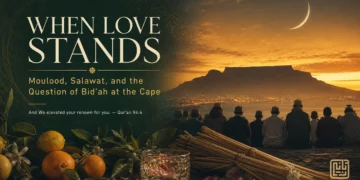
In the Cape, Rabīʿ al-Awwal has a sound before it has an argument. It is the measured cadence of the riwāyah, one voice finding another; the soft answering chorus of salawāt; the small percussion of knives against citrus leaves. It has a fragrance too: lemon and orange, rosewater and oil, rampies passing from hand to hand until the room becomes a garden the eye cannot see.

Then comes the moment many remember from childhood. The seated riwāyah gives way to the long, melodic salawāt. Bodies begin to rise. Some stand quickly, some slowly, some with tears already close. The salawāt is now carried not only by the tongue but by the whole body.

And, almost as reliably, the objection arrives: This is bidʿah. The Prophet ﷺ did not celebrate his birthday. The Companions did not stand like this. Love cannot make lawful what revelation did not prescribe.

The objection deserves more than mockery, just as the practice deserves more than dismissal. If we are speaking about the Messenger of Allah ﷺ, then both love and law demand adab. The real question is not whether Muslims should love him. It is how acts of love are understood within the grammar of the Sharīʿah.

The strongest objection should be heard

Those who oppose the annual Moulood make a recognisable legal argument. The religion was completed. The Messenger ﷺ taught his community how to worship. Neither he nor the earliest generations instituted an annual religious festival for his birth. They therefore fear that fixing a date, a recurring form and particular ceremonies, turns permitted devotion into an observance for which no specific precedent exists. They invoke the prophetic warnings that whatever is introduced into the religion without belonging to it is rejected, and that every blameworthy innovation is misguidance.[1]

This position should be stated fairly. Its serious representatives do not oppose salawāt itself. They affirm that invoking blessings and peace upon the Prophet ﷺ is among the finest acts of devotion, encouraged at all times. Their objection concerns the annual form, the ceremonial standing and any belief that these acts are required, uniquely meritorious on that occasion, or accompanied by the Prophet ﷺ’s physical presence.[1]

That is a real argument. But it is not the only argument found in the scholarly tradition.

“We raised for you your remembrance”

At the centre of Rabīʿ al-Awwal stands a verse of astonishing tenderness:

“وَرَفَعْنَا لَكَ ذِكْرَكَ

“And We elevated your renown for you.” (Sura Ash-Sharh, 94:4)

The word dhikrak carries more than fame. It is his mention, remembrance and renown. Classical tafsīr connects this elevation with the Prophet ﷺ being mentioned alongside the worship of Allah: in the testimony of faith, the adhān, the prayer and the public proclamation of Islam.[2]

Allah did not merely preserve the name of His Beloved ﷺ. He raised its remembrance.

The Qur’an then addresses believers directly: Allah and His angels send blessings upon the Prophet ﷺ; believers are commanded to invoke blessings and peace upon him.[3] Salawāt itself is therefore not a later invention in search of legitimacy. It is Qur’anic obedience. To pronounce his name with blessing is not to manufacture a rank for him. Allah has already raised his rank. Salawāt is our entrance into an honour that precedes us.

The dispute begins only when this undisputed devotion is gathered into a particular communal and annual form.

ؑCan a birth be remembered with gratitude?

When the Prophet ﷺ was asked about fasting on Monday, he replied that it was the day on which he was born and the day on which revelation came to him.[4] This report does not, by itself, establish every later form of Moulood. It does establish something important: his birth was not treated as a meaningless biographical date. It was named within an act of gratitude and worship.

The Qur’an also marks the births of prophets with peace. Of Yaḥyā عليه السلام it says, “Peace be upon him the day he was born” (Sura Maryam, 19:15); and ʿĪsā عليه السلام says, “Peace be upon me the day I was born.” (Sura Maryam, 19:33)[5] Again, these verses are not a detailed programme for an annual gathering. They do, however, make it difficult to argue that remembering a prophetic birth with gratitude is alien to the religious imagination of the Qur’an.

This is the foundation used by scholars who permit Moulood: the birth of the Prophet ﷺ is remembered through acts already rooted in revelation—reciting Qur’an, studying sīrah, sending salawāt, feeding people, giving charity, joining family ties and thanking Allah for the mercy of the Messenger ﷺ. Egypt’s Dār al-Iftāʾ, for example, explicitly includes remembrance, praise, food and standing among permissible expressions of gratitude, provided the gathering consists of lawful acts.[6]

The argument for permissibility is therefore not that a later generation may invent a new prayer or add a new pillar to Islam. It is that established acts of devotion may be organised around an occasion that calls the community to gratitude.

The work hidden inside the word bidʿah

Part of the conflict is carried inside a single word. Muslim scholars have not always used bidʿah at the same level of meaning.

In one usage, the word covers anything newly arranged after the Prophetic period. Such new matters are then judged according to the established categories of law: obligatory, recommended, permissible, disliked or forbidden. Al-ʿIzz ibn ʿAbd al-Salām is famously associated with this approach. In another usage, represented by scholars such as Ibn Rajab, bidʿah in its legal sense is reserved for a religious innovation with no valid foundation in the Sharīʿah. A new arrangement that rests upon an established principle may be linguistically new without being a blameworthy religious innovation.[6]

This helps explain why ʿUmar رضي الله عنه could gather people behind one reciter for the night prayer in Ramaḍān and call it an “excellent bidʿah.”[7] He was not claiming authority to invent worship. He was describing a new organisation of a practice with Prophetic roots.

The two approaches use vocabulary differently, but they ask a similar substantive question: Does the new form serve and remain within the principles of revelation, or does it contradict them and claim a religious authority it was never given?

Calling something bidʿah therefore begins the analysis; it does not complete it. We must still identify the act, its intention, its contents, the beliefs attached to it and the consequences it produces. The class notes that prompted this essay make a related point from Ḥanafī legal theory: declarations of prohibition require disciplined attention to the strength and meaning of evidence, not the speed of a social-media verdict.[8]

Moulood is not one isolated act

What exactly is being judged when someone says, “Moulood is forbidden”?

If the gathering consists of Qur’an, a lesson from the sīrah, salawāt, lawful poetry, feeding guests and charity, each element has an independent basis in the religion. The later arrangement of these elements is what requires evaluation. Scholars that permit Moulood treat the gathering as a means serving established ends: gratitude, learning, remembrance and love. Opposing scholars treat its annual recurrence and religious symbolism as the creation of an observance the earliest community did not institute.

This is the actual point of disagreement. It cannot be settled merely by listing the good ingredients, nor merely by observing that the completed arrangement is historically later. One side emphasises the established roots of the component acts; the other emphasises the absence of precedent for their ritualised annual form.

A careful judgement must also distinguish between one Moulood and another. A lawful gathering does not become unlawful because a different gathering elsewhere contains exaggeration or prohibited conduct. Equally, the word Moulood cannot make every practice inside it lawful. Fabricated stories do not become true because they are narrated with emotion. Extravagance does not become gratitude. Neglecting an obligation does not become love. Every gathering remains answerable to the Sharīʿah.

Why do we stand?

At the Cape, the most visible point of controversy is often the qiyām: the moment people rise for the long, melodic salawāt following the seated recitation of the riwāyah.

Standing is not a pillar of the Moulood. It is not an obligation, and it should not be made a test of anyone’s love for the Prophet ﷺ. Its defenders understand it as embodied adab—a customary gesture of honour when words alone feel insufficient. They do not stand because the rank of the Prophet ﷺ needs their bodies to raise it. Allah has already raised his remembrance. They stand because love sometimes asks the body to join the tongue.

Here too, the inherited legal record contains disagreement. Within later Shāfiʿī discussion, one view criticised the standing as an innovation without a specific transmitted basis, while another regarded the established custom favourably because it expressed honour for the Prophet ﷺ. A contemporary summary of those texts concludes that both positions have scholarly reference and that a person may follow either.[9] A recent Dār al-Iftāʾ ruling likewise considered a Moulood containing Qur’an, sīrah, praise, brief standing for salawāt, fragrance, supplication and food to be recommended.[6]

The fairest practical rule may therefore be simple: stand without condemning those who remain seated; remain seated without contempt for those who stand.

The moment becomes spiritually dangerous when courtesy is converted into coercion—when standing is treated as compulsory, when a seated person is shamed, or when unsupported beliefs are imposed upon the gathering. It also becomes unjust when every person who stands is accused of believing that the Prophet ﷺ is physically present. People’s stated intentions should not be replaced by an opponent’s suspicion.

The Cape does not remember beneath glass

For Cape Muslims, Moulood is not only an abstract legal file. It is an inheritance carried through families, mosques and neighbourhoods. Rampies sny brings generations together around cut lemon and orange leaves, rosewater and fragrance. Riwāyah carries Arabic praise-poetry in collective melody. The gathering transmits vocabulary, posture, memory and belonging from elders to children.[10]

Tradition is not proof by itself. Age cannot make an unlawful act lawful. But tradition is not nothing either. A practice may become a vessel in which lawful meanings are carried across centuries. Before breaking the vessel, one should ask what it has held for a people who preserved Islam through slavery, displacement, forced removals and the repeated fracture of community.

The answer cannot be to preserve every detail uncritically. Living inheritance requires knowledge. Our Moulood gatherings should teach the meanings of the salawāt being recited. Narrations should be distinguished according to their reliability. Poetry should deepen tawḥīd rather than confuse it. Food should reach the lonely and the poor, not only the already comfortable. Children should encounter the sīrah not as distant ornament but as a moral demand.

To protect Moulood is therefore also to reform it where necessary—so that fragrance does not replace substance and beautiful recitation does not excuse ugly conduct.

The better question

Perhaps the most searching question is not, “Did you stand?” It is, “What happened after you stood?”

Did salawāt make the tongue gentler when speaking about other Muslims? Did the sīrah make us more truthful in business, more faithful to promises, more patient with family? Did remembering the orphan of Makkah open our homes to an orphan, a widow, a refugee or a neighbour in need? Did praise of the Prophet ﷺ’s mercy make us more merciful?

The Qur’an does not praise him ﷺ merely for being the subject of our songs. It declares him to be upon an immense character.[11] A Moulood worthy of his remembrance must therefore seek the formation of character. Love that never enters conduct remains sentiment. Law without tenderness becomes a weapon. The Prophetic way demands both disciplined worship and transformed hearts.

Those who celebrate should not declare their chosen form obligatory, treat it as a third legal Eid, or measure another Muslim’s faith by attendance. Those who abstain should not turn a recognised scholarly disagreement into licence for contempt, nor declare every gathering forbidden without examining its actual contents and the juristic reasoning of those who permit it.

Disagreement need not empty the room of brotherhood.

When love stands

When the seated riwāyah gives way to the long, melodic salawāt and the room begins to rise, I do not imagine that our standing increases the honour of the Prophet ﷺ. His honour does not wait for us. Allah has said it already:

وَرَفَعْنَا لَكَ ذِكْرَكَ

“We raised for you your remembrance.” (Sura Ash-Sharh, 94:4)

We stand, rather, in the hope that our own names might be gathered among those who remembered him with love.

Then we sit again.

And the greater standing begins: standing for truth when it costs us, standing beside the vulnerable, standing against the cruelty of our own egos, standing in prayer before Allah, and standing within the world as people whose remembrance of Muḥammad ﷺ has made mercy visible.

By scent, by song, by salawāt, the Cape remembers the Beloved Prophet ﷺ.

May that remembrance teach us how to live.

Sources and further reading

1.    General Presidency for Scholarly Research and Ifta, “Ruling on Celebrating the Mawlid,” in Safeguarding Tawḥīd. https://risala.prh.gov.sa/en/content/107?translated=true

2.    Sura Ash-Sharh, 94:4 and al-Ṭabarī’s commentary. https://quran.com/94/4 and https://quran.ksu.edu.sa/tafseer/tabary/sura94-aya4.html

3.    Sura Al-Ahzab, 33:56. https://quran.com/33/56

4.    Ṣaḥīḥ Muslim 1162e, the Monday fast and the Prophet ﷺ’s birth. https://sunnah.com/muslim:1162e

5.    Sura Maryam, 19:15 and 19:33. https://quran.com/19/15 and https://quran.com/19/33

You may also want to read

Turkey-Syria earthquake: Europe, with billions for war, shows its true heartless face

Turkey-Syria earthquake: Europe, with billions for war, shows its true heartless face

1 March 2023 - Updated on 28 August 2024
Shaykh Yusuf al-Maqassari: Islam, resistance, and intellectual circulations in the early modern Indian Ocean

Shaykh Yusuf al-Maqassari: Islam, resistance, and intellectual circulations in the early modern Indian Ocean

10 April 2025 - Updated on 11 April 2025
My roots say samoosa, daltjie and falooda

My roots say samoosa, daltjie and falooda

25 September 2025 - Updated on 26 September 2025
Why South Africa’s Muslims are trading the ulama councils for the courtroom

Why South Africa’s Muslims are trading the ulama councils for the courtroom

30 April 2026
Reanimating the promise of our Constitution in a divided society through intercultural and interfaith dialogue

Reanimating the promise of our Constitution in a divided society through intercultural and interfaith dialogue

19 August 2024 - Updated on 23 August 2024
Beyond jurisprudence: Ijtihād as a first principle of Islamic thinking

Beyond jurisprudence: Ijtihād as a first principle of Islamic thinking

15 October 2025

6.    Egypt’s Dār al-Iftāʾ, rulings on Moulood, its forms, and the classification of bidʿah. https://dar-alifta.org/ar/fatwa/details/22043/ and https://www.dar-alifta.org/ar/Fatwa/Details/12471/

7.    Ṣaḥīḥ al-Bukhārī 2009, ʿUmar’s description of the organised night prayer. https://sunnah.com/bukhari:2009

8.    Shaykh Allie Khalfe, “Rabi al-Awwal 2025,” unpublished class transcript supplied by the author.

9.    “Qiyam in Mawlid,” a summary of two later Shāfiʿī positions. https://islamqa.org/shafii/shafiifiqh/30151/qiyam-in-mawlid/

10. South African History Online, “The Cape Malay”; and Voice of the Cape, “‘Rampies sny’ a unique celebration of Prophet’s birthday.” https://sahistory.org.za/article/cape-malay and https://vocfm.co.za/rampies-sny-unique-celebration-prophets-birthday/

11. Sura Al-Qalam, 68:4. https://quran.com/68/4

  • This essay is a reflective treatment of a recognised scholarly disagreement, not a personal fatwa. Readers seeking a ruling for their own practice should consult a trusted, qualified scholar who understands their legal school and community context.

Adli Yacubi is the writer behind Rabbāni Scrolls, where he reflects on faith, memory, spiritual life and the living inheritance of the Cape Muslim community.

Subscribe to our Newsletters

* indicates required
Choose the newsletters you'd like to receive
Advertisement

You may also want to read

The ‘stemme’ rise: how Cape Mawlid nurtures listening, love and community
Moulood

The ‘stemme’ rise: how Cape Mawlid nurtures listening, love and community

11 September 2026
G20 contradictions deepen as US debt rises and Global South agenda recedes
OPINION

G20 contradictions deepen as US debt rises and Global South agenda recedes

10 September 2026
Too many politicians, too little political work
OPINION

Too many politicians, too little political work

8 September 2026
A new chapter for Mowbray cemetery as board takes office
OPINION

A new chapter for Mowbray cemetery as board takes office

6 September 2026
Scholars at Masjidul-Quds Moulood call for everyday integrity
Moulood

Scholars at Masjidul-Quds Moulood call for everyday integrity

3 September 2026
Zionism at its most reviled: why Israel needs the “extremist settler”
OPINION

Zionism at its most reviled: why Israel needs the “extremist settler”

3 September 2026
August 2026

August 2026

FILE SIZE : 15 MB
Download
Advertisement

Latest News

Why becoming a wealthy Muslim is commendable in Islam

15 September 2026

HPCSA backs down as Dr Mofokeng is cleared and Zionist complaint is dismissed

15 September 2026

The ‘stemme’ rise: how Cape Mawlid nurtures listening, love and community

11 September 2026

South Africa and Saudi Arabia strengthen ties on Hajj, Umrah and tourism

10 September 2026

G20 contradictions deepen as US debt rises and Global South agenda recedes

10 September 2026

Islamic thought meets modern cosmology in a compelling new book

9 September 2026
Advertisement
Advertisement
Next Post
The immigration debate: class, race and South Africa’s unresolved crisis

The immigration debate: class, race and South Africa’s unresolved crisis

The living heritage of Moulood traditions at Zandvliet

The living heritage of Moulood traditions at Zandvliet

Reading the Prophet: knowing the sīrah, reading ourselves

Reading the Prophet: knowing the sīrah, reading ourselves

Mowbray Cemetery elections: Competing narratives and an unverified candidate list

Mowbray Cemetery elections: Competing narratives and an unverified candidate list

ABOUT MUSLIM VIEWS
About Us
Archives
Terms & Conditions
Privacy Policy
Contact Us
Donate to Muslim Views
NEWS
Local
National
World
OPINION
Columnists
Discussion with Dangor
Editorial
Guest Writers
FEATURES
AWQAF SA
Imam Haroon
Tributes
FINANCE
Islamic Finance
ISLAM
Eid
Faith and Practice
Family
Hajj and Umrah
Moulood
Quraan
Ramadaan
FEATURES
Arts
Books
Education
Food
Health
Motoring
Sport
Technology

© Muslim Views 2026. All Rights Reserved

Design by: theimagehouse

Loading...

[mc4wp_form id=6780]

No Result
View All Result
  • NEWS
    • Local
    • National
    • World
  • OPINION
    • Columnists
    • Discussions with Dangor
    • Editorial
    • Guest Writer
  • FEATURES
    • AWQAF SA
    • Imam Haron
    • Tributes
    • 1500 Years of Prophetic Legacy
  • LIFESTYLE
    • Arts
    • Books
    • Education
    • Food
    • Health
    • Motoring
    • Sport
    • Technology
  • FINANCE
    • Islamic Finance
  • ISLAM
    • Eid
    • Faith and Practice
    • Family
    • Hajj and Umrah
    • Moulood
    • Quran
    • Ramadaan
  • ARCHIVES
  • DONATE