
















![Does ta’wīl mean interpretation or fulfilment? A Quranic reassessment [+video]](https://muslimviews.co.za/wp-content/uploads/2026/10/Tawil-Kaskas-360x180.webp)



















![Why becoming a wealthy Muslim is commendable in Islam [+videos]](https://muslimviews.co.za/wp-content/uploads/2026/09/Muslim-Trade-Business-1-360x180.webp)







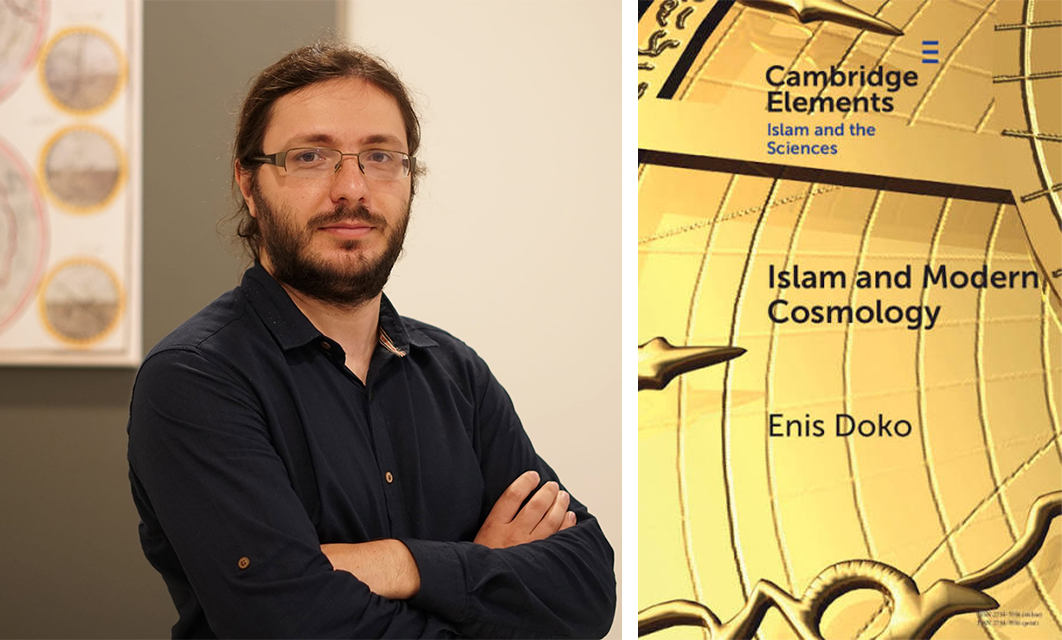

Enis Doko’s Islam and Modern Cosmology examines how Muslims can engage the Big Bang theory and the multiverse while remaining grounded in the Quran and Islamic thought, offering a faith-based response to modern physics.
Review by PROFESSOR AUWAIS RAFUDEEN
Enis Doko. Islam and Modern Cosmology. Cambridge University Press, 2026
This is a little gem of a book. It provides an approach for Muslims to engage cutting-edge and even future physics while being true to the Islamic tradition.
The author, Enis Doko, a professor at Ibn Haldun University in Turkiye, is well placed to speak to this topic, having a background in physics while conversant with the relevant aspects of this tradition.
Doko’s focus is on cosmology, namely, the origin, evolution and end of the universe. He starts his book by presenting the most widely accepted theory of this cosmology, the Big Bang model. In this model, primarily shaped by Einstein’s theory of general relativity, the universe starts as an extremely dense point of energy, which then expands and cools to form particles, atoms and gases, which in turn is the basis of the galaxies, stars, planets and life as we know them today.
You may also want to read


Scientists estimate that the Big Bang, the origin of the universe, took place approximately 13.8 billion years ago. They also estimate that the observable universe is 93 trillion light-years in size (remembering that light travels at about 300 000 km a second). When measured against this mind-boggling number, our own Earth is literally microscopic: “a mote of dust suspended in a sunbeam”, to recall cosmologist Carl Sagan’s famous description.

So how do Muslim scholars approach this prevailing perspective?
For Doko, their perspectives will be informed by the Quran as well as classical and contemporary Islamic thinking on this issue.
There are various verses in the Quran that are suggestive of the Big Bang. Thus:
“Do the disbelievers not realize that the heavens and earth were once joined, then We separated them? And We created from water every living thing. Will they not then believe?” (Sura An-Anbiyah, 21:30)
This joining here could be interpreted as referring to the immense ball of energy at the start of the universe before it became “separated” into matter.
Another verse is interpreted by some as referring to the expanding nature of the universe:
“And the heaven We constructed with strength, and indeed We are [its] Expander.” (Sura Adh-Dhariyat, 51:47)
But Doko himself is cautious of such interpretations. For him, the Quran is not a textbook that is there to prove contemporary scientific accounts of reality. Rather, it is fundamentally a Book of moral and spiritual guidance that sees the world as a testing ground in our journey back to Allah.
Science can complement the Quran but the two have different objectives. At the same time, there is nothing in the Quran that contradicts contemporary scientific knowledge.
In fact, the Quran is deliberately open to interpretation, or “underdetermined” as Doko calls it. By underdetermination is meant that the data of the Quran is such that it can yield a variety of philosophical and theological interpretations. There is no single Quranic cosmology.
Thus Muslim history has already shown that scholars such as Imam Ghazali, Ibn Sina, Mulla Sadra and Ibn Taymiyyah, amongst others, have approached some of the most profound questions, such as the nature of time and creation, in sometimes radically different ways, with all seeing themselves as speaking firmly from within the Islamic tradition.
For Doko, such different philosophical and theological approaches are to be expected. In fact, such approaches need to be continually developed, refined and revised in the light of the prevailing scientific evidence.
Personally, I think we should see the Quran’s underdetermined data as one of its miracles. It is designed to speak to every epoch and, no doubt, as current scientific views develop, we will no doubt be able to see how its verses relate to future perspectives.
From a Sunni theological perspective (and Doko also locates himself in this perspective while being open to others), our current moment and our scientific knowledge are also created by God. So this knowledge, whatever its past or future forms, is always real for us.
One way in which current scientific knowledge can refine standard theological models is shown in Doko’s discussion of the fine-tuning argument for God’s existence.
The standard models provide compelling arguments such as the cosmological and design arguments. In the cosmological argument, there must necessarily be a first cause to all things. After all, even with the Big Bang, one must still ask: who or what brought that dense point of energy into existence? The design argument sees the ordered functioning of a complex universe as evidence of an “intelligence” behind existence. In this argument, such functioning could not have come about by chance. A table, for example, must point to the existence of a carpenter or manufacturer.
The fine-tuning argument can be seen as the design argument on steroids. According to scientists such as Stephen Hawking, the physical laws of the universe had to be precisely right for life to have emerged. Had there been even extremely small deviations in the proportions of basic forces such as gravity and the electrostatic force, human beings and other life-forms would likely not have existed. For example, if there was a tiny deviation in the force of gravity, then the universe would have either expanded too quickly or collapsed in on itself. In both cases, life would not have emerged.
Doko compares the chances of finding the right conditions for life to emerge to walking into a desert and finding the one grain of sand that would allow this to happen. This, of course, is extremely unlikely and so points to a higher intelligence that has made these conditions possible.
Some scientists have argued that there is not just this grain of sand (our universe) that exists, but the other grains of sand as well. It is just that we cannot see and experience these other universes, even though they are theoretically possible. For such scientists, we exist in a “multiverse”. The multiverse is speculative at this stage. But Doko argues that, even if it were to be proven, there is nothing in Islamic teachings that excludes this possibility. After all, Allah is Rabbul Aalameen, that is, Lord of all the worlds, many of which we of course have no knowledge of.
Finally, Doko deals with the crucial question: in this vast, almost limitless universe or even multiverse, human beings are but a tiny speck. So, what do we make of human existence? Here Doko reminds us that our essential nature is spiritual. The vastness of the universe reminds our ego that it is only a mere speck in Allah’s creation, which is healthy for combatting our sense of self-importance. At the same time, amongst creation, humans have been especially chosen for a moral and spiritual mission which in the end outweighs anything material and physical. So, we are not unimportant and should continually reflect on our true purpose here.
This book, which deals with the latest scientific perspectives in an informed manner, while remaining deeply grounded in faith, should prove rather useful to many Muslims seeking meaningful Islamic responses to some important contemporary questions.
Professor Auwais Rafudeen teaches Islamic Studies and Arabic in the College of Human Sciences, School of Humanities at the University of South Africa (Unisa).