




Muslim Views
No Result
View All Result
  • News
    • All
    • Local
    • National
    • World
    Court resets Mowbray Cemetery nomination rules days before deadline

    Court resets Mowbray Cemetery nomination rules days before deadline

    Gaza ER screening panel calls for action to support healthcare workers

    Gaza ER screening panel calls for action to support healthcare workers

    Five-year plan set in motion to tackle crime in Manenberg

    Five-year plan set in motion to tackle crime in Manenberg

    Cape Town musicians rally behind displaced Palestinian composer

    Cape Town musicians rally behind displaced Palestinian composer

    Rally for solidarity with migrants ahead of planned march

    Rally for solidarity with migrants ahead of planned march

    The scholar who refused to turn Islam into an enemy: The legacy of John Esposito

    The scholar who refused to turn Islam into an enemy: The legacy of John Esposito

    The greatest monuments are not in stone, but in lives transformed

    The greatest monuments are not in stone, but in lives transformed

    Mass march to Parliament planned to combat xenophobia and Afrophobia

    Mass march to Parliament planned to combat xenophobia and Afrophobia

    How Sanef is helping journalists build mental resilience

    How Sanef is helping journalists build mental resilience

    Awqaf SA strengthens water security at Rahima Moosa Hospital

    Awqaf SA strengthens water security at Rahima Moosa Hospital

    • National
    • World
    • Local
  • Opinion
    • All
    • Columnists
    • Discussions with Dangor
    • Editorial
    • Guest Writer
    Spain’s defiance and the geopolitics of Ceuta’s migration flashpoint

    Spain’s defiance and the geopolitics of Ceuta’s migration flashpoint

    Marking 140 years since the closure of the Tana Baru

    Marking 140 years since the closure of the Tana Baru

    The day Pakistan lost Kashmir

    The day Pakistan lost Kashmir

    Data centres pose greater risks than we thought

    Data centres pose greater risks than we thought

    Organised labour in South Africa’s class struggle

    Organised labour in South Africa’s class struggle

    Gen Z cockroaches and the end of political obedience

    Gen Z cockroaches and the end of political obedience

    When Sipho asked me to make duʿa

    When Sipho asked me to make duʿa

    The nuclear leash: Washington’s deal to put Saudi back in its place

    The nuclear leash: Washington’s deal to put Saudi back in its place

    Spain’s World Cup triumph, Messi and the politics of Palestine

    Spain’s World Cup triumph, Messi and the politics of Palestine

    The myth of apolitical law

    The myth of apolitical law

  • Features
    • All
    • 1500 Years of Prophetic Legacy
    • AWQAF SA
    • General Features
    • Imam Haron
    • Tributes
    Marking 140 years since the closure of the Tana Baru

    Marking 140 years since the closure of the Tana Baru

    Abbas Rumaney remembered for his faith, wisdom, humour and generosity

    Abbas Rumaney remembered for his faith, wisdom, humour and generosity

    Grappling with Apartheid labels

    Grappling with Apartheid labels

    The scholar who refused to turn Islam into an enemy: The legacy of John Esposito

    The scholar who refused to turn Islam into an enemy: The legacy of John Esposito

    The greatest monuments are not in stone, but in lives transformed

    The greatest monuments are not in stone, but in lives transformed

    Legacy of educator Haji Mogamat Rashad Jedaar lives on

    Legacy of educator Haji Mogamat Rashad Jedaar lives on

    Reclaiming agency: From ritual to action Part 3

    Reclaiming agency: From ritual to action Part 3

    June 16, the Call of Islam, and the many rivers of liberation

    June 16, the Call of Islam, and the many rivers of liberation

    Reclaiming agency: From ritual to action Part 2

    Reclaiming agency: From ritual to action Part 2

    Reclaiming agency: From ritual to action Part 1

    Reclaiming agency: From ritual to action Part 1

    Goolam Hoosain Abed: The last of the famous sporting family departs

    Goolam Hoosain Abed: The last of the famous sporting family departs

    Abdullah Ibrahim crafted a magnificent new culture for South Africa

    Abdullah Ibrahim crafted a magnificent new culture for South Africa

    The hidden heritage of racial ‘passing’

    The hidden heritage of racial ‘passing’

    The Commonwealth war graves at the Mowbray Muslim Cemetery

    The Commonwealth war graves at the Mowbray Muslim Cemetery

    Honouring a chess giant: The legacy of Dr Shabier Bhawoodien

    Honouring a chess giant: The legacy of Dr Shabier Bhawoodien

  • Lifestyle
    • All
    • Arts
    • Books
    • Education
    • Food
    • Health
    • Motoring
    • Sport
    • Technology
    Languages of Care: Extending worship through art

    Languages of Care: Extending worship through art

    Cape Town musicians rally behind displaced Palestinian composer

    Cape Town musicians rally behind displaced Palestinian composer

    More than a game, or the Clash of Titans

    More than a game, or the Clash of Titans

    Help Ruqaya Ismail represent SA at the Commonwealth Fencing Championship

    Help Ruqaya Ismail represent SA at the Commonwealth Fencing Championship

    Goolam Hoosain Abed: The last of the famous sporting family departs

    Goolam Hoosain Abed: The last of the famous sporting family departs

    Abdeyah da Costa and the dihlīz of Dorp Street

    Abdeyah da Costa and the dihlīz of Dorp Street

    A mother’s taweez and the Cape’s interfaith traditions [+ video]

    A mother’s taweez and the Cape’s interfaith traditions [+ video]

    Inaugural Islamic Expo to be hosted in Cape Town

    Inaugural Islamic Expo to be hosted in Cape Town

    Imraan Buccus on faith, activism and SA’s political crisis

    Imraan Buccus on faith, activism and SA’s political crisis

    The Book of Mercy: A powerful Ramadan read on compassion in Islam

    The Book of Mercy: A powerful Ramadan read on compassion in Islam

  • Finance
    • All
    • Islamic Finance
    First Abu Dhabi Bank’s African opportunity could reshape Islamic finance

    First Abu Dhabi Bank’s African opportunity could reshape Islamic finance

    Family takaful’s research boom exposes an industry failing the underserved

    Family takaful’s research boom exposes an industry failing the underserved

    Can AI and blockchain save takaful from exclusion and a crisis of trust?

    Can AI and blockchain save takaful from exclusion and a crisis of trust?

    The sacred journey is now a marketplace that prices out the poor

    The sacred journey is now a marketplace that prices out the poor

    Why Shariah compliance alone cannot guarantee sound investment returns

    Why Shariah compliance alone cannot guarantee sound investment returns

    Why serious Muslim investors must look beyond basic Shariah screens today

    Why serious Muslim investors must look beyond basic Shariah screens today

    Why Mufti Taqi Usmani says cryptocurrency is not Shariah compliant today

    Why Mufti Taqi Usmani says cryptocurrency is not Shariah compliant today

    Today’s two-pot withdrawal could threaten tomorrow’s retirement security

    Today’s two-pot withdrawal could threaten tomorrow’s retirement security

    War clouds gather over the Islamic finance boom

    War clouds gather over the Islamic finance boom

    Israel and the perfect storm of global economic isolation

    Israel and the perfect storm of global economic isolation

  • Islam
    • All
    • Eid
    • Faith and Practice
    • Family
    • Hajj and Umrah
    • Moulood
    • Quran
    • Ramadaan
    When Sipho asked me to make duʿa

    When Sipho asked me to make duʿa

    A sound heart in a world of strangers

    A sound heart in a world of strangers

    Can our mosques become the heart of the Ummah?

    Can our mosques become the heart of the Ummah?

    Karbala – between obligation and inability

    Karbala – between obligation and inability

    16 June 1976: Qibla’s call to conscience

    Reclaiming our future – drawing lessons from Karbala and Soweto 1976

    Karbala, Gaza and xenophobia: Why history still matters today

    Karbala, Gaza and xenophobia: Why history still matters today

    Adnaan Adams (right) addressing the congregation at Masjidut Taqwa in Newfields Estate, Cape Town, on Friday, June 12. (Photo: Supplied)

    Reflecting on a khutbah and the community it seeks to serve

    The panellists at the Muslim Personal Law symposium at the University of Cape Town on June 8, clockwise from top right: Professor Fatima Seedat, Ayesha Royker, Rehema Namukose and Khensani Motlhante. (Photos: Anwar Omar)

    Advancing gender justice in Muslim Personal Law

    What do we owe the Earth?

    What do we owe the Earth?

    Hajj, human frailty and the compassion of Allah

    Hajj, human frailty and the compassion of Allah

  • Archives
  • Donate
Muslim Views
  • News
    • All
    • Local
    • National
    • World
    Court resets Mowbray Cemetery nomination rules days before deadline

    Court resets Mowbray Cemetery nomination rules days before deadline

    Gaza ER screening panel calls for action to support healthcare workers

    Gaza ER screening panel calls for action to support healthcare workers

    Five-year plan set in motion to tackle crime in Manenberg

    Five-year plan set in motion to tackle crime in Manenberg

    Cape Town musicians rally behind displaced Palestinian composer

    Cape Town musicians rally behind displaced Palestinian composer

    Rally for solidarity with migrants ahead of planned march

    Rally for solidarity with migrants ahead of planned march

    The scholar who refused to turn Islam into an enemy: The legacy of John Esposito

    The scholar who refused to turn Islam into an enemy: The legacy of John Esposito

    The greatest monuments are not in stone, but in lives transformed

    The greatest monuments are not in stone, but in lives transformed

    Mass march to Parliament planned to combat xenophobia and Afrophobia

    Mass march to Parliament planned to combat xenophobia and Afrophobia

    How Sanef is helping journalists build mental resilience

    How Sanef is helping journalists build mental resilience

    Awqaf SA strengthens water security at Rahima Moosa Hospital

    Awqaf SA strengthens water security at Rahima Moosa Hospital

    • National
    • World
    • Local
  • Opinion
    • All
    • Columnists
    • Discussions with Dangor
    • Editorial
    • Guest Writer
    Spain’s defiance and the geopolitics of Ceuta’s migration flashpoint

    Spain’s defiance and the geopolitics of Ceuta’s migration flashpoint

    Marking 140 years since the closure of the Tana Baru

    Marking 140 years since the closure of the Tana Baru

    The day Pakistan lost Kashmir

    The day Pakistan lost Kashmir

    Data centres pose greater risks than we thought

    Data centres pose greater risks than we thought

    Organised labour in South Africa’s class struggle

    Organised labour in South Africa’s class struggle

    Gen Z cockroaches and the end of political obedience

    Gen Z cockroaches and the end of political obedience

    When Sipho asked me to make duʿa

    When Sipho asked me to make duʿa

    The nuclear leash: Washington’s deal to put Saudi back in its place

    The nuclear leash: Washington’s deal to put Saudi back in its place

    Spain’s World Cup triumph, Messi and the politics of Palestine

    Spain’s World Cup triumph, Messi and the politics of Palestine

    The myth of apolitical law

    The myth of apolitical law

  • Features
    • All
    • 1500 Years of Prophetic Legacy
    • AWQAF SA
    • General Features
    • Imam Haron
    • Tributes
    Marking 140 years since the closure of the Tana Baru

    Marking 140 years since the closure of the Tana Baru

    Abbas Rumaney remembered for his faith, wisdom, humour and generosity

    Abbas Rumaney remembered for his faith, wisdom, humour and generosity

    Grappling with Apartheid labels

    Grappling with Apartheid labels

    The scholar who refused to turn Islam into an enemy: The legacy of John Esposito

    The scholar who refused to turn Islam into an enemy: The legacy of John Esposito

    The greatest monuments are not in stone, but in lives transformed

    The greatest monuments are not in stone, but in lives transformed

    Legacy of educator Haji Mogamat Rashad Jedaar lives on

    Legacy of educator Haji Mogamat Rashad Jedaar lives on

    Reclaiming agency: From ritual to action Part 3

    Reclaiming agency: From ritual to action Part 3

    June 16, the Call of Islam, and the many rivers of liberation

    June 16, the Call of Islam, and the many rivers of liberation

    Reclaiming agency: From ritual to action Part 2

    Reclaiming agency: From ritual to action Part 2

    Reclaiming agency: From ritual to action Part 1

    Reclaiming agency: From ritual to action Part 1

    Goolam Hoosain Abed: The last of the famous sporting family departs

    Goolam Hoosain Abed: The last of the famous sporting family departs

    Abdullah Ibrahim crafted a magnificent new culture for South Africa

    Abdullah Ibrahim crafted a magnificent new culture for South Africa

    The hidden heritage of racial ‘passing’

    The hidden heritage of racial ‘passing’

    The Commonwealth war graves at the Mowbray Muslim Cemetery

    The Commonwealth war graves at the Mowbray Muslim Cemetery

    Honouring a chess giant: The legacy of Dr Shabier Bhawoodien

    Honouring a chess giant: The legacy of Dr Shabier Bhawoodien

  • Lifestyle
    • All
    • Arts
    • Books
    • Education
    • Food
    • Health
    • Motoring
    • Sport
    • Technology
    Languages of Care: Extending worship through art

    Languages of Care: Extending worship through art

    Cape Town musicians rally behind displaced Palestinian composer

    Cape Town musicians rally behind displaced Palestinian composer

    More than a game, or the Clash of Titans

    More than a game, or the Clash of Titans

    Help Ruqaya Ismail represent SA at the Commonwealth Fencing Championship

    Help Ruqaya Ismail represent SA at the Commonwealth Fencing Championship

    Goolam Hoosain Abed: The last of the famous sporting family departs

    Goolam Hoosain Abed: The last of the famous sporting family departs

    Abdeyah da Costa and the dihlīz of Dorp Street

    Abdeyah da Costa and the dihlīz of Dorp Street

    A mother’s taweez and the Cape’s interfaith traditions [+ video]

    A mother’s taweez and the Cape’s interfaith traditions [+ video]

    Inaugural Islamic Expo to be hosted in Cape Town

    Inaugural Islamic Expo to be hosted in Cape Town

    Imraan Buccus on faith, activism and SA’s political crisis

    Imraan Buccus on faith, activism and SA’s political crisis

    The Book of Mercy: A powerful Ramadan read on compassion in Islam

    The Book of Mercy: A powerful Ramadan read on compassion in Islam

  • Finance
    • All
    • Islamic Finance
    First Abu Dhabi Bank’s African opportunity could reshape Islamic finance

    First Abu Dhabi Bank’s African opportunity could reshape Islamic finance

    Family takaful’s research boom exposes an industry failing the underserved

    Family takaful’s research boom exposes an industry failing the underserved

    Can AI and blockchain save takaful from exclusion and a crisis of trust?

    Can AI and blockchain save takaful from exclusion and a crisis of trust?

    The sacred journey is now a marketplace that prices out the poor

    The sacred journey is now a marketplace that prices out the poor

    Why Shariah compliance alone cannot guarantee sound investment returns

    Why Shariah compliance alone cannot guarantee sound investment returns

    Why serious Muslim investors must look beyond basic Shariah screens today

    Why serious Muslim investors must look beyond basic Shariah screens today

    Why Mufti Taqi Usmani says cryptocurrency is not Shariah compliant today

    Why Mufti Taqi Usmani says cryptocurrency is not Shariah compliant today

    Today’s two-pot withdrawal could threaten tomorrow’s retirement security

    Today’s two-pot withdrawal could threaten tomorrow’s retirement security

    War clouds gather over the Islamic finance boom

    War clouds gather over the Islamic finance boom

    Israel and the perfect storm of global economic isolation

    Israel and the perfect storm of global economic isolation

  • Islam
    • All
    • Eid
    • Faith and Practice
    • Family
    • Hajj and Umrah
    • Moulood
    • Quran
    • Ramadaan
    When Sipho asked me to make duʿa

    When Sipho asked me to make duʿa

    A sound heart in a world of strangers

    A sound heart in a world of strangers

    Can our mosques become the heart of the Ummah?

    Can our mosques become the heart of the Ummah?

    Karbala – between obligation and inability

    Karbala – between obligation and inability

    16 June 1976: Qibla’s call to conscience

    Reclaiming our future – drawing lessons from Karbala and Soweto 1976

    Karbala, Gaza and xenophobia: Why history still matters today

    Karbala, Gaza and xenophobia: Why history still matters today

    Adnaan Adams (right) addressing the congregation at Masjidut Taqwa in Newfields Estate, Cape Town, on Friday, June 12. (Photo: Supplied)

    Reflecting on a khutbah and the community it seeks to serve

    The panellists at the Muslim Personal Law symposium at the University of Cape Town on June 8, clockwise from top right: Professor Fatima Seedat, Ayesha Royker, Rehema Namukose and Khensani Motlhante. (Photos: Anwar Omar)

    Advancing gender justice in Muslim Personal Law

    What do we owe the Earth?

    What do we owe the Earth?

    Hajj, human frailty and the compassion of Allah

    Hajj, human frailty and the compassion of Allah

  • Archives
  • Donate
Muslim Views
Advertisement

Marking 140 years since the closure of the Tana Baru

1 August 2026 - Updated on 3 August 2026
in FEATURES, Guest Writer
Reading Time: 8 mins read
A A
Marking 140 years since the closure of the Tana Baru

The Tana Baru Cemetery is situated prominently in the “amphitheatre” of Table Mountain. (Photo: Anwar Omar)

Share on TwitterShare on FacebookShare on Whatsapp

Cape Town’s Tana Baru commemoration marked 140 years since the colonial closure of South Africa’s oldest Muslim cemetery, honouring the pioneers buried there and recalling the community uprising that defended this sacred ground in 1886.

By ANWAR OMAR

On a cold, rainy winter’s day in Cape Town, more than 100 descendants of those buried in the Tana Baru gathered at the Boorhaanol Cultural Hub in Bo-Kaap on Sunday, June 28, 2026, to mark 140 years since the colonial closure of South Africa’s oldest Muslim cemetery.

The planned commemorative march was cancelled due to the weather, but nothing could dampen the devotion that filled the Hub. The Habibia Muslim Brigade and various nasheed groups provided a moving backdrop to a ceremony that was as much a celebration as a commemoration.

Organised by the Boorhaanol Islam Movement in collaboration with the Tana Baru Trust, the gathering honoured the fateful day of January 15, 1886, when colonial authorities shut the gates of the Tana Baru, igniting one of the earliest acts of mass civil resistance in the history of Cape Town. Despite the cancellation of the march, a small group of youth carried a mock bier symbolising Ibn Amaldien, the child whose burial sparked the uprising against the Tana Baru’s closure, ensuring that the symbolic link between the gathering and the sacred ground above was not broken.

https://muslimviews.co.za/wp-content/uploads/2026/08/01.mp4

From slavery to sacred ground

Between 1652 and 1818, close to 70% of enslaved people brought to the Cape Colony came from India and the East Indies, East Africa, Ceylon, Malaya and Mauritius. Many were already Muslim; others converted, drawn by a faith that offered dignity to people denied it by their enslavers (Mellet, 2024). They were artisans, fishermen, builders, traders, political exiles and banished princes who together forged the cradle of Islam in South Africa (Davids and Da Costa, 1994). On October 2, 1805, the Batavian government formally granted the land to Frans van Bengalen for use as a Muslim cemetery (Davids, 1985).

Closure: an act of colonial erasure

The Public Health Act of 1883 gave colonial authorities grounds to close Cape Town’s cemeteries. Under Abdol Burns, the community presented compelling evidence: Muslim graves at the Tana Baru were buried five to six feet underground, far deeper than the shallow vault burials at Somerset Road Cemetery. The authorities proceeded with the closure and, on January 15, 1886, the decree was finalised (Davids, 1985).

The uprising

The colonial administration miscalculated the depth of the Muslim community’s conviction. Just two days after the closure, a child of Amaldien Rhode, a Muslim fisherman from Woodstock, died. The community unanimously decided to bury the child at the Tana Baru. Davids (1985) describes how, that same afternoon, Abdol Burns led 3 000 Muslims in protest from Woodstock, along Sir Lowry Road, through Darling and Shortmarket Streets, to bury Ibn Amaldien at the Tana Baru.
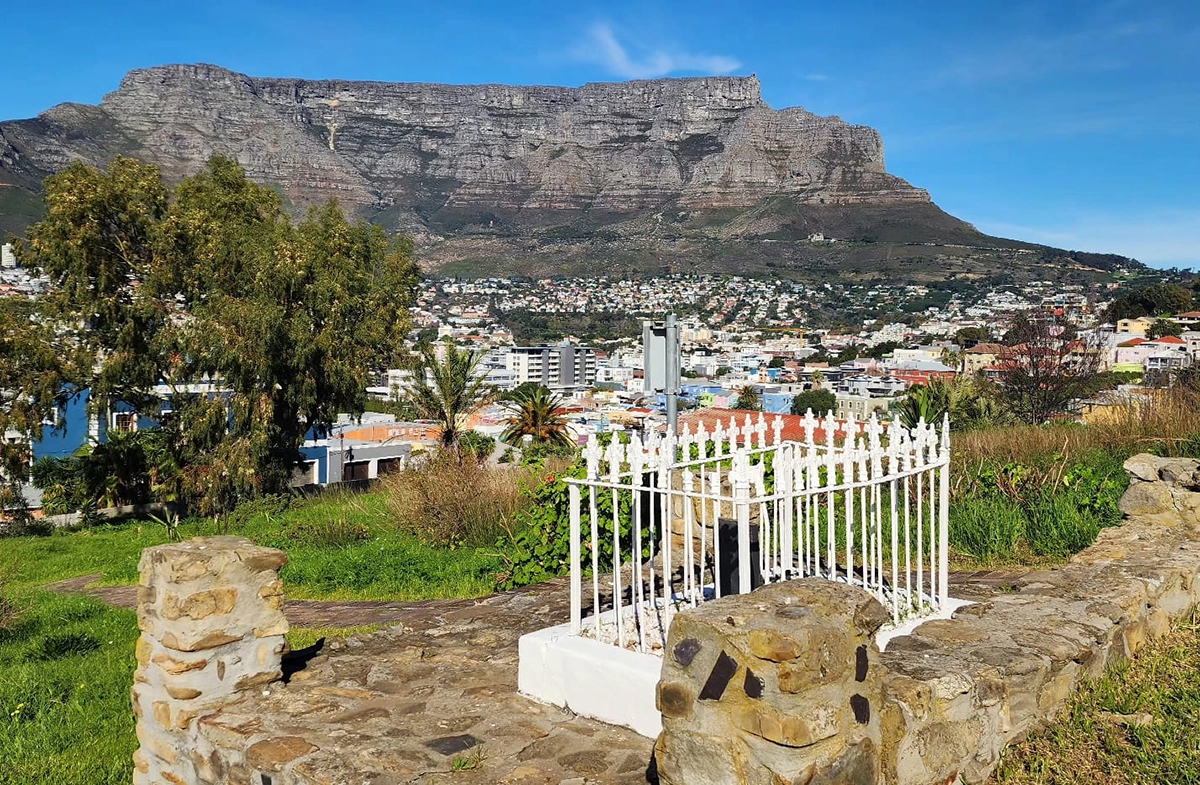
The grave of Ibn Amaldien, the child whose burial sparked the Tana Baru uprising against its closure. (Photo: Anwar Omar)

The uprising brought the city to a standstill for three days, igniting one of the earliest acts of mass civil resistance at the Cape. A 1 200-strong Corps of Volunteers was mobilised to stop the protest burials, but the burial of Ibn Amaldien continued during the night. Such unity of action had never previously been experienced by the Muslims of Cape Town (Davids, 1985). The colonial authorities responded with criminal charges. Abdol Burns and 12 others who led the resistance were arrested, found guilty of public riot, fined ten pounds and sentenced to two months’ imprisonment with hard labour (Davids, 1985).

Today they are remembered as heroes, not as criminals.

Even as Burns served his sentence, the community built its response. Within weeks, members from Bo-Kaap to Salt River mobilised to acquire land in Mowbray, establishing the Mowbray Muslim Cemetery less than two months after the Tana Baru’s closure. Burns was appointed vice-chairperson of the new board while still in prison. Now 140 years old itself, the Mowbray Muslim Cemetery remains the Tana Baru’s active institutional successor (Wills, 2023).

Abdol Burns, other cemetery pioneers and Ibn Amaldien are honoured by protesters at the Boorhaanol Cultural Hub during the 140th commemoration on June 28, 2026 of the closure of the Tana Baru. (Photo: Anwar Omar)

The souls in the soil

What makes the Tana Baru irreplaceable is not merely its age, but who lies within it. The following are among the pioneers buried here, in chronological order of their passing.

Tuan Said Aloewie (died 1803) arrived at the Cape in 1744, was banished to Robben Island in chains and was listed on the Bandieten Rolle (prisoners list) as a “Mohammedansche Priester”. Cape law threatened death for practising any religion other than Reformed Protestantism. Undeterred, he became a policeman to gain access to the keys to the Slave Lodge in order to preach Islam to those incarcerated at the Lodge. He became Cape Town’s first official imam, a God-fearing nation builder (Morton, 2025).
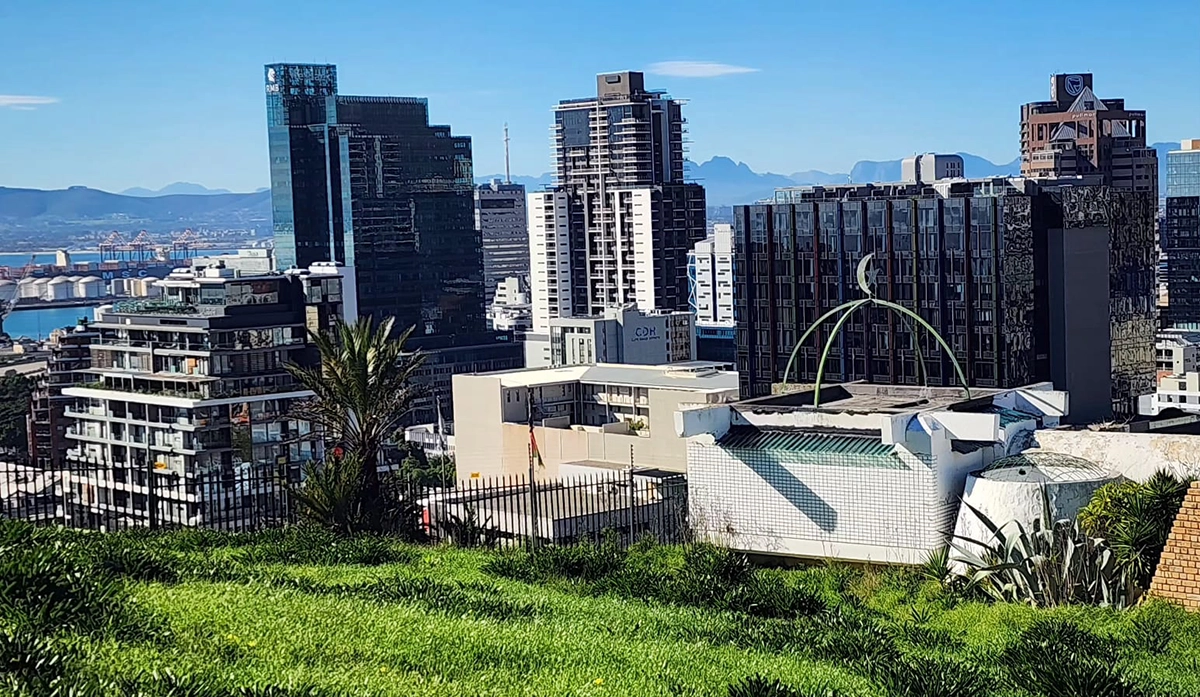
Omar of Ambon (died 1799) was banished to the Cape in 1772 and later shared Robben Island with Tuan Guru and Paay Schaapie. Classified as a Free Black in 1790, he was among the first at the Cape to hold the Sufi title of Mawlana and was the progenitor of the Savahl, Kafaar and Manan families found across South Africa today (TB, n.d.).

Tuan Guru – Imam Abdullah Kadi Abdus Salaam (died 1807) was born in 1712 as a prince of the royal house of Tidore in the Spice Islands of Indonesia. His ancestry can be traced to the Prophet Muhammad (ﷺ). Imprisoned on Robben Island from 1780 to 1793, he transcribed the entire Quran from memory twice and authored Ma’rifatul Islami wa’l Imani, a 613-page treatise on Islamic jurisprudence cited as an authoritative text by the Cape Supreme Court. On his release, he established South Africa’s first madrassah (1793), drawing 375 students from the enslaved and Free Black community, and converted the Dorp Street warehouse into the Auwal Masjid, South Africa’s oldest mosque, where he served as founding imam (Morton, 2023; TB, n.d.).

He held the first open Friday prayer in South Africa in a disused quarry in Chiappini Street, defying laws that threatened death for doing so. Tuan Guru died in 1807, aged 95. His handwritten Quran remains on display at the Auwal Mosque. His Robben Island imprisonment connects him across centuries to Nelson Mandela, who visited the Auwal Mosque, acknowledging that continuum of resistance. Tuan Guru was, and remains, the founding father of Islam in South Africa (Morton, 2023; TB, n.d.).

Tuan Guru’s shrine against the Cape Town skyline in the background. (Photo: Anwar Omar)

Paay Schaapie – Tuan Nuruman (date of death unrecorded) was banished to the Cape from Batavia in 1770 and to Robben Island in 1786 for assisting runaway slaves. He was known for his Azeemats (spiritual talismans), sought by the enslaved for spiritual protection. On his release, he befriended Governor Janssen, who granted him land on the Tana Baru as a burial ground for him and his family. He dug a well on the hillside for grazing animals; its remnants remain visible in close proximity to his qabr today.
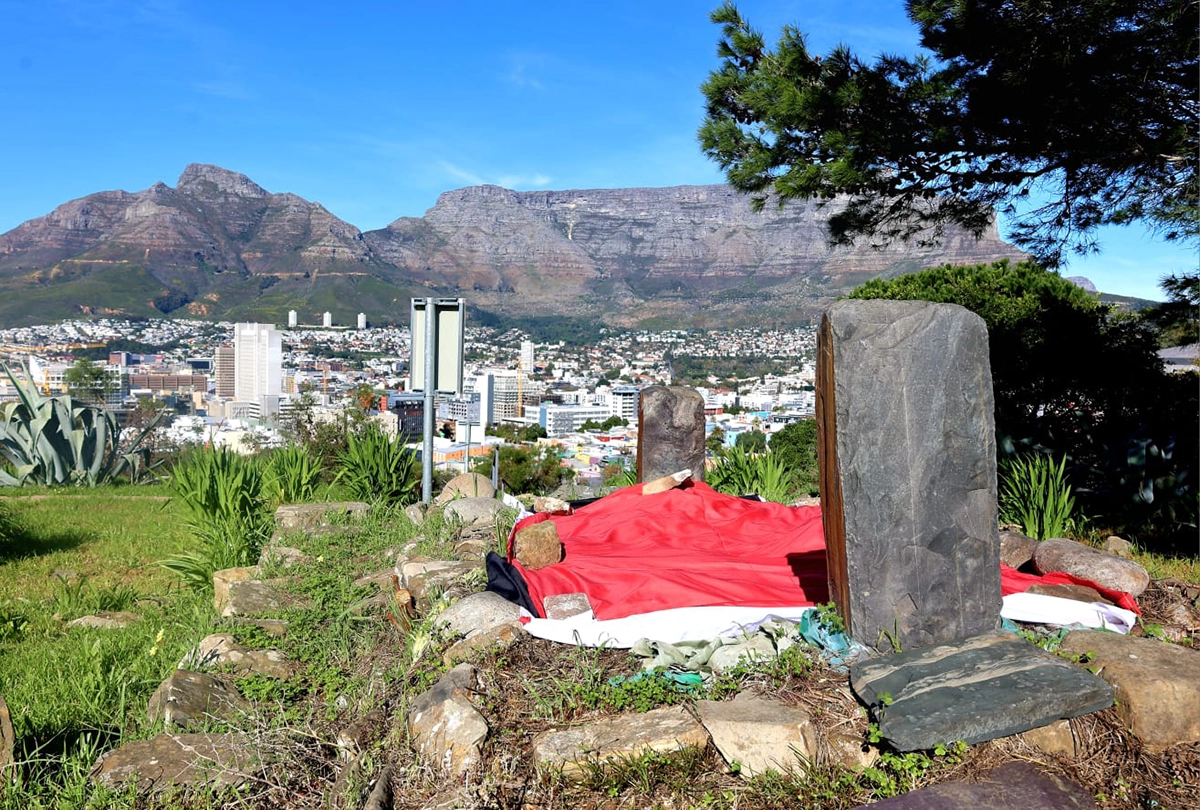
The gravesite of Paay Schaapie against the backdrop of Table Mountain. (Photo: Anwar Omar)

Rozetta of the Cape (died October 14, 1842) is the only positively identified grave of an enslaved woman on the Tana Baru. Born around 1788 to enslaved parents, three generations of her family appear on the slave register under one owner—a man whose name, the graveside sign notes, “does not deserve to be remembered”. Freed under the Slavery Abolition Act of 1833, she was still recorded as a “slave woman” on her 1838 death register. Her gravestone names her “Nyai Rosetta” (Lady Rosetta), reflecting the respect bestowed on her by her community both in life and death (TB, n.d.).

Rozetta’s identification illuminates something larger. The Tana Baru was granted in 1804, three decades before slavery was abolished in 1834. Given the centrality of Islam among the Cape’s enslaved population, many of the more than 20 000 people interred at the Tana Baru were almost certainly enslaved or formerly enslaved, their names unrecorded and headstones long since lost. Rozetta’s grave represents all those whose memory the colonial administration sought to erase.

Her inscription was researched by Cape Town historian Abdudaiyaan Petersen (TB, n.d.).
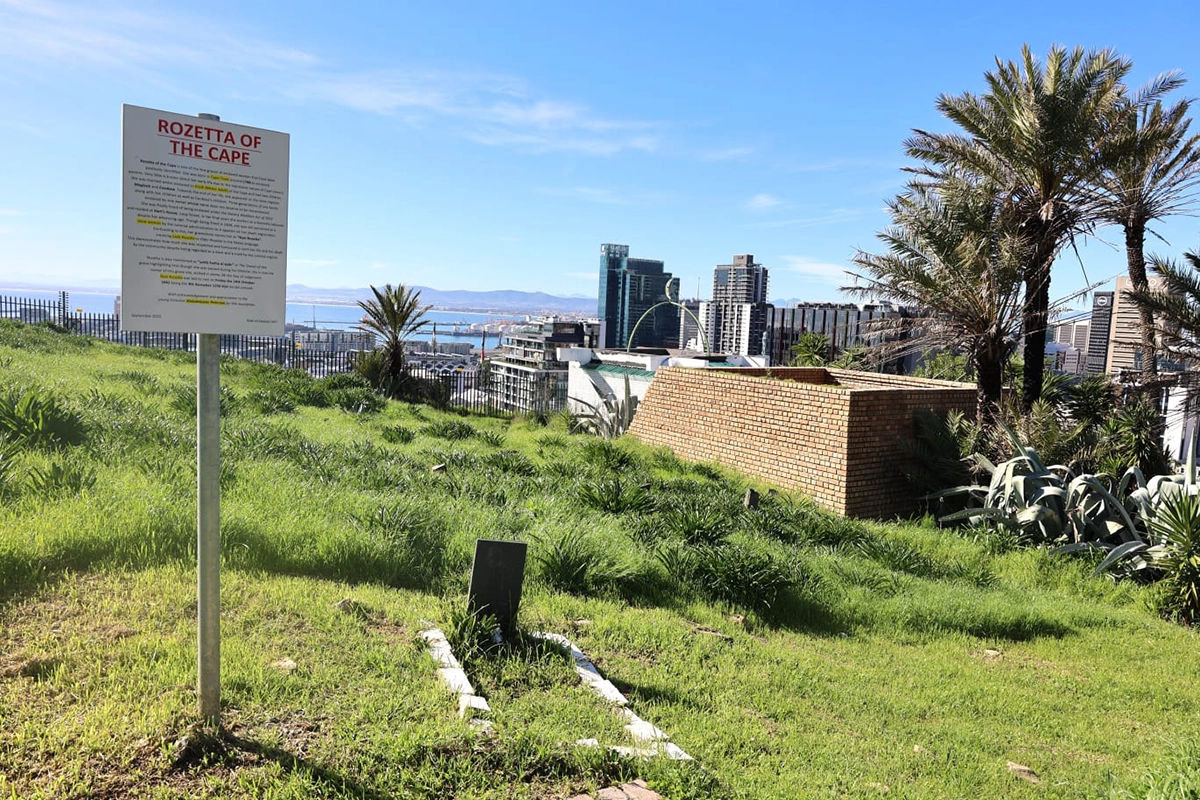
The gravesite of Lady Rozetta, with the shrine of Tuan Guru and the city skyline in the background. (Photo: Anwar Omar)

Imam Hasnullah – Jan van Boeghies (died November 12, 1846) was born in 1734 in Sulawesi, Indonesia, and brought to the Cape as a slave. He married his owner, Salia of Macassar, and so gained his freedom. He joined Tuan Guru’s madrassah as an Arabic teacher and co-founded the Palm Tree Mosque in Long Street. With his inheritance, he purchased enslaved people, freed them and converted them between 1800 and 1820. He died at the extraordinary age of 112 (TB, n.d.).
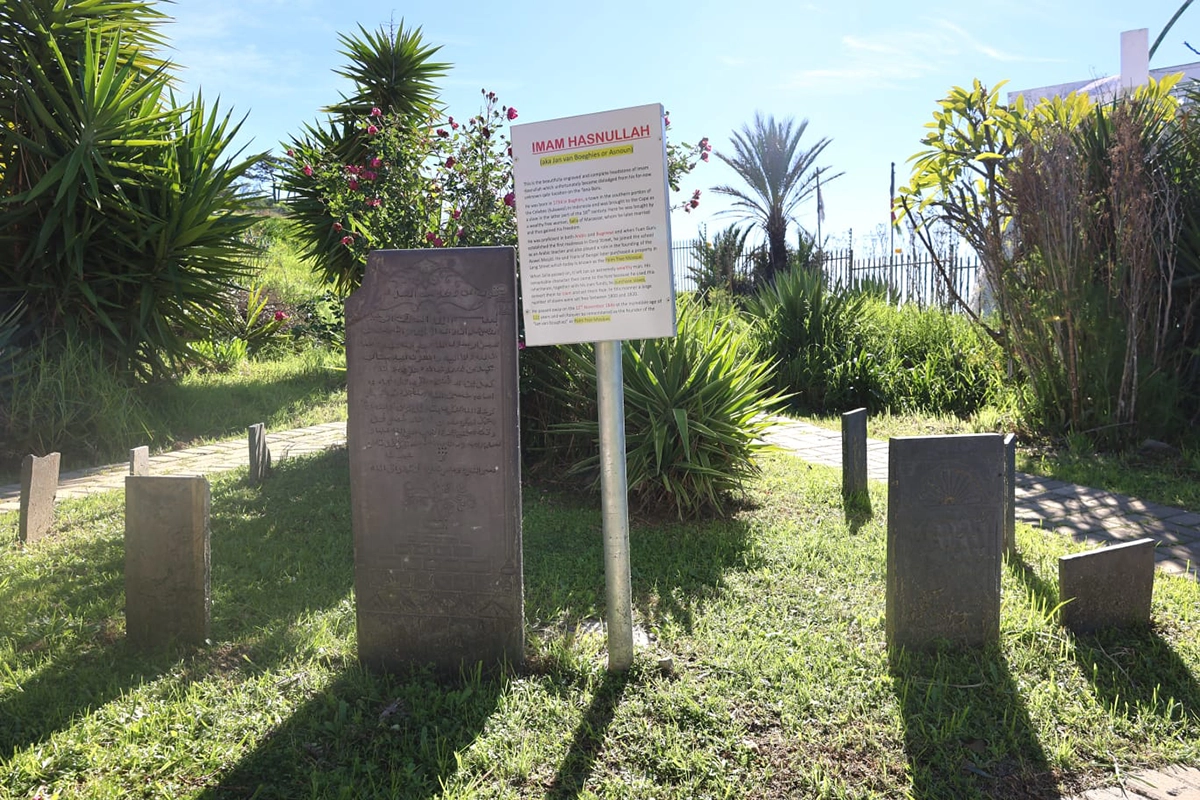
The gravestone of Imam Hasnullah. (Photo: Anwar Omar)

Carel Pelgrim – Hadjie Gasanodien (died circa May 1863), born in 1785, was an imam, teacher and tailor and, by all accounts, the first Cape Muslim to perform the Hajj to Mecca. His pilgrimage of 1833 lasted three to five years, earning him the name Pelgrim (Pilgrim) for the rest of his life (TB, n.d.).

Abubakr Effendi (died June 29, 1880) was born in Turkey around 1835 and arrived at the Cape in 1862 at the request of parliamentarian De Roubaix to mediate the community’s doctrinal disputes. He founded the Hanafi School of Thought and introduced the red fez worn by Muslim men at the Cape, a practice that continues to this day. He authored Bayannuddin, a 354-page text in Arabic-Afrikaans, published as a gift to the Muslim community by the Turkish government. He died at the young age of 45 (Morton, 2023; TB, n.d.).

The Chinese burial ground

On the same day that the burial erven were gifted to Cape Muslims, Erf 963 was granted to the Chinese community, the only known Chinese burial ground in Cape Town. According to the Tana Baru Information Boards (n.d.), three categories of Chinese lie buried here: non-Muslims who arrived as such; those who converted to Islam in Malaysia and Indonesia before reaching the Cape; and those who reverted to Islam at the Cape through the influence of Tuan Guru, Paay Schaapie and Tuan Said Aloewie.

A sign indicating the direction to the Chinese graveyard. (Photo: Anwar Omar)

A grave in the Chinese precinct was recently uncovered through the diligent efforts of Faysil Bassier. The Tana Baru Trust has reached out to both the Chinese embassy and the local Chinese community to make them aware of this burial ground, though no formal engagement has yet resulted. It remains a part of the Tana Baru precinct whose full story is still waiting to be told (TB, n.d.).

No certainty exists as to when this piece of land was first used by the Chinese community. However, CP Thunberg, a well-known botanist at the time, described a Chinese burial in Cape Town in his Travels in Europe, Africa & Asia. He mentioned that it was near the town and, as far as can be determined, this is the only known Chinese burial ground in Cape Town (Davids, 1985).

You may also want to read

Suliman Ghoor: A legacy of quiet philanthropy and vision

Suliman Ghoor: A legacy of quiet philanthropy and vision

30 March 2026
Organised labour in South Africa’s class struggle

Organised labour in South Africa’s class struggle

29 July 2026 - Updated on 30 July 2026
SAFTU pays tribute to journalist Terry Bell – champion of workers and justice

SAFTU pays tribute to journalist Terry Bell – champion of workers and justice

26 March 2026
The Imam: soundscaped back to life / 3

The Imam: soundscaped back to life / 3

25 September 2020 - Updated on 1 March 2022
Palestine

The Olympics: Sports double standards at play by the ‘civilised’ world

25 July 2024
Tribute to a dedicated doctor, life-long student and peer

Tribute to a dedicated doctor, life-long student and peer

25 September 2025 - Updated on 26 September 2025

Why the Tana Baru matters

The Tana Baru is almost certainly the oldest cemetery still in existence in South Africa and, for the Cape Muslim community, it is a foundational space documenting their presence in this part of the world. Every mosque, every madrassah, every Hajj and every call to prayer across the Bo-Kaap traces its origins to the men and women buried on this hillside. They did not simply practise a religion at the Cape; they planted it in the face of laws that threatened death for doing so.

The 140th memorial was not a gathering to mourn a closure but to celebrate 140 years of refusal to yield to the 1886 closure, the community’s refusal to let its sacred ground fall into obscurity and the present generation’s refusal to allow ancestral land to become a commodity. It was simultaneously a moment to honour the Mowbray Muslim Cemetery, born 55 days after that same defiance (Wills, 2023) and now 140 years old, as the living institutional successor of the Tana Baru.

References

Davids, A. (1985). The History of the Tana Baru. The Committee for the Preservation of the Tana Baru, 1985, Longmarket Street, Cape Town.

Davids, A. and Da Costa, Y. (1994). Pages From Cape Muslim History. Naqshabandi-Muhammadi South Africa, Gatesville, 7766, RSA.

Mellet, P. T. (2024). The Truth About Cape Slavery: The Foundations of Colonial South Africa. Tafelberg Publishers Ltd.

Morton, S. (2025). The Circle of Saints: Stories of the Kramats at the Cape. Awqaf South Africa, 2025.

Tana Baru (TB) Information Boards (n.d.).

Wills, I. (2023). “Her Majesty’s Loyal Opposition: Protest, Petition, and Prison in British South Africa, 1875–1906.” A senior thesis submitted to the History Department of Princeton University in partial fulfilment of the requirements for the degree of Bachelor of Arts, April 18, 2023.

* indicates required
Choose the newsletters you'd like to receive
Advertisement

You may also want to read

Spain’s defiance and the geopolitics of Ceuta’s migration flashpoint
OPINION

Spain’s defiance and the geopolitics of Ceuta’s migration flashpoint

3 August 2026
Abbas Rumaney remembered for his faith, wisdom, humour and generosity
Tributes

Abbas Rumaney remembered for his faith, wisdom, humour and generosity

31 July 2026 - Updated on 3 August 2026
The day Pakistan lost Kashmir
OPINION

The day Pakistan lost Kashmir

30 July 2026
Data centres pose greater risks than we thought
OPINION

Data centres pose greater risks than we thought

30 July 2026
Organised labour in South Africa’s class struggle
OPINION

Organised labour in South Africa’s class struggle

29 July 2026 - Updated on 30 July 2026
Gen Z cockroaches and the end of political obedience
OPINION

Gen Z cockroaches and the end of political obedience

28 July 2026 - Updated on 30 July 2026
July 2026

July 2026

FILE SIZE : 9 MB
Download
Advertisement

Latest News

Spain’s defiance and the geopolitics of Ceuta’s migration flashpoint

3 August 2026

Marking 140 years since the closure of the Tana Baru

1 August 2026 - Updated on 3 August 2026

Abbas Rumaney remembered for his faith, wisdom, humour and generosity

31 July 2026 - Updated on 3 August 2026

The day Pakistan lost Kashmir

30 July 2026

Data centres pose greater risks than we thought

30 July 2026

Court resets Mowbray Cemetery nomination rules days before deadline

30 July 2026
Advertisement
Advertisement
Next Post
Spain’s defiance and the geopolitics of Ceuta’s migration flashpoint

Spain’s defiance and the geopolitics of Ceuta’s migration flashpoint

ABOUT MUSLIM VIEWS
About Us
Archives
Terms & Conditions
Privacy Policy
Contact Us
Donate to Muslim Views
NEWS
Local
National
World
OPINION
Columnists
Discussion with Dangor
Editorial
Guest Writers
FEATURES
AWQAF SA
Imam Haroon
Tributes
FINANCE
Islamic Finance
ISLAM
Eid
Faith and Practice
Family
Hajj and Umrah
Moulood
Quraan
Ramadaan
FEATURES
Arts
Books
Education
Food
Health
Motoring
Sport
Technology

© Muslim Views 2026. All Rights Reserved

Design by: theimagehouse

Loading...
No Result
View All Result
  • NEWS
    • Local
    • National
    • World
  • OPINION
    • Columnists
    • Discussions with Dangor
    • Editorial
    • Guest Writer
  • FEATURES
    • AWQAF SA
    • Imam Haron
    • Tributes
    • 1500 Years of Prophetic Legacy
  • LIFESTYLE
    • Arts
    • Books
    • Education
    • Food
    • Health
    • Motoring
    • Sport
    • Technology
  • FINANCE
    • Islamic Finance
  • ISLAM
    • Eid
    • Faith and Practice
    • Family
    • Hajj and Umrah
    • Moulood
    • Quran
    • Ramadaan
  • ARCHIVES
  • DONATE