































![The market-builder who restrained the market [Part 2]](https://muslimviews.co.za/wp-content/uploads/2026/08/PHOTO-2026-08-25-17-16-32-360x180.jpg)
![The merchant preceding the Prophetic mission [Part 1]](https://muslimviews.co.za/wp-content/uploads/2026/08/01-360x180.jpg)












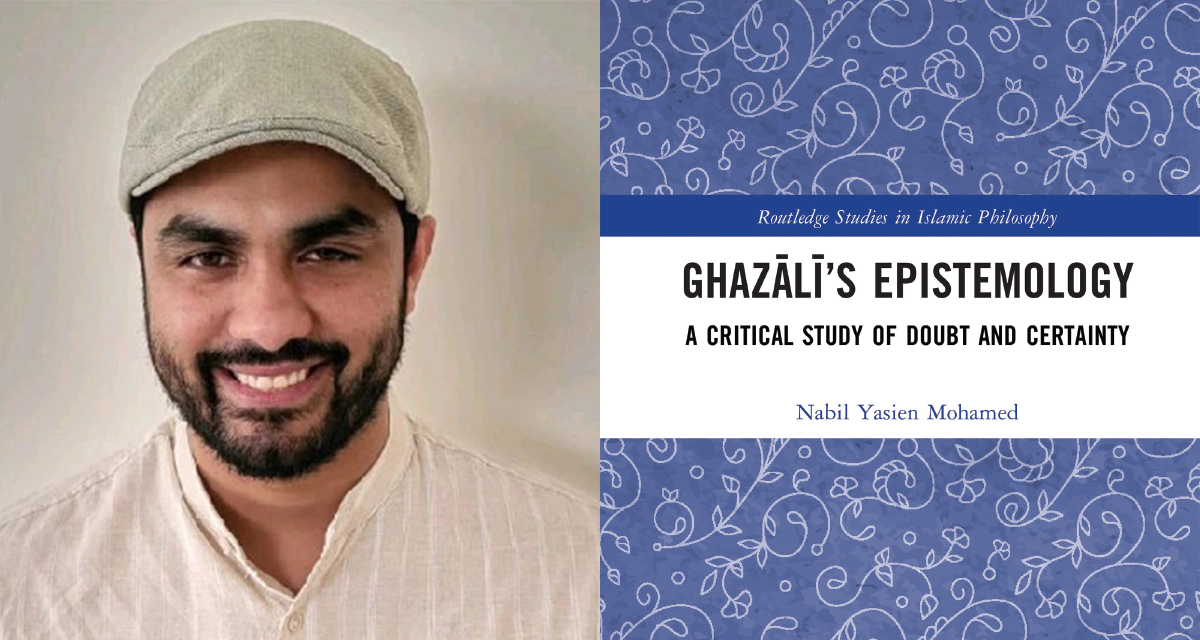

Nabil Yasien Mohamed’s study of Ghazālī traces how doubt, reason, revelation and Sufi experience converge in the search for certainty, challenging the familiar view that the great Muslim thinker simply rejected philosophy for mysticism.
REVIEWED BY ABU KAROLIA
Nabil Yasien Mohamed, 2024. Ghazālī’s Epistemology: A Critical Study of Doubt and Certainty. Routledge, Taylor & Francis Group, London and New York
Abū Ḥāmid al-Ghazālī (d. 1111) occupies a distinctive position in Islamic intellectual history. In Ghazālī’s Epistemology: A Critical Study of Doubt and Certainty, Nabil Yasien Mohamed – lecturer in Islamic Studies in the Department of Religion and Theology at the University of the Western Cape – examines a question in Ghazālī’s intellectual project: how can certainty be attained?
Mohamed explores Ghazālī’s scepticism, treatment of reason and religious authority, engagement with philosophy, and account of certainty within Sufism. Rather than presenting these as separate stages, Mohamed connects them through Ghazālī’s search for secure knowledge.
Doubt and the foundations of knowledge
Mohamed begins with Ghazālī’s intellectual crisis and his questioning of the foundations of knowledge. Ghazālī examines sense perception, rational judgement and inherited belief, asking whether they can provide genuine certainty. His treatment of taqlīd, or uncritical imitation, is central: he questions beliefs accepted through inheritance without rejecting religious tradition or authority. At the foundation of this inquiry is God as the ultimate source of truth and knowledge.
For Mohamed, Ghazālī’s doubt is methodological, not a permanent sceptical position. Doubt tests the foundations of knowledge and becomes part of Ghazālī’s search for certainty. His recovery from doubt is therefore crucial. Certainty is not restored through another chain of rational proofs, but through a Divine Light, or nūr, that illuminates the soul and restores confidence in foundational truths.
You may also want to read





Mohamed shows that, although sense perception and reason are genuine faculties of knowing, certainty cannot ultimately depend on autonomous human reason or an endless chain of proofs. Reason remains important, but human knowing is ultimately grounded in God and made possible through divine illumination. Ghazālī’s scepticism therefore becomes a means of reconstruction: he moves from inherited belief, through critical examination, towards certainty grounded in God and illuminated by the Divine Light.
Reason, the Bāṭinites, and religious authority
Mohamed’s discussion of the Bāṭinites is significant because it places certainty at the intersection of reason and religious authority. Their doctrine of authoritative instruction, known as taʿlīm, locates certainty in the guidance of an Imam whose instruction provides the interpretation of religious truth.
Ghazālī examines whether the claim to infallible authority can itself be rationally established, rather than simply replacing the Imam with autonomous reason. Reason remains necessary for examining claims and recognising the validity of revelation, but it does not become an unrestricted source of knowledge.
Ghazālī’s treatment of taʾwīl, or interpretation, further illustrates this relationship. Where an apparent meaning of revelation appears to conflict with an established rational principle, interpretation may be required. This does not make reason superior to revelation. Rather, Ghazālī seeks to reconcile apparent meanings with established knowledge while preserving the authority of revelation. Mohamed’s analysis demonstrates that Ghazālī’s epistemology is concerned with establishing the proper authority and limits of different modes of knowing.
Philosophy and the limits of reason
Mohamed’s treatment of Ghazālī’s engagement with philosophy is a contribution. The Tahāfut al-Falāsifa (The Incoherence of the Philosophers) is often presented as evidence that Ghazālī rejected philosophy. Ghazālī mastered logic and philosophical argument and employed rational methods in his works. His criticism was directed not at rational inquiry itself but at philosophical claims that, in his view, exceeded what demonstration could establish.
His concern was whether philosophers, especially Ibn Sīnā and the Avicennian tradition, had actually demonstrated the metaphysical conclusions they presented as certain. His critique therefore targets the limits of philosophical demonstration rather than rational inquiry itself.
Ghazālī’s criticism of philosophy is consequently epistemological as well as theological. He asks what human reason can demonstrate and where claims to certainty must give way to other sources of knowledge. Mohamed presents the Tahāfut as a critical examination of the scope and limits of demonstrative reasoning.
Revelation and human knowledge
Mohamed presents revelation as central to Ghazālī’s epistemology because some realities cannot be established through philosophical demonstration. Reason can establish certain truths and recognise the rational possibility of matters affirmed by revelation, but it cannot provide certainty about every metaphysical or religious reality.
Ghazālī does not simply abandon reason in favour of revelation. Reason establishes what it can, recognises its own limits, and thereby points beyond itself to forms of knowledge grounded in revelation and prophetic authority. Revelation then provides knowledge concerning realities that exceed the reach of reason.
Mohamed consequently presents a more integrated relationship between the rational and the revealed than the opposition between “reason” and “faith”.
Sufism and experiential certainty
The Sufi dimension is central to Mohamed’s study. Ghazālī distinguishes between intellectual knowledge and the direct realisation of truth. This is expressed through dhawq, or spiritual “tasting”, through which knowledge becomes more than conceptual understanding.
Mohamed’s analysis challenges any reading in which philosophy represents the highest route to certainty and Sufism a secondary development. While Ghazālī recognises the role of philosophical reasoning, Mohamed emphasises the importance of Sufi knowledge, unveiling, and spiritual realisation in completing the search for certainty. Sufism therefore represents not an abandonment of rational inquiry but a form of knowledge that reaches dimensions unavailable to demonstration alone.
Mohamed considers different levels of certainty, including ʿilm al-yaqīn, or knowledge of certainty, ʿayn al-yaqīn, or eye of certainty, and ḥaqq al-yaqīn, or truth of certainty.
Spiritual knowledge emerges through religious and ethical praxis, purification, and disciplined practice. Mohamed situates mystical cognition and unveiling within Ghazālī’s framework of revelation and spiritual discipline, showing why Sufism is central rather than peripheral to his epistemological project.
Critical assessment
The strength of Mohamed’s study is its refusal to reduce Ghazālī to a single intellectual method. Rational inquiry, revelation, and experiential knowledge are treated as interconnected dimensions of the search for certainty.
The book demonstrates that Ghazālī’s criticism of philosophy was not a rejection of reason. His use of rational argument shows its importance while recognising its limits. Mohamed’s treatment of the Bāṭinites further demonstrates Ghazālī’s concern with the grounds on which authority can claim certainty.
By connecting scepticism, philosophical criticism, religious authority, revelation, and Sufi experience, Mohamed avoids treating Ghazālī’s intellectual development as a series of disconnected stages. This approach is one of the book’s strengths and helps explain why certainty in Ghazālī cannot be reduced to a single method of knowing.
Conclusion
Mohamed’s Ghazālī’s Epistemology: A Critical Study of Doubt and Certainty provides a compelling account of Ghazālī’s search for certainty. Its contribution is to move beyond the familiar portrayal of Ghazālī as an opponent of philosophy who subsequently turned to Sufism.
Ghazālī subjects inherited belief and claims to authority to scrutiny, tests philosophical demonstration, and gives revelation and mystical cognition a central place in the attainment of certainty. The result is an epistemology in which reason remains indispensable but limited, while revelation and spiritual praxis extend knowledge beyond philosophical demonstration.
Mohamed’s study consequently presents Ghazālī not as abandoning reason, but as defining its proper place within a broader account of human knowledge. Its interdisciplinary character makes it valuable to students and scholars of Islamic philosophy, theology, Sufism, and intellectual history. It is suited to postgraduate study and brings together dimensions of Ghazālī’s thought too often treated separately in understanding his enduring search for certainty.
Abu Karolia holds an MA from the University of Johannesburg and is a researcher with interests in Islamic intellectual history and contemporary Muslim thought. He has been involved in community activism, civic engagement and faith-based organising for many years. He is a founder member of the Movement for a United South Africa (MUSA).