





![Does ta’wīl mean interpretation or fulfilment? A Quranic reassessment [+video]](https://muslimviews.co.za/wp-content/uploads/2026/10/Tawil-Kaskas-360x180.webp)






![Why becoming a wealthy Muslim is commendable in Islam [+videos]](https://muslimviews.co.za/wp-content/uploads/2026/09/Muslim-Trade-Business-1-360x180.webp)




‘Service to Allah is not escape from the world. It is not hiding from suffering while polishing private spirituality. Service to Allah is to live the original covenant in public and private life.’
By QIBLA ECONOMIC POLICY UNIT
‘Am I not your Lord?’ (Q 7:172)
Before we had names, passports, sects, races, classes, careers, followers or fears — we answered Him.
‘Indeed. We bear witness.’
That was the first covenant. The original undertaking. The deepest truth about what it means to be human. Every one of us carries the echo of that moment somewhere inside us. Buried beneath ego, distraction, nationalism, consumption and fear — the soul still remembers.
And Allah tells us why we were created:
‘I did not create jinn and mankind except to serve Me.’ (Q 51:56)
Service to Allah is not escape from the world. It is not hiding from suffering while polishing private spirituality. Service to Allah is to live the original covenant in public and private life. It is to carry Alastu into the streets of history. It is to make remembrance breathe inside institutions, politics, economics, neighbourhoods and movements.
Taqwa is our fragile attempt to do that.
Taqwa is not perfection. It is not spiritual branding. It is not religious performance. It is not merely mastering sacred vocabulary or memorising the opinions of scholars who lived centuries ago.
Taqwa is the trembling effort of cracked vessels trying to honour an ancient promise.
It is living as though Allah is present because He is.
‘Wherever you turn, there is the Face of Allah.’ (Q 2:115)
The muttaqi person is not someone floating above the world untouched by pain. The muttaqi person is the one whose heart has become too alive to ignore the cries of creation. One cannot claim awareness of Allah while remaining indifferent to widows, orphans, refugees, workers, the homeless, the hungry, the violated and the crushed.
The Quran does not separate taqwa from justice.
‘Be just. That is closest to taqwa.’ (Q 5:8)
Justice is not secondary to spirituality. Justice is spirituality walking in public.
And the Quran tells us that the most honoured among us are those with the most taqwa. (Q 49:13) Not the wealthiest. Not the loudest. Not the most followed. Not the most powerful.
The most God-conscious.
But what does God-consciousness look like in an age of genocide?
What does taqwa mean while Gaza burns?
What does remembrance mean when children are pulled from rubble while the world debates their humanity?
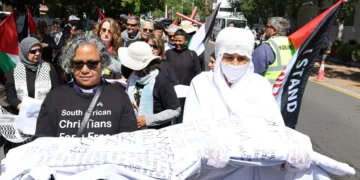
What does it mean to prepare for Hajj, attend an Ijtima’, sit in a Sufi conference, or complete another retreat while the Nakba stretches across generations like an open wound?
These questions must haunt us.
Not because prayer, dhikr, tawbah and purification are unimportant. They are essential. But the Prophets never stopped at private transformation. They built communities. They challenged tyrants. They defended the weak. They organised people. They created moral movements in history.
The Prophets called people to taqwa — and then built institutions to protect human dignity.
Private taqwa without social responsibility eventually collapses into selfishness.
The Quran links inner transformation to social transformation. Allah speaks of taqwa, justice and human responsibility together (applying the might of iron/weapons) because human beings were never meant to carry faith alone and in isolation. (Q 57:25)
Our micro-transformation must become macro-transformation.
Our tawbah must become social repair.
Our niyyah must become collective struggle.
Our muhasabah must become institutional accountability.
The Sahaba paid a price for faith. They sacrificed comfort, wealth, status and safety to build a different world. Why do we think we can inherit their legacy without sacrifice?
Today we live in societies built on class arrogance, patriarchy, racism, war economies and spiritual emptiness. We have inherited systems that teach us to normalise inequality and consume endlessly while others drown in oceans and starve behind walls.
And still the question is not: ‘Where is Allah?’
The question is: Where is man?
Where are the human beings who still feel enough to act?
Where are the people who refuse to worship comfort while the world burns?
Where are the people who understand that taqwa is not retreat from the world but deeper entry into it with moral courage?
To be muttaqi is to allow Allah’s Presence to make you restless in the face of injustice.
It is to be unable to sleep peacefully while others are denied peace.
It is to carry Gaza into your prayers and your politics.
It is to carry Sudan into your ethics.
It is to carry the poor into your economics.
It is to carry the refugee into your understanding of borders.
It is to carry the broken into your understanding of God.
Taqwa is not learned merely in classrooms. Allah teaches it through life, struggle, heartbreak and responsibility.
‘And be conscious of Allah, and Allah teaches you.’ (Q 2:282)
He teaches those who show up.
Those who organise.
Those who feed.
Those who march.
Those who build.
Those who protect.
Those who refuse silence.
Those who refuse despair.
Those who refuse to let evil become normal.
This is why taqwa cannot remain private.
We need movements. Organisations. Institutions. Community structures. Schools. Clinics. Campaigns. Accountability networks. Social solidarity. Ethical economies. Public courage.
We need people willing to do the hard work of democracy, justice and collective care because they know Allah sees them wherever they are.
Real taqwa makes people braver, not quieter.
It makes people more compassionate, not more self-obsessed.
It makes people more accountable, not more arrogant.
And perhaps this is what it means to answer the original covenant in our time.
Not simply by saying ‘Allah is my Lord’ with our tongues.
But by building a world that reflects what it means for Allah to be Lord.
A world where dignity matters.
Where justice matters.
Where truth matters.
Where the vulnerable matter.
Where human beings refuse to become spectators to cruelty.
We are fragile people.
We are flawed people.
We are cracked vessels.
But perhaps Allah does not ask for perfection.
Perhaps He asks for witness.
Perhaps He asks whether we will still honour the promise we made before history began.
‘Am I not your Lord?’
The question still echoes.
You may also want to read


And our lives are our answer.
Issued by: Qibla Economic Policy Unit – Contacts: Aziz Kader +27 82 453 2716; Yusuf Patel +27 60 190 7439; Khalid Khan +27 84 900 6655; Reederwaan Craayenstein 0738 090 3464