

























![The market-builder who restrained the market [Part 2]](https://muslimviews.co.za/wp-content/uploads/2026/08/PHOTO-2026-08-25-17-16-32-360x180.jpg)
![The merchant preceding the Prophetic mission [Part 1]](https://muslimviews.co.za/wp-content/uploads/2026/08/01-360x180.jpg)








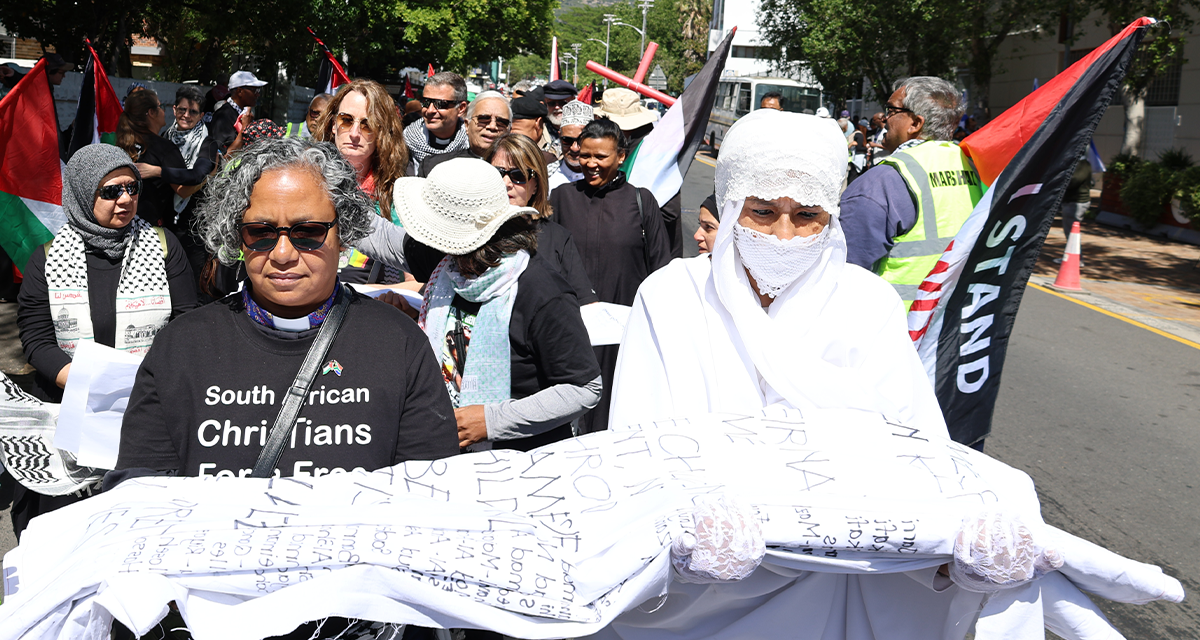

Three years after October 7, Cape Town’s interfaith vigil carried shrouds bearing the names of Palestinian children killed by Israel in Gaza through the city to Archbishop Desmond Tutu’s resting place, renewing a weekly call for justice and witness.
By ANWAR OMAR
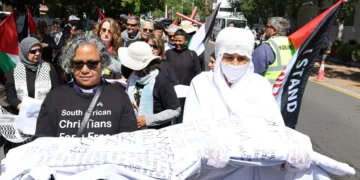
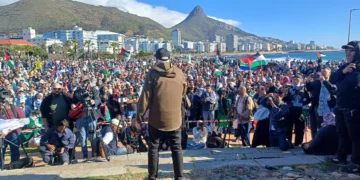
On Wednesday, October 7, an interfaith procession carried 20-metre shrouds bearing the names of the Palestinian children killed by Israel in Gaza through Cape Town to Archbishop Desmond Tutu’s resting place, on what would have been his 95th birthday.
Unveiling the shroud outside the Cape Town Holocaust & Genocide Centre
At 10 o’clock on Wednesday morning, about 1 000 participants gathered outside the Cape Town Holocaust & Genocide Centre on Hatfield Street. They unrolled the first of two shrouds, bearing the names of children under five, and everyone there held it open in silence for an hour.
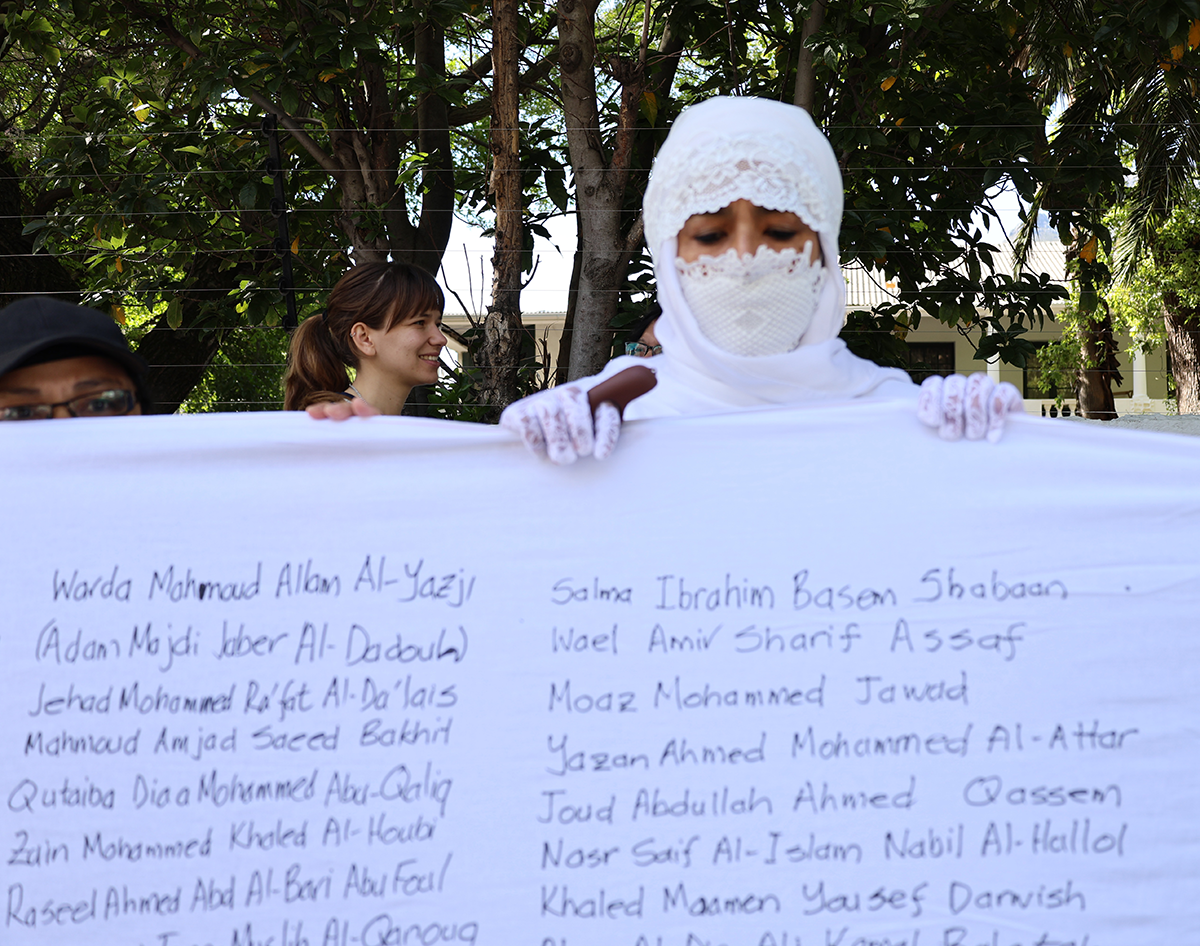
Imam Dr A Rashied Omar of the Claremont Main Road Masjid opened with a prayer. “As we stand outside this Holocaust museum, we affirm our shared humanity,” he said. “Every child is sacred. A Jewish child, a Palestinian child, a child is sacred. Our opposition to injustice is not hostility towards a certain people or a certain faith.”
The day marked three years since the start of a full-blown genocide in Gaza. The starting point was deliberate. The Centre exists to remember genocide, but it has not spoken about Gaza. It is not the first time protesters have gathered at its door for exactly that reason.
More than 22 000 children killed in Gaza
The shrouds carry the handwritten names of children killed in Gaza, grouped by age. The first holds the names of all the children under five; the second, children up to seven. Between them, the two shrouds carry about 3 000 names. A third, for children up to 13, is being written now. The organisers intend to keep writing, shroud after shroud, until all the more than 22 000 children killed have been named. The custom behind them began in Gaza itself: as the bombing went on, parents wrote their children’s names on their bodies.
“They did it so that, if their homes were bombed and the children could not be recognised, their names would still be known,” says Father Peter-John Pearson, who proposed the Cape Town shrouds. “Their identity and dignity would be preserved, as a final statement of resistance to their slaughter.”
The idea began in the United States with Priests Against Genocide, whose shroud was carried from a church in Philadelphia to the United Nations in September. Watching it, Pearson saw a role for Cape Town.
“It would be a wonderful gesture for us, who know the brutality of oppression, to stand in solidarity, to memorialise, to remember and to resist erasure here too,” he says.
The names were written in ceremonies at the Claremont Main Road Masjid, the Central Methodist Church in Greenmarket Square and the Homecoming Centre in District Six.
“That has ensured that it is a full cry from all of humanity, across our historical divisions,” Pearson says.
Carrying the shrouds through the city
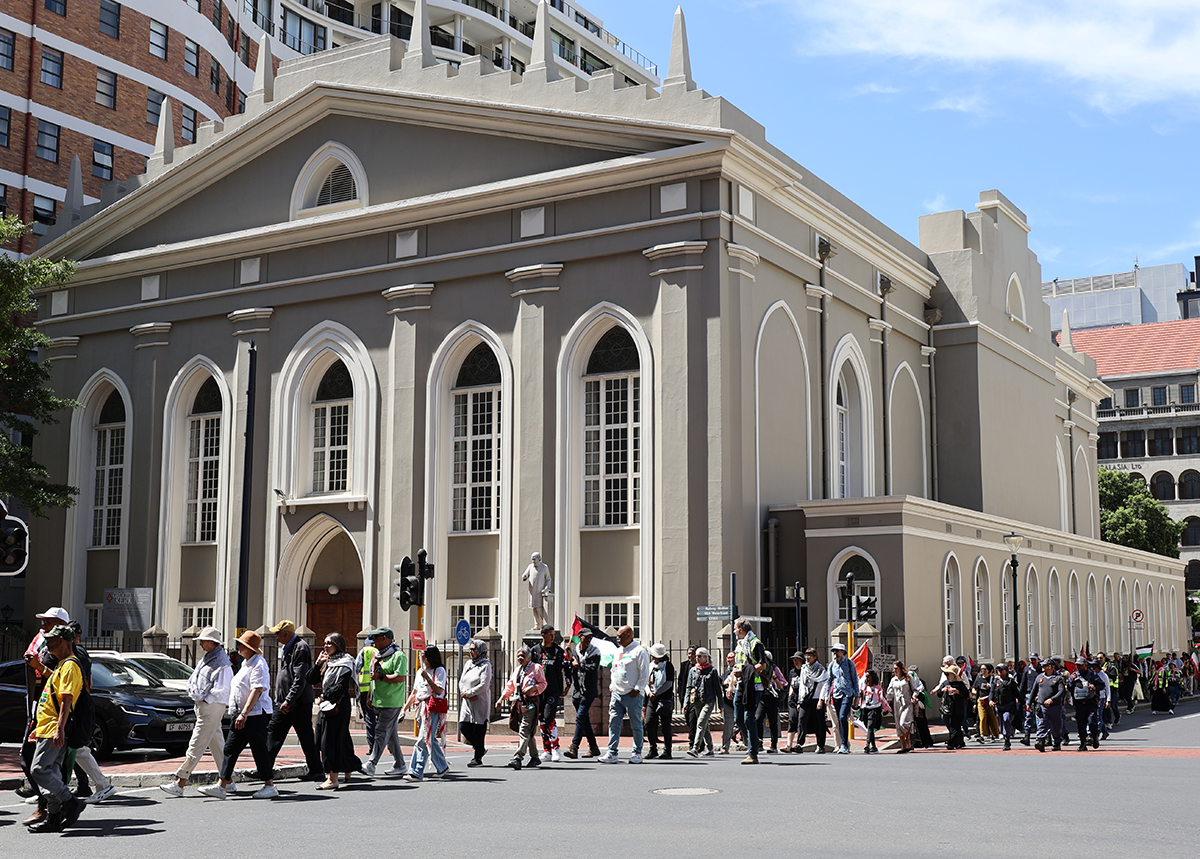
Just after 11am, the procession moved off on foot. The shrouds, rolled up, were carried from venue to venue by two to four participants, with different people taking them up at each stop.
The first stop was the Cathedral of St Mary, where Megan Krowitz read a poem entitled “I Cannot Tell the Difference”.
At the Groote Kerk, the oldest church in South Africa, the procession stopped again, and Dominee Rian de Villiers addressed the gathering.
“We reject the killing of children by anyone, for any reason,” he said. “We reject any theology or any ideology that blesses this violence, and any silence that continues to permit it.”
He called for the Palestinian people to be “free from occupation, free from oppression, and free from apartheid, so that their children may grow up as equals in the land of their birth.”
At the Central Methodist Church on Greenmarket Square, the shroud came back to the place where some of the names were first written, and Reverend Sikawu Makubalo addressed the gathering.
“We stand as South Africans, knowing exactly what Ubuntu means,” he said. “We belong to one another. No river can divide us. No sea can divide us. No mountain can divide us.”
Three years on the steps
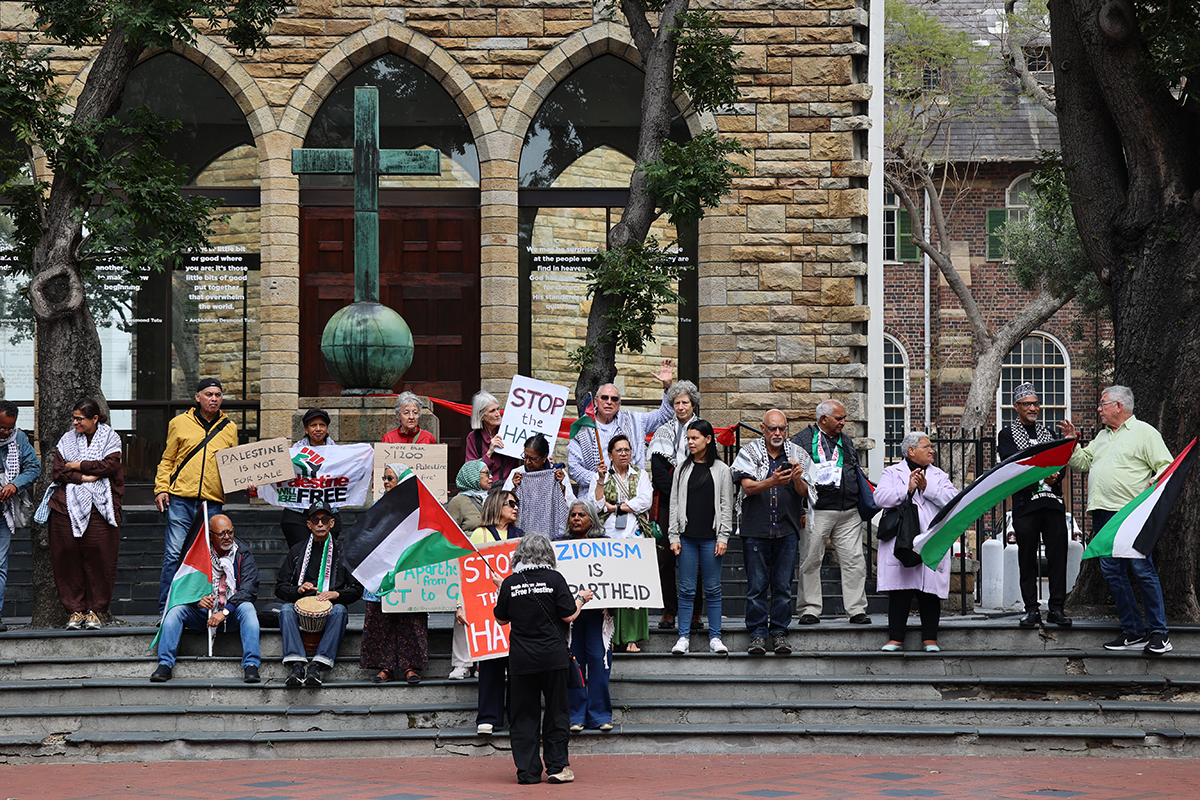
The procession grew out of a vigil that has met every Wednesday since October 11, 2023. It began with the church. Two weeks earlier, the Provincial Standing Committee of the Anglican Church of Southern Africa had declared Israel an apartheid state. On October 10, Bishop Joshua Louw of the Diocese of Table Bay invited his parishes to join the bishops and Archbishop Thabo Makgoba in a silent vigil on the steps of St George’s, then led by Dean Michael Weeder.
The letter asked for four to five Wednesdays.
“We expected a short period of witness, a few weeks of bells and silence, after which we hoped the fighting would stop and the vigil would end,” Weeder recalls.
The vigil has not missed a Wednesday since, not on Christmas Day, nor through the Cape winter rains. Its participants believe it is the only interfaith vigil in the world to have gathered every week since the start of the genocide. Christian clergy and laity stand beside Muslim activists, members of South African Jews for a Free Palestine and people of no faith.
Dr Gonda Perez, one of the day’s organisers, is among the regulars. “Our presence on the steps tells the world that we will not allow them to simply look the other way,” she says.
Noon at the Arch’s resting place
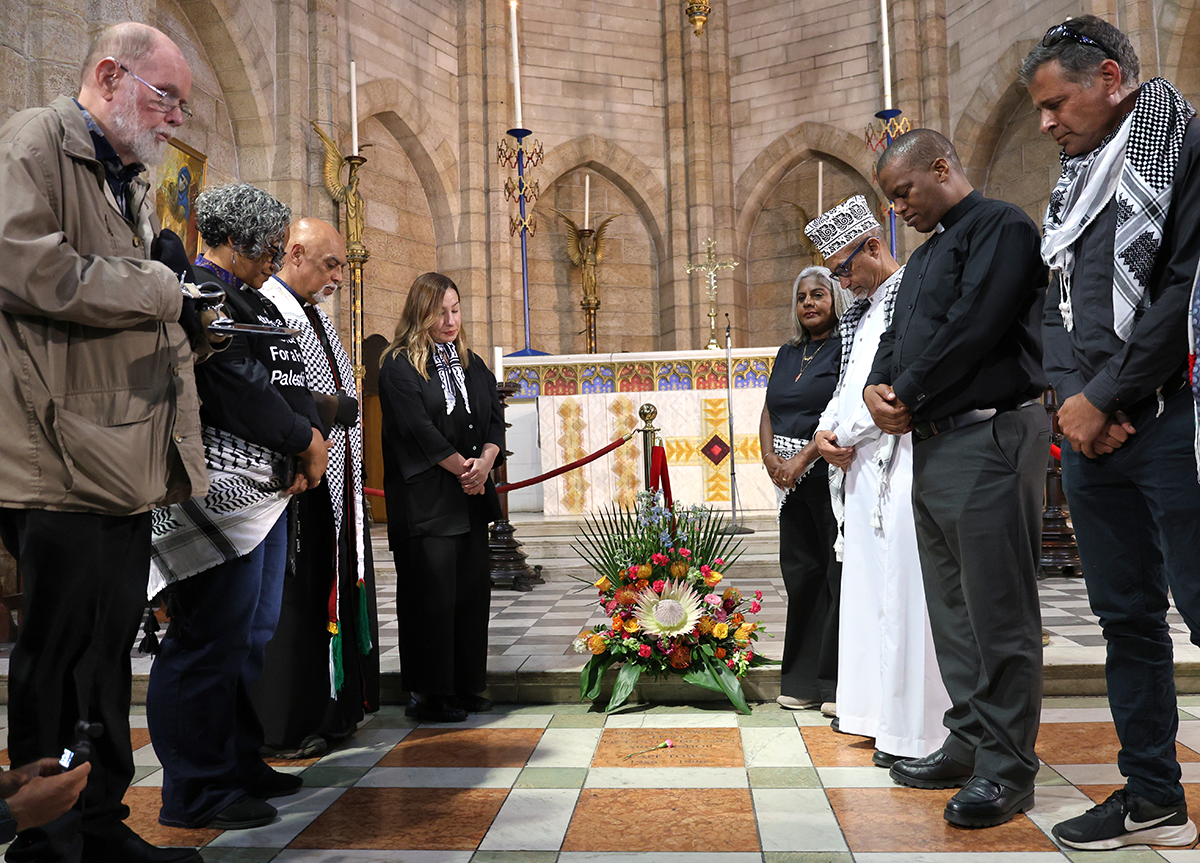
At noon, the hour of the Angelus, the midday prayer Tutu kept, the procession entered St George’s Cathedral. Before the high altar, where the Archbishop’s ashes rest, participants prayed.
Father Pearson gave an address inside the Cathedral. He again referred to the parents of Gaza who marked their children’s legs with their names “so that if they were blown to pieces, they would have some part of their child that was named.”
“Must we sink to that level of absolute barbarity where a parent has to write the child’s name so that they can be recognised?” he asked. “I think history will not only look at the perpetrators, but history will look at those who are complacent, those whose silence has given the powerful the space to act. And history will condemn us.”
Professor Sa’diyya Shaikh of University of Cape Town then recited the Fatiha, the opening surah of the Quran, which Muslims customarily read for the deceased. She offered it in Arabic for the soul of Desmond Tutu and for the more than 20 000 children killed in Gaza.
The prayers reached beyond Gaza: for all who died on October 7, 2023 and the families of the women found dead in Ekurhuleni since July, and for the women and children of Sudan and Ukraine.
Archbishop Desmond Tutu walked this road before. In 2008 he reached Gaza through Egypt to lead a UN mission into the killing of 19 civilians in Beit Hanoun, and told its people: “you will be free”.
On what would have been his birthday, the ceremony ended with a wreath laid at the Archbishop’s grave before the high altar.
Back on the Freedom Steps
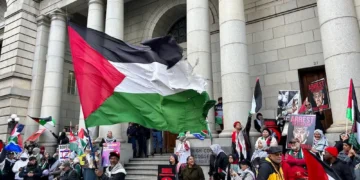
At 12:30 the gathering returned to the Freedom Steps, where the vigil has met every week since the start of the genocide, and the shroud was unrolled once more.

Michael Weeder, the Cathedral’s former Dean, explained why clergy had come. The horror unfolding each day, he said, is happening in the land Christians call holy, where the church was founded at Pentecost. To stand aloof from what is happening where their faith began would be immoral, he said.
“It will be a theological and doctrinal miscalculation of what humanity is all about.”
You may also want to read


Response by the vigilers
St George’s was a refuge long before the vigil. Perez was 15 or 16 when she first protested on its steps.
“We grew up knowing that if we were chased by the police, we could find refuge within the church,” she says.
Jimi Matthews, a veteran anti-apartheid activist and journalist, remembers the 1970s and 1980s, when police chased protesting students into the Cathedral itself.
For both, Palestine is a debt.
“Palestine is South Africa’s fight,” Perez says. “We would not be where we are today without the international solidarity we were shown.”
She studied alongside Palestinians in Algeria.
“We knew apartheid, so it is easy for us to identify it in Palestine. We knew forced removals, and we can see how brutally Palestinians are removed from their homes.”
“During the darkest days of apartheid, the Palestinians were in the forefront of offering us solidarity,” Matthews says. “Many of our combatants were trained by the PLO.”
Nelson Mandela said as much in 1997: “We know too well that our freedom is incomplete without the freedom of the Palestinians.”
“Now, in their greatest hour of need,” Matthews says, “we have an opportunity to repay that debt.”
“For as long as Palestinians are denied justice, dignity and freedom, we will continue to gather,” says Imam Omar.
For Matthews, each Wednesday “strengthens my resolve to persist in showing my opposition to the Zionist entity and to all its supporters in Israel as well as those in South Africa. Archbishop Tutu taught us that we cannot remain silent, or look away, when such serious crimes are being carried out right in front of our eyes.”
Every Wednesday, Perez says, the vigil tells the world to look at what is happening in Palestine.
“We will not look away.”