











![Does ta’wīl mean interpretation or fulfilment? A Quranic reassessment [+video]](https://muslimviews.co.za/wp-content/uploads/2026/10/Tawil-Kaskas-360x180.webp)


















![Why becoming a wealthy Muslim is commendable in Islam [+videos]](https://muslimviews.co.za/wp-content/uploads/2026/09/Muslim-Trade-Business-1-360x180.webp)









These legal measures not only impose severe restrictions on women but also reveal a troubling misconception about men and their roles in society. These laws are founded on the belief that Afghan men are incapable of self-control or respect around women.
By MOEGAMMAD TAHIER KARA
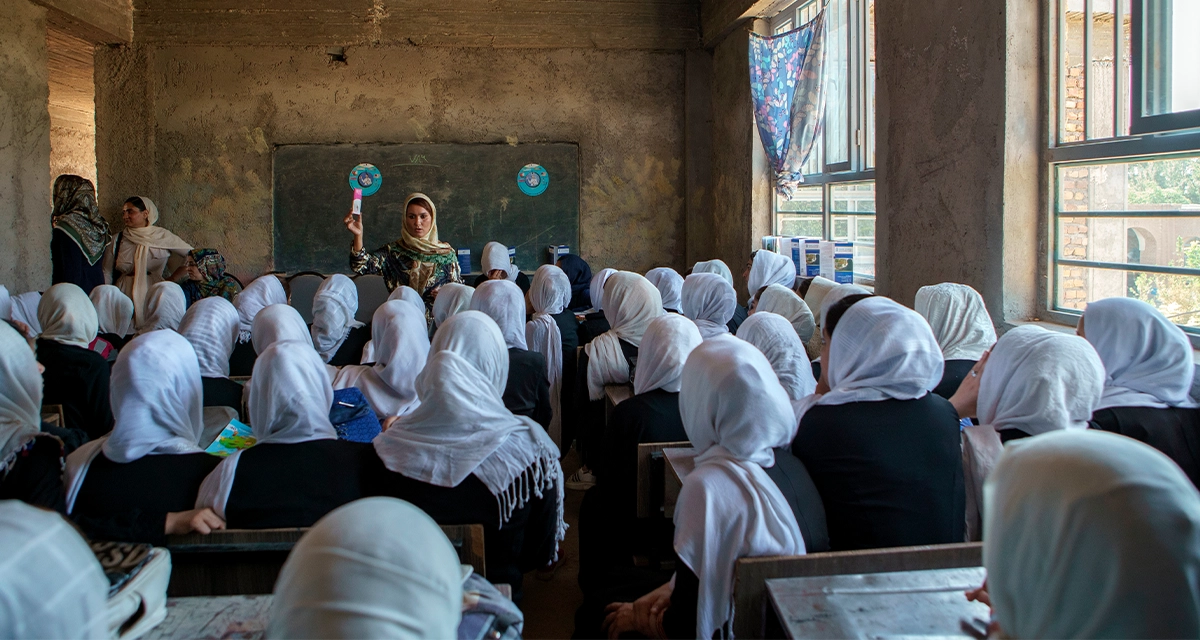
The Taliban’s recent laws impose extreme restrictions on women, including mandatory full-body coverings, severe limitations on public presence and education and barriers to employment and healthcare. These measures reflect a deeply controlling and regressive view of gender roles, significantly curtailing women’s rights and freedoms.
These legal measures not only impose severe restrictions on women but also reveal a troubling misconception about men and their roles in society. These laws are founded on the belief that Afghan men are incapable of self-control or respect around women, suggesting that men are driven solely by instinct rather than reason or virtue.
This distorted view reflects the Taliban’s own perspective more than it does the reality of Afghan society. By reducing men to individuals who require external controls to behave morally, the regime fails to recognise the inherent dignity, respect, and integrity within individuals.
Just as the Taliban’s treatment of women is unjust, their perception of men as inherently weak or lacking in virtue is equally damaging. This warped portrayal diminishes both genders, confining them to simplistic roles that do not align with the more nuanced and respectful vision of human relations found in broader Islamic and Afghan cultural values.
Adopted last month, the Taliban’s new laws have provoked widespread international condemnation, especially from human rights organisations. Among the most draconian of these measures is the mandatory burka, which now requires women to cover their entire face and body with thick, concealing material.
The official justification for this severe imposition is to prevent ‘temptation’ for men, implying that men are incapable of controlling their impulses when confronted with a woman’s appearance, and shifting the responsibility entirely onto women to shield men from their own lack of self-restraint.
This reasoning not only places an unfair and disproportionate burden on women but also sends a deeply flawed message about men’s ability to act with integrity and self-discipline. It portrays men as inherently weak and ruled by uncontrollable desires, necessitating strict external measures to regulate their behaviour. In doing so, the Taliban’s laws reinforce a harmful and reductive narrative that denies both men and women their full humanity. Women are reduced to objects that must be hidden, while men are depicted as creatures governed solely by instinct, unable to engage with women respectfully and equally.
This skewed portrayal of gender dynamics reflects the Taliban’s broader authoritarian mindset, which seeks to control through fear and repression, rather than recognising the potential for mutual respect and dignity in human relationships.
The Taliban’s restrictions on women extend beyond mere attire, severely infringing on their participation in public life. Women are prohibited from speaking in public spaces, with the rationale that a woman’s voice is a source of temptation. This extreme measure effectively erases women from the public sphere.
Furthermore, women are forbidden from making eye contact with men who are not their husbands or blood relatives, reflecting an obsessive and controlling gender ideology. It is also important to note that the Taliban’s interpretation includes a woman’s voice as part of her awrah (the parts of the body that must be covered), further illustrating their restrictive and distorted views on gender and modesty, which diverge from Shariah principles.
You may also want to read





The Taliban’s new laws not only oppress women but also reflect a deeply flawed view of men. By enforcing measures like the mandatory burka – requiring women to fully conceal themselves to prevent ‘temptation’ – the Taliban imply that men are incapable of controlling their desires around women.
This view, which reduces men to beings governed by base instincts, is further reinforced by their requirement that men maintain a beard at least three fingers long, as if masculinity is defined by appearance alone. Such beliefs distort Islamic teachings, where no rigid enforcement of beard length existed, nor was moral worth tied to physical traits.
By promoting these superficial standards for both men and women, the Taliban undermine the dignity of both, serving their agenda of control while ignoring the deeper, more nuanced values of character and respect found in Islam and Afghan culture.
The Taliban’s insistence on enforcing such rules reflects a broader misinterpretation of the Sunnah and an oversimplified view of gender roles, where both men and women are judged by external characteristics rather than the quality of their character. True masculinity – or, indeed, the measure of any person – cannot be reduced to superficial traits.
The virtues that define a person in Islam, and in life, such as compassion, integrity and justice, go far beyond physical appearance. To equate the length of a beard with a man’s worth is a deeply flawed interpretation that diminishes the richness of what it means to be a virtuous and morally upright individual.
The Taliban’s regression to the rigid controls of their 1990s regime isolates Afghanistan once again. Rather than reflecting the true values of Afghan society or the teachings of Islam, these laws reveal the Taliban’s insecurities and authoritarian mindset.
By casting women as temptations to be hidden and men as beings driven by brute instinct, the regime imposes a deeply flawed view of humanity. Islam teaches mutual respect, dignity, and moral accountability for both men and women, but the Taliban’s misrepresentation of gender roles diminishes women’s autonomy and reduces men to mere symbols of physical strength and appearance.
This narrow, patriarchal vision distorts the rich, multifaceted ways in which both genders are meant to contribute to society. By enforcing control through such a simplistic and oppressive lens, the Taliban project their own internal fears and insecurities onto the population, disregarding the true depth and potential of human dignity and character as emphasised in Islam.
- by Moegammad Tahier Kara is a Master’s Student in Sociology of Education, Stellenbosch University.