





























![The market-builder who restrained the market [Part 2]](https://muslimviews.co.za/wp-content/uploads/2026/08/PHOTO-2026-08-25-17-16-32-360x180.jpg)
![The merchant preceding the Prophetic mission [Part 1]](https://muslimviews.co.za/wp-content/uploads/2026/08/01-360x180.jpg)








By ADEEL AHMED
For Muslim families navigating home loans, credit cards and rising costs, riba can seem unavoidable. Adeel Ahmed examines the Quran’s clear prohibition, explains scholarly interpretation and offers practical steps towards real change.
In many Muslim homes in Cape Town, Durban and Johannesburg, the conversation about riba never happens. The bond on the house, the credit card in the wallet, the short-term loan taken in a tight month — these are treated as facts of modern life, not religious questions. When the topic does come up, it is usually settled with a shrug: “Everyone does it… There is no real alternative… The scholars themselves disagree on the details.”
That silence is the problem. Because the Quran doesn’t treat riba as a minor technicality. It treats it as one of the most serious moral issues in economic life. And the reason is far more practical — and far more compassionate — than most Muslims have ever been told.
Why Riba Became Invisible
Riba didn’t become normal because Muslims stopped caring. It became normal for four quiet reasons.
It feels abstract
Nobody sees riba. It arrives as a line on a bank statement, a percentage buried in a contract. Unlike theft or dishonesty, it never looks like a sin. It looks like paperwork.
The halal option looks harder
Islamic banking products in South Africa exist, but they are less advertised, sometimes pricier, and often poorly explained. When the conventional bond is approved in days and the alternative requires weeks of questions, most families take the path of least resistance.
Disagreement became an excuse
There are genuine scholarly debates about the details of modern finance. But “the scholars disagree on the details” has quietly become a licence to ignore what they agree on: that stipulated interest on a loan is riba, and riba is prohibited. Full stop.
Desperation
Some families genuinely feel trapped — a bond taken years ago, a business kept alive by an overdraft. Judging them helps no one. What helps is understanding why the prohibition exists, because that understanding is what finally motivates change.
What the Quran actually says
A quick note before we go further, because precision matters here. Below I separate two things: what the Quran states explicitly, and what scholars have understood from those statements. Both matter. They aren’t the same.
Trade is NOT like riba. In Sura Al-Baqarah (2:275), the Quran quotes the objectors: they claimed trade and interest are the same thing, since both produce profit. The Quran rejects the comparison. That is the explicit text.
What do scholars draw from it? That the difference lies in the nature of the transaction. In trade — a sale, a lease, a service — real value changes hands: goods, effort, benefit. In riba, money itself is rented out at a guaranteed price, and the return doesn’t depend on anything real happening in the world. One caution, though, and it matters: this doesn’t mean every permissible transaction must involve shared risk. Islamic law permits fixed-profit sales (murabaha) and leasing (ijara) — the buyer knows the price, the lessor knows the rent, and nobody shares anyone’s business risk. The line the Quran draws isn’t “risk versus no risk.” It is trade versus interest on a loan.
Why the warning is so severe
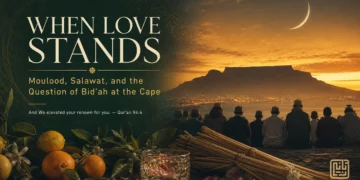
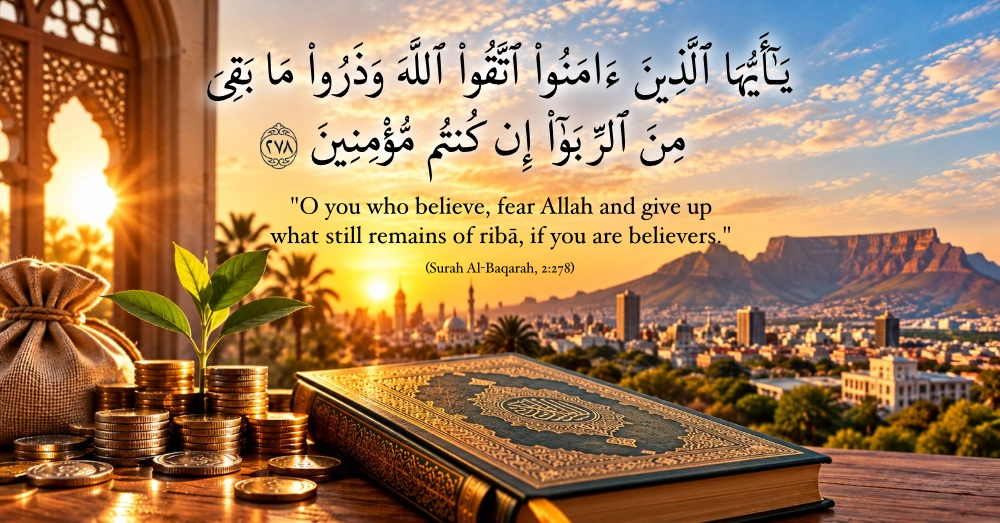
(Sura Al-Baqarah, 2:278-279) carries the strongest language in the Quran on any financial matter — those who persist are told to expect “war from Allah and His Messenger.” That is the text, and it isn’t ambiguous.
Why such severity? Here we move into scholarly understanding, and scholars have pointed to the social damage: interest-bearing debt systematically drains borrowers and concentrates wealth, contract by contract, across a whole economy. That is a wisdom behind the ruling — not a condition of it. And this point needs stating plainly: riba is prohibited whether the borrower is rich or poor, whether anyone can prove exploitation or not. The prohibition doesn’t wait for a victim to be identified.
The “doubled and multiplied” verse
You may also want to read


![The market-builder who restrained the market [Part 2]](https://muslimviews.co.za/wp-content/uploads/2026/08/PHOTO-2026-08-25-17-16-32-120x86.jpg)

Sura Aal-Imran (3:130) warns against consuming riba “doubled and multiplied” — a reference its first listeners would have recognised instantly: the pre-Islamic practice where a debtor who couldn’t pay on time saw his debt doubled, then doubled again. The verse names the practice of its day.
But — and this is the mainstream scholarly position, held across the schools — the prohibition isn’t limited to doubled or compounded interest. Any stipulated increase on a loan, large or small, falls under the same ruling. The verse illustrates; it doesn’t exhaust.
The alternative the Quran offers
Notice what the Quran places next to the prohibition: charity. Sura Al-Baqarah (2:276) says Allah “destroys riba and gives increase to charity.” The contrast is in the text itself. An economy can run on guaranteed extraction, or it can run on generosity and fair exchange. The Quran doesn’t ask Muslims to leave economic life. It asks them to build a fairer corner of it.
Four steps for an ordinary family
Understanding the reasoning is the beginning. Here is what acting on it looks like.
- Audit honestly
Sit down as a family and list every interest-bearing product: bonds, credit cards, personal loans, store accounts. You can’t fix what you haven’t faced. Do this without shame. It is an inventory, not a trial.
- Start with what is easiest
Credit cards and short-term debt are the low-hanging fruit. Clearing them first — and refusing new ones — is the fastest way to cut riba out of your life. Many families find this single step changes everything.
- Ask about the alternatives — properly, and locally
This is where South African readers have more options than they think. Al Baraka Bank operates as a fully Islamic bank in South Africa. FNB, Absa and Standard Bank all run Islamic finance windows offering Shariah-compliant home finance and vehicle finance. The products exist; they’re simply not marketed to you.
So go and ask — in writing. Ask your bank what a Shariah-compliant home loan would cost compared with your current bond, what the paperwork involves, and how long approval takes. Ask what happens to your existing bond if you switch. Written questions get written answers, and written answers can be compared. Demand creates supply. Every family that asks makes the next family’s path easier.
- Teach your children the “why”
Children who only hear “riba is haram” will drop the rule the day it inconveniences them. Children who understand the reasoning — that the Quran banned a system, not just a sin; that scholars extended the ban to every stipulated increase; that fair alternatives exist — carry the principle for life. Teach the verse first, then the reasoning scholars built on it. In that order.
The question worth asking
Riba survived fourteen centuries not because the case for it is strong, but because the case against it was never properly taught. The Quran made its position plain: trade is permitted, interest on loans is not, and the two aren’t the same thing. Scholars then did the careful work of applying that position — to fixed-profit sales, to modern bonds, to every new contract the market invents.
The question for every Muslim family isn’t whether the prohibition is real. It couldn’t be clearer. The question is whether we’ll finally teach our children the difference between what the Quran said and what we assumed — and then act on it. A generation that understands the distinction won’t need to be policed. It will choose differently on its own.
Adeel Ahmed is an Islamic scholar with an MPhil in Quranic exegesis (Tafseer) and the founder of [QuranlyHub], where he develops Quran-research-based solutions to the problems facing Muslim families.