








![Does ta’wīl mean interpretation or fulfilment? A Quranic reassessment [+video]](https://muslimviews.co.za/wp-content/uploads/2026/10/Tawil-Kaskas-360x180.webp)























![Why becoming a wealthy Muslim is commendable in Islam [+videos]](https://muslimviews.co.za/wp-content/uploads/2026/09/Muslim-Trade-Business-1-360x180.webp)


![The market-builder who restrained the market [Part 2]](https://muslimviews.co.za/wp-content/uploads/2026/08/PHOTO-2026-08-25-17-16-32-360x180.jpg)







By MPHUTLANE WA BOFELO
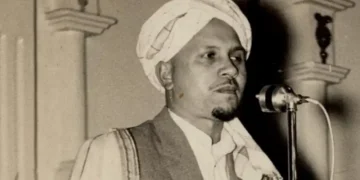
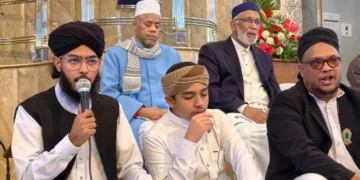
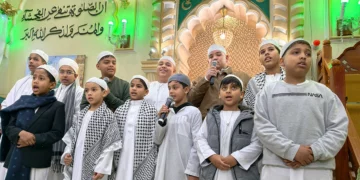
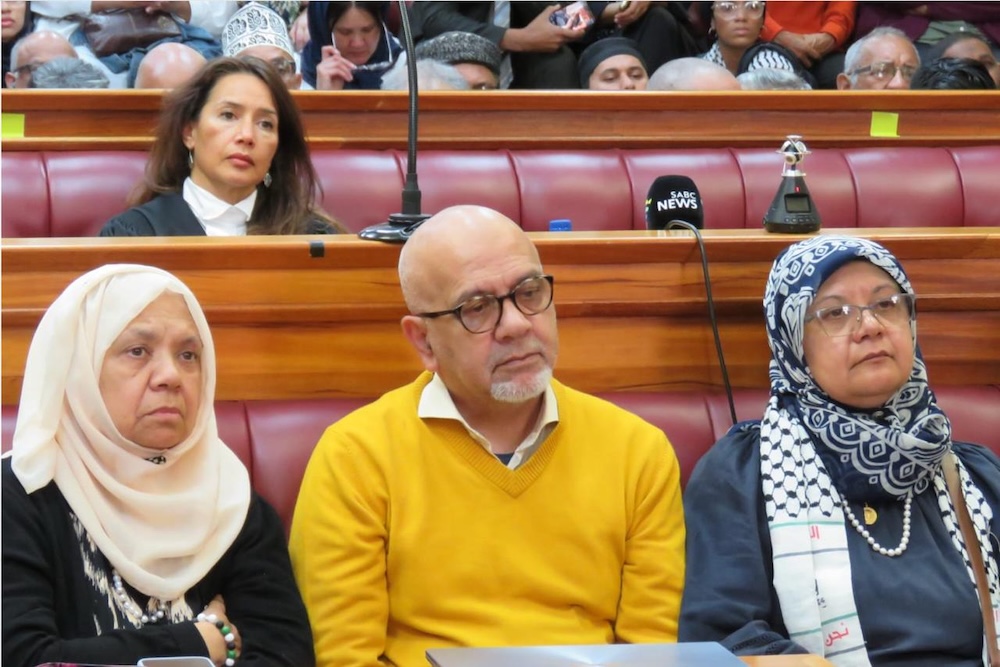
On September 26, 2026, Al-Mustafa International University – South Africa honoured Imam Abdullah Haron at a symposium on Ubuntu, religion and nation-building, a fitting tribute to a martyr in the struggle for a just and equal society.
In African cosmology, a person’s name is never merely a label. A name carries meaning, identity, reputation and, in an important sense, destiny. The Sesotho idiom expresses this profound understanding:
“Lebitso lebe ke seromo; lebitso le letle ke thoriso.”
Literally, a bad name is a bad omen, while a good name is praise, elevation and affirmation of character. A person’s name therefore becomes inseparable from the life that person lives and the social meaning that life acquires. In this spirit, Azania does not remember Imam Abdullah Haron just as a historical personality. He is remembered for the kind of human being his name represents, the kind of society his life imagined, and his example demands of us today.
His name itself offers us a remarkable vocabulary through which to understand his vocation.
Imam: leadership as guidance and responsibility
The word Imam signifies a leader, a guide – one who stands at the front, but whose leadership is not simply a position of authority.
The Imam is expected to guide society towards a higher standard of personal, social, moral, political and economic conduct.
Leadership, in this understanding, is therefore not domination. It is service.
It is the responsibility to discern the needs of one’s community, to speak to its circumstances and to accompany people in the struggle to create a more just and humane society.
This conception of leadership resonates profoundly with Ubuntu.
Ubuntu does not understand the human being as an isolated individual. I am because we are. My humanity is realised through my relationship with other human beings. My dignity is bound up with the dignity of others.
Leadership, therefore, cannot be separated from the wellbeing of the community.
The name Abdullah means the servant of Allah.
This is not merely a declaration of religious affiliation. It expresses a way of being.
To be the servant of Allah is to surrender one’s life to the will of Allah and to seek, through one’s conduct, to reflect the attributes of the Divine: mercy, compassion, justice, generosity, forgiveness and care for creation.
Servanthood consequently becomes a form of liberation from the tyranny of the ego.
The question is no longer simply:
“What can I gain?”
It becomes:
“What can I contribute?”
“Whom can I serve?”
“How can my life advance justice, dignity and human flourishing?”
Here again, we encounter Ubuntu.
Ubuntu is not merely an intellectual proposition about interconnectedness. It is a discipline of living in which the humanity of another person places an obligation upon me.
It is compassion translated into conduct.
“Haroon”: the one who helps to make the message understood
The name Haroon, associated with the Prophet Haroon, carries another important dimension.
In the Quranic account, Prophet Musa (Moses) asks Allah to appoint his brother Haroon as his helper because of his ability to communicate and articulate the message.
Haroon therefore represents the gift of speech in the service of truth: the capacity to take a message and make it intelligible, relevant and accessible to the people who must hear it.
This is especially significant when we reflect upon Imam Abdullah Haron.
His genius was not simply that he possessed a religious message.
It was that he understood how that message had to be lived and communicated within the concrete realities of his time and place.
He did not remove religion from people’s lived experiences.
He brought religious and spiritual meaning into those experiences.
He articulated the message of justice, equality, dignity and human solidarity in a language that spoke to the realities of ordinary people.
And, crucially, he did not merely speak compassion.
He practised it.
Ubuntu is what we do
This is perhaps where Imam Abdullah Haron’s legacy speaks most powerfully to Ubuntu.
Ubuntu is often reduced to a philosophical idea or translated into a slogan.
But Ubuntu is more demanding than that.
Ubuntu is what you do.
Ubuntu is how you live.
Ubuntu is who you become.
It is expressed through social practice.
It is demonstrated in how we treat the vulnerable, how we respond to injustice, how we share resources, how we protect the dignity of another person and how we conduct ourselves when there is no reward for doing what is right.
Ubuntu therefore cannot be separated from ethics.
It cannot be separated from justice.
It cannot be separated from compassion.
And it cannot be separated from religion when religion is understood as a lived relationship between human beings, the Creator and creation.
Religion as a way of life
This brings us to an important understanding of religion, or at least, the religion of Islam.
It is not merely a set of beliefs that we carry in our minds or rituals that we perform at particular times.
At its deepest level, religion is a way of life.
It asks us to transform belief into character, spirituality into conduct and worship into service.
A person may speak eloquently about justice, but the question is whether justice is visible in their relationships.
A person may speak eloquently about compassion, but the question is whether compassion becomes visible when another human being is suffering.
A person may speak about the unity of humanity, but the question is whether that unity survives contact with difference — differences of race, class, religion, language, culture and political conviction.
Imam Abdullah Haron demonstrated a religious spirituality that entered the world of lived human experience.
His religion was not an escape from society.
It was an ethical engagement with society.
This is why his legacy remains relevant to the South Africa of today.
Our history produced profound divisions — racial, economic, spatial, cultural and psychological.
The democratic South Africa that emerged from that history has given us a constitutional vision of equality, dignity and human rights. But the existence of constitutional principles does not automatically produce a society in which those principles are lived.
The work of building One South Africa therefore remains a social and ethical project.
It requires more than laws.
It requires a transformation of relationships.
It requires that we encounter one another not as members of competing categories, but as human beings whose dignity is mutually connected.
That is where Ubuntu becomes indispensable.
Ubuntu gives ethical substance to the idea of a common South African humanity.
It tells us that South Africa cannot become one merely by occupying the same geographical territory.
We become one through the quality of our relationships, through solidarity, through justice and through a willingness to recognise the humanity of the other as inseparable from our own.
Heritage Month often invites us to look backwards — to remember where we come from, the cultures that shaped us and the people whose lives contributed to our collective story.
But heritage is not only something we inherit.
Heritage is also something we continue to make.
You may also want to read






The question before us is therefore not simply:
“What did Imam Abdullah Haron do?”
The deeper question is:
“What will we do with the inheritance of his example?”
If his name represents leadership, service, communication, compassion and justice, then remembering him requires more than commemorating him.
It requires emulating the principles embodied in his life.
The greatest tribute to a person is not the monument erected in their memory.
It is the continuation of the values for which they lived.
A good name and a living legacy
We return, therefore, to the wisdom of African cosmology:
Lebitso lebe ke seromo; lebitso le letle ke thoriso.
A bad name is a bad omen; a good name is praise.
The greatness of Imam Abdullah Haron lies not simply in the fact that he bore a distinguished name.
It lies in the fact that his life gave meaning to his name.
Imam — he led and guided.
Abdullah — he understood himself through service to Allah.
Haron — he embodied the responsibility to communicate a message in a language and manner accessible to the people of his time.
And the message he embodied was not confined to words.
It was expressed through solidarity with people, through compassion, through the pursuit of justice and through a refusal to separate spiritual life from social responsibility.
That is why his legacy speaks across religious and cultural boundaries.
It belongs not only to Muslims.
It belongs to Azania’s broader heritage of people who understood that faith must produce ethical action and that humanity must be demonstrated in relationship with others.
As we honour Imam Abdullah Haron today, let us therefore understand Ubuntu not as a slogan but as a summons.
A summons to live differently.
A summons to see the humanity of the other.
A summons to turn compassion into action.
A summons to understand leadership as service.
A summons to make justice a practice rather than merely a principle.
And a summons to build an Azania in which our diversity does not become a permanent source of separation, but a foundation for a shared humanity.
For Ubuntu is not simply something we say.
It is something we do.
It is something we live.
It is something we become.
And perhaps this is the most enduring lesson of Imam Abdullah Haron: that the highest expression of religion is not merely the ability to speak about Allah, but the ability to allow one’s relationship with Allah to transform the way one treats human beings.
That is the meeting point between Ubuntu and Deen.
That is the meeting point between faith and social responsibility.
And that is the path towards One Azania; One Nation, One People.
May the name of Imam Abdullah Haron continue to be a lebitso le letle — a good name, a name of praise — not merely because we remember the life he lived, but because we allow the values he embodied to live through us.
Dr Mphutlane wa Bofelo is a scholar and researcher in Governance and Political Transformation, specialising in Development Politics, Public Leadership, Popular Politics and Worker Education.