



















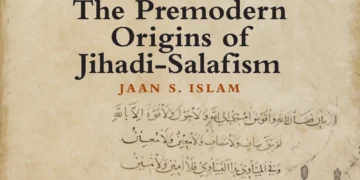














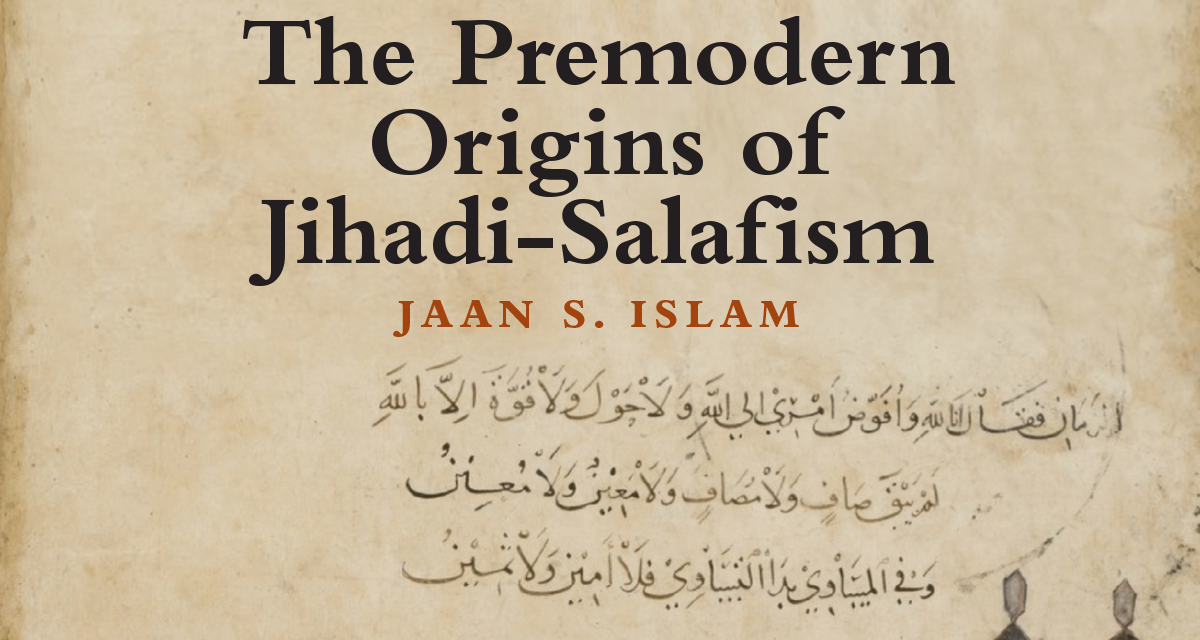

Jaan Islam’s The Premodern Origins of Jihadi-Salafism argues that modern jihadist ideas on takfīr, jihad and divine sovereignty draw deeply on premodern Sunni legal and political thought rather than a purely modern Wahhābī rupture.
Jaan S Islam. The Premodern Origins of Jihadi-Salafism. 2026
Review by MOHAMMAD YUSUF PETERSEN
Twenty-five years have passed since the September 11 attacks on New York, an event that gave rise to the “wars on terror” and reshaped Western relations with Muslims worldwide. Numerous invasions and bombardments of Muslim lands have brought mass physical destruction, yet they have failed to suppress Muslims who seek to defend themselves from Western hegemony. The Taliban retook Kabul in 2021; Damascus was liberated in 2024. In 2001, the world settled on an explanation for men like these, and for the thinkers who shaped them: a Wahhābī aberration led by fanatics. This book argues that the explanation was too small. A quarter-century on, its question is the right one: where did their ideas come from?
The book is an academic monograph by Jaan Islam, professor of political science at Boğaziçi University in Istanbul. Like most academic monographs, it is dense and heavily footnoted. Jaan Islam argues that Jihadi Salafism is not a modern Wahhābī innovation but has broad premodern roots running through mainstream Sunni political-legal thought. In doing so, he aims to show that Jihadi Salafism stands outside Western categories, namely the good/bad Muslim dichotomy. Jaan Islam builds his study on the legal-political thought of five influential jihadist thinkers of recent decades: ʿAbdullāh ʿAzzām, Sayyid Imām al-Sharīf, Abū Baṣīr al-Ṭarṭūsī, Abū Muḥammad al-Maqdisī and Abū Qatāda al-Filasṭīnī. He traces the genealogy of their ideas on divine sovereignty, excommunication (takfīr) and jihad, and situates them within premodern Islamic thought.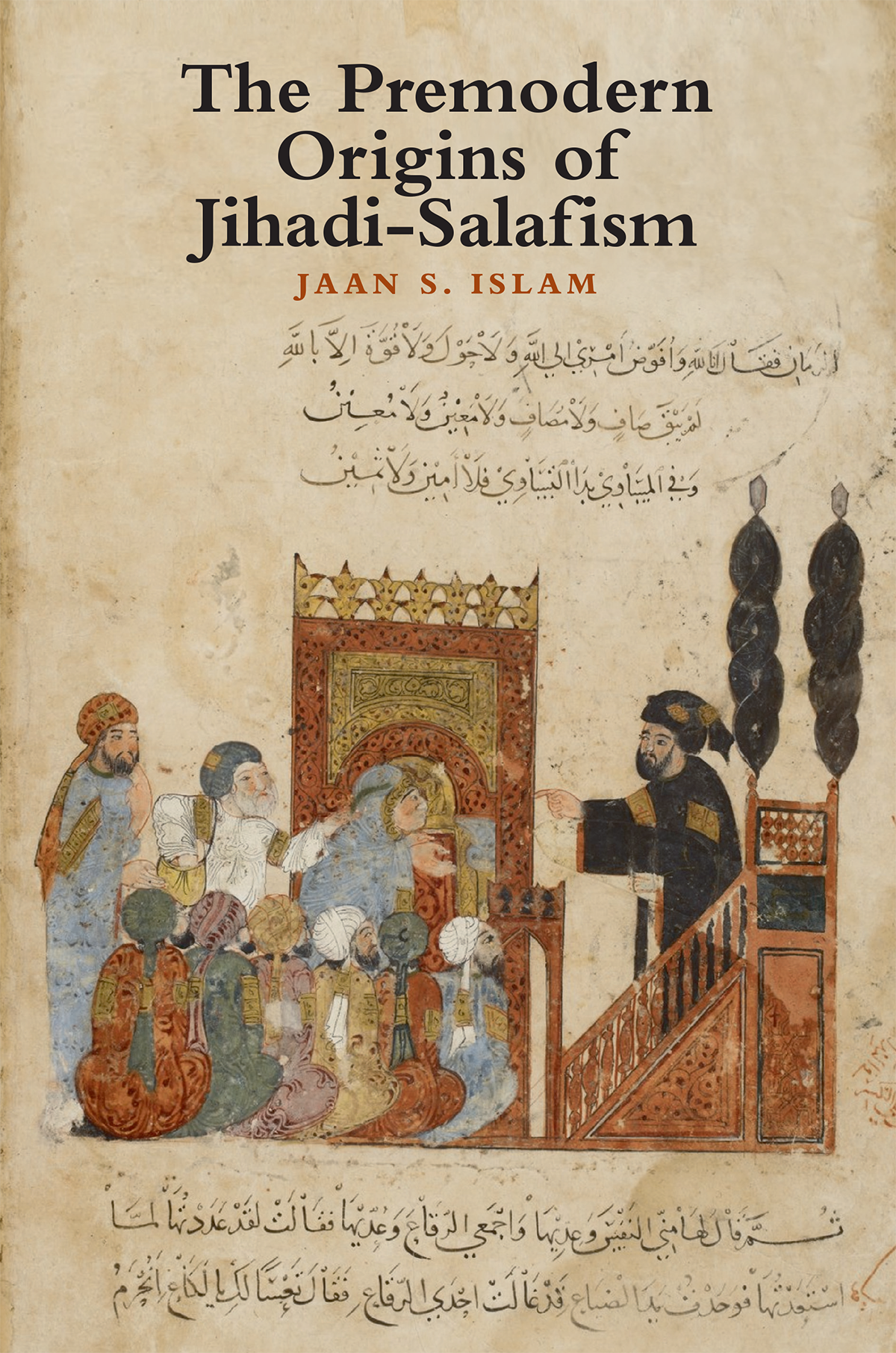
Chapter five — a central chapter of the book — offers the clearest illustration of Islam’s modus operandi. The chapter centres on two clusters of Qurʾānic verses, Q4:59–65 and Q5:44–47, and their exegesis. Taken together, as the commentators read them, the verses hold that failure to implement the Sharīʿa opens one up to excommunication. Jaan Islam’s claim here is narrow and specific: the exegesis that allows a modern jihadist to call a secular ruler an apostate was not invented by Wahhābīs or Quṭb. It was worked out by Shāfiʿī–Ashʿarī commentators between the 12th and 15th centuries, and the five figures read those commentators directly. He tracks this through al-Rāzī, al-Āmidī, Ibn al-ʿArabī, al-Qurṭubī, al-Nawawī, Ibn Ḥajar and the two Subkīs, then shows ʿAzzām, al-Sharīf, Abū Baṣīr and Abū Qatāda citing the same men for the same conclusion.
The chapter’s stated “most important finding” (p 163): Ashʿarī, Māturīdī and Salafī scholars disagree about what faith is, but agree that certain actions, above all refusing to implement the Sharīʿa, take a person out of Islam. So the theological quarrel has no practical consequence in law. That is the sentence the whole chapter is built to earn. The chapter shows the five as trained jurists working with real texts from within the Sharīʿa’s own corpus. It is arguably the book’s strongest case for premodern origins.
If Chapter five shows the method, Chapter eight delivers the surprise. Here Jaan Islam traces the doctrine of divine sovereignty (ḥākimiyya) not to Arabia but to India. The chain begins with Shāh Walī-Allāh of Delhi (d 1762) and his son’s fatwa of 1803, which declared British India the Abode of War “because Muslims lost [political] sovereignty and the infidels have come to administer the affairs of the country” (p 256). It passes to the grandson Shāh Ismāʿīl and the scholars who would establish Deoband, then to Mawdūdī and Quṭb, and from them to ʿAzzām, al-Maqdisī and Abū Baṣīr. It ends in Kabul, where a Deobandi movement now governs a state that Salafī jihadists recognise as the return of divine rule.
The pivot is a definition. The Ḥanafī jurists held that a land is the Abode of Islam when the Sharīʿa governs it, whoever lives there: “the dominance of Islam or disbelief is a function of the dominance of its law” (al-Kāsānī, p 262). Sayyid Imām al-Sharīf takes this definition, by way of the 19th-century Indian scholar Ṣiddīq Ḥasan Khān, and applies it to the world after 1924, in which the Sharīʿa “had become absent from the world in its entirety” (p 267). He then sorts that world into abodes: apostasy, where fighting the rulers is obligatory (Egypt, Turkey); disbelief (the United States); returned disbelief (Israel). Jaan Islam calls the result “a near-Foucauldian understanding of power” (p 265), that is, sovereignty as the physical ability to enforce God’s law, and nothing less.
This is why the Taliban matter to the book. Abū Baṣīr congratulated them within two weeks of Kabul’s fall in 2021, and Jaan Islam insists these ʿulamāʾ “are not merely tolerating the Taliban for strategic purposes” (p 274). They see in a Māturīdī, Deobandi government the fulfilment of a doctrine they share, even while condemning its theology as innovation. The reader who expected a Salafī story finds a Ḥanafī one. Jaan Islam, to his credit, calls the convergence “limited” (p 18).
In assessing this monograph, two matters stand out: Jaan Islam’s treatment of Jihadi Salafism demonstrates to the reader that concepts such as jihad and the Sharīʿa are not modern abominations but terms etched into the lexicon of Islamic intellectual history. The mujāhidīn, seeking to articulate themselves in a world unrecognisable to them, returned to the classical texts and strove to re-establish what lies at the heart of the tradition itself: the supremacy of God’s word over everything. This is the book’s biggest strength and arguably shows the falsity of the West’s characterisation of the mujāhidīn as bloodthirsty savages hell-bent on wreaking havoc on the world surrounding them. This reality, as Jaan Islam states, “ought to cultivate a healthy scepticism towards the field of so called ‘terrorism studies’, which reduces peoples, ideas, societies, cultures and Islamic concepts to objects of analysis within a framework imposed by external observers seeking to engineer change” (p 319).
You may also want to read



The second matter is a weakness of method, and it concerns not the mujāhidīn’s aim but their route to it. Jaan Islam proves that the mujāhidīn cite the tradition; he seldom asks whether they read it correctly, and these are not the same claim. Al-Sharīf’s treatment of apostasy is the clearest case (pp 206–8). Classical law reserves the ḥadd (a scripturally fixed punishment) to the ruler, and al-Sharīf knows it. His way out is a Shāfiʿī–Ḥanbalī ruling on the apostate who flees the Sharīʿa’s jurisdiction and becomes a ḥarbī (an enemy combatant), which he stretches to cover “the ṭawāghīt [tyrants who rule by other than God’s law]… their soldiers, and their helpers among writers and journalists” (p 208). A rule for one man who escaped the ruler’s reach is applied to the men who hold it, and to whole classes of people without the individual trial the tradition insists on. Jaan Islam records the move as “an attempt to stay within the tradition” (p 207) and leaves it there. A reader trained in fiqh will want the judgement he withholds.
This book is not an easy read, but for scholars, teachers, journalists and policymakers willing to lend an ear, it is a timely and important contribution. Jaan Islam writes for specialists, and the general reader will meet pages of transliterated names and legal terminology before the argument surfaces. But the spine holds. Follow Chapters five and eight and the case makes itself: the mujāhidīn were not improvising, they were reading. Jaan Islam shows, with patience and a formidable archive, that the jihadists are inside the tradition. He leaves the reader with the harder question of what the tradition itself would say to them.
Mohammad Yusuf Petersen is completing an Honours degree in Islamic Studies at the University of the Western Cape, Department of Religion. His research interests are ḥadīth methodology and questions of scripture, canon, and authenticity in the Sunnī tradition. A graduate of the Darun Naʿīm Institute and the Dār al-ʿUlūm al-ʿArabiyya al-Islāmiyya in Strand, he lectures at the Zahraa Institute and teaches at GoodTree Quranic School.