






































By NABEEL ALKHALIDY
A familiar narrative portrays the Prophet Muhammad ﷺ as living in enduring poverty. The writer challenges that view, arguing that the Quran instead depicts a financially self-sufficient leader whose wealth served family and community.
Growing up, almost all of us heard the exact same story: that the Prophet Muhammad ﷺ lived in extreme poverty. We were told stories of him and his family spending months without a single fire lit in his kitchen, and dying in debt with his armour mortgaged to a Jewish moneylender for a handful of barley!
It is a narrative painted so often that many accept it without question. But when you open the Quran and read it with an open mind, a completely different picture emerges.
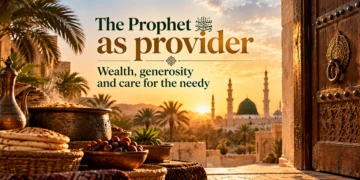
The Quran does not depict a helpless, impoverished leader struggling to make ends meet. Instead, it presents a hard-working, financially self-sufficient and deeply generous leader, someone whose household operated like a thriving community sanctuary and food bank, providing for his family, his relatives and the entire community.
Let’s examine what the Quran actually says and dismantle these persistent myths once and for all.
Allah made him wealthy and self-sufficient
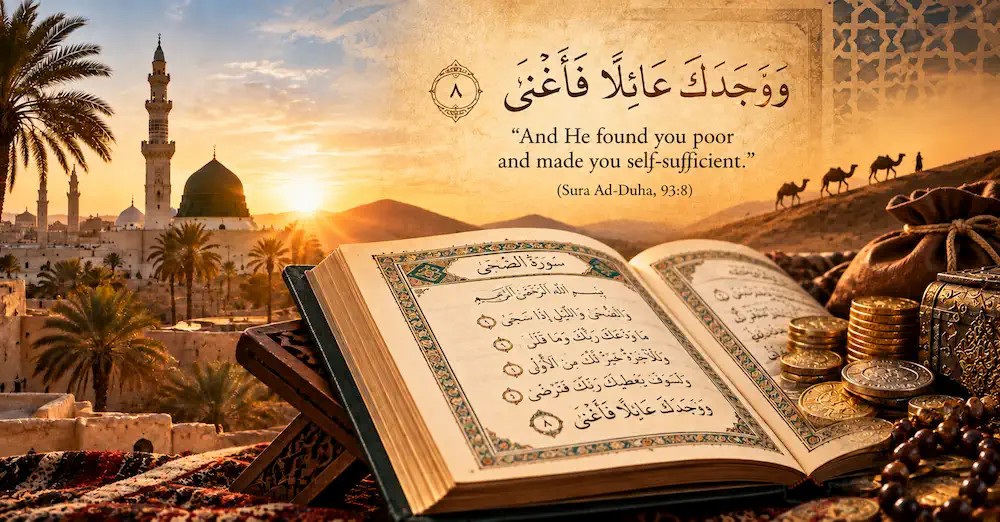
The idea that the Prophet ﷺ spent his life in financial destitution directly contradicts the explicit words of Allah in the Quran. In Sura Ad-Duha, Allah reminds the Prophet ﷺ of His divine favours upon him:
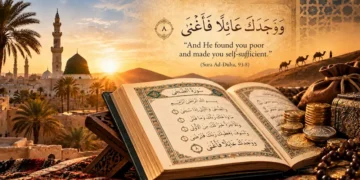
“وَوَجَدَكَ عَائِلًا فَأَغْنَىٰ”
“And He found you poor and made you self-sufficient.” (Sura Ad-Duha, 93:8)
The word used here is Aghna (أَغْنَىٰ), meaning Allah enriched him and made him independent and non-reliant on others besides Allah ﷻ. Allah did not leave His Messenger in a state of financial helplessness. He removed his reliance on others and granted him self-sufficiency.
How did this wealth come about? It wasn’t sent to him from the sky! The Prophet ﷺ was a man of action, commerce and relentless effort. Allah describes the daily routine of the Prophet ﷺ in Sura Al-Muzzammil:
“إِنَّ لَكَ فِي النَّهَارِ سَبْحًا طَوِيلًا”
“Indeed, for you by day is prolonged occupation.” (Sura Al-Muzzammil, 73:7)
The phrase Sabhan Tawila (سَبْحًا طَوِيلًا) refers to long, intensive daytime activities, moving through society, managing affairs, conducting business and working hard. The Prophet ﷺ was an active merchant long before his prophethood, and he continued to be engaged in the economic life of his community.
Furthermore, when the disbelievers criticised the Prophet ﷺ for being an ordinary human, Allah highlighted his presence in the commercial hubs of society:
“وَقَالُوا مَالِ هَٰذَا الرَّسُولِ يَأْكُلُ الطَّعَامَ وَيَمْشِي فِي الْأَسْوَاقِ”
“And they say, “What is this messenger that eats food and frequents the markets?”” (Sura Al-Furqan, 25:7)
He walked through the markets (Al-Aswaq), engaged in trade, bought, sold and built financial stability. He earned his living from honourable, hard work and used his wealth to establish his family and support those around him.
Capital and marriage provisions
The Quran reveals that the Prophet ﷺ possessed sufficient capital to fulfil substantial financial obligations. In seventh-century Arabia, getting married involved significant financial transactions in the form of dowries (Mahr). Look at what Allah says regarding his marriages:
“يَا أَيُّهَا النَّبِيُّ إِنَّا أَحْلَلْنَا لَكَ أَزْوَاجَكَ اللَّاتِي آتَيْتَ أُجُورَهُنَّ”
“O Prophet, indeed We have made lawful to you your wives to whom you have given their due compensation [dowries].” (Sura Al-Ahzab, 33:50)
You may also want to read





Providing financial compensation and dowries for multiple wives requires substantial liquid assets, not the funds of a man living in crippling poverty.
Beyond initial dowries, maintaining multiple households requires ongoing financial stability. The popular narrative suggests the Prophet ﷺ favoured certain wives or left them in financial neglect, but the Quran tells us he was guided on the straight path (Sirat Mustaqeem), which is the guidance of the Quran.
Being on the straight path means absolute justice, fairness and balance. He did not favour one wife over another in financial maintenance, living conditions or provision. Every wife was provided her own residence and full financial support. Establishing and maintaining multiple independent households with complete financial equity is a feat that strictly requires wealth, stability and continuous income, not poverty.
Divine resource allocations in the Quran
Beyond his personal trade, Allah established revenue streams for the Prophet ﷺ within Quranic law itself. Look at how war booty (Ghanimah) and state revenues (Fai’) were legally divided:
“وَاعْلَمُوا أَنَّمَا غَنِمْتُم مِّن شَيْءٍ فَأَنَّ لِلَّهِ خُمُسَهُ وَلِلرَّسُولِ وَلِذِي الْقُرْبَىٰ”
“And know that anything you obtain of war booty – then indeed, for Allah is one fifth of it and for the Messenger and for [his] near relatives…” (Sura Al-Anfal, 8:41)
Allah explicitly assigned one-fifth (20%) of state spoils to the Messenger ﷺ to distribute to close relatives and the needy. This wasn’t a symbolic gesture; it was a massive stream of resources designed to finance his leadership, support his family and fund public welfare.
Allah reinforces this institutional support in Sura Al-Hashr:
“مَّا أَفَاءَ اللَّهُ عَلَىٰ رَسُولِهِ مِنْ أَهْلِ الْقُرَىٰ فَلِلَّهِ وَلِلرَّسُولِ وَلِذِي الْقُرْبَىٰ وَالْيَتَامَىٰ وَالْمَسَاكِينِ وَابْنِ السَّبِيلِ كَيْ لَا يَكُونَ دُولَةً بَيْنَ الْأَغْنِيَاءِ مِنكُمْ”
“And what Allah bestowed to His Messenger from the people of the towns – it belongs to Allah and to the Messenger and to near relatives and orphans and the traveller – so that it will not be a perpetual distribution among the rich from among you.” (Sura Al-Hashr, 59:7)
The Quran literally legislated that state-level wealth be channelled directly to the Prophet ﷺ so he could manage public needs and prevent money from staying concentrated solely among the rich.
Al-Kawthar: abundance in action
To understand how the Prophet ﷺ handled his wealth, we have to look at one of the most profound chapters in the Quran: Sura Al-Kawthar.
“إِنَّا أَعْطَيْنَاكَ الْكَوْثَرَ فَصَلِّ لِرَبِّكَ وَانْحَرْ”
“Indeed, We have granted you Al-Kawthar. So connect to your Lord and sacrifice.” (Sura Al-Kawthar, 108:1-2)
What is Al-Kawthar? The root word comes from kathrah (abundance), but on an extreme scale. It means total plenitude and unending divine support, spiritual light, family and progeny, blessings and vast wealth. Allah didn’t just give him enough to scrape by; he gave him complete abundance.
Then comes the command: Fa salli li rabbika wanhar. Notice the two-part instruction:
1. Connect with Allah through prayer and other acts of devotion (فَصَلِّ لِرَبِّكَ ).
2. Give out to the people by distributing the wealth (وَانْحَرْ).
The word وَانْحَرْ specifically refers to slaughtering a camel. In ancient Arabia, a camel wasn’t just meat; it was an individual’s most prized, high-value asset. Allah was instructing him to take his most valuable possessions and sacrifice them to feed and provide for the community.
This captures the Prophet’s economic philosophy: receive abundance from Allah, hold nothing back out of fear of poverty and use your best assets to take care of the people around you.
Providing first for relatives and the needy
The Prophet ﷺ was able to be so generous because Allah commanded him to distribute wealth directly to those in need, starting with his own kin:
“وَآتِ ذَا الْقُرْبَىٰ حَقَّهُ وَالْمِسْكِينَ وَابْنَ السَّبِيلِ”
“And give the relative his right, and the needy and the traveller…” (Sura Al-Isra, 17:26)
The Quranic command is clear: you must fulfil the financial rights of Dhul Qurbah (close relatives), the Masakeen (the poor) and travellers. The Prophet ﷺ prioritised his family and the destitute in his giving.
To give generously to entire clans, support widows, finance travellers and maintain open houses for the public, one must possess significant resources. You cannot give away what you do not have.
Why the myth persists and why it matters
When we weigh the popular stories against the plain text of the Quran, the traditional narrative of poverty crumbles. The idea that he died penniless with his battle armour pawned to a Jewish merchant for basic grain is completely at odds with a leader who received designated state shares, owned properties, traded in markets, and paid dowries and maintained multiple households.
Over centuries, historical reports and hadith accounts were passed down through various chains, and many of these accounts reflected brief, isolated moments of temporary hardship such as periods of economic boycotts or war, rather than the overall, permanent state of the Prophet’s life. Over time, storytellers and preachers exaggerated these snapshot moments to promote a specific, extreme vision of asceticism (Zuhd).
When we believe our Prophet ﷺ and role model was helpless and broke, it breeds a passive, defeatist mindset. But when you embrace the Quranic reality, you see an active trader, property owner, provider and powerhouse of capability.
Looking ahead to Part Two
I have provided sufficient evidence from the Quran that the Prophet ﷺ was rich and not struggling financially, as is portrayed in the historical accounts many of us have grown up believing in.
In Part Two, I will provide an example of how this wealth was used to benefit the community as a whole. Very few people understand that the houses of the Prophet ﷺ were charity centres for the less fortunate. We will endeavour to highlight this next, In Sha Allah.
Nabeel M A Alkhalidy is an Islamic educator and researcher based in Australia with over 15 years of experience teaching Arabic and the Quran. His research focuses on Quranic exegesis and etymology. He also developed a unique curriculum using internal Quranic tools to uncover enriched, 21st-century interpretations.