
















































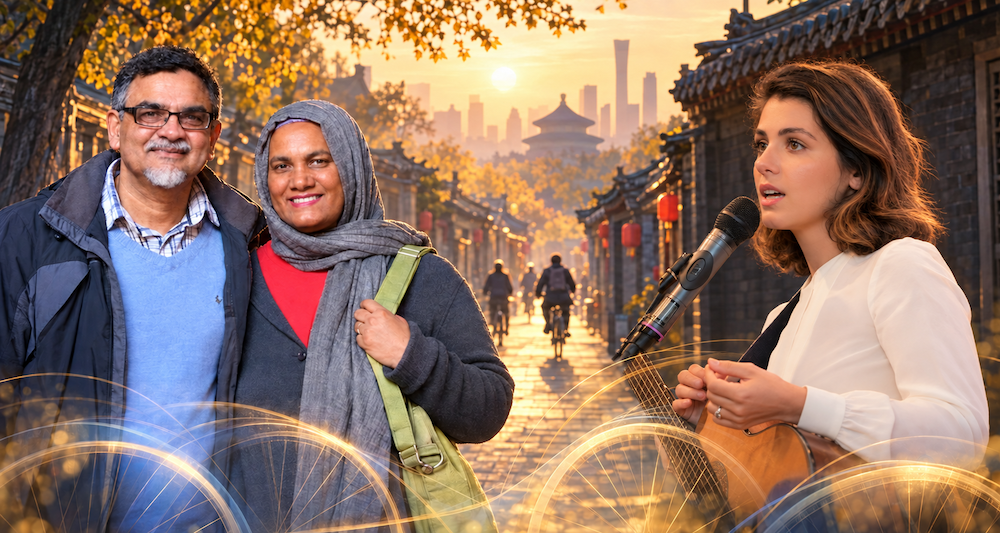

A 2012 visit to China still evokes reminiscences, says PROFESSOR YASIEN MOHAMED, who shares his memories of his travel to Beijing with his late wife Zaida.
Whenever I think of Beijing, I hear Katie Melua singing, “There are nine million bicycles in Beijing.” The song was a favourite of my late wife, Zaida, who accompanied me there in May 2012. After the long flight from Cape Town, we arrived in a crowded city of twenty million people. Since her death, the song has returned to me as both melody and memory, binding Beijing to the journey we shared.
Two students welcomed us at the airport and drove us to Renmin University of China. Its tree-lined avenues and gardens, where people practised Tai Chi, offered a gentle first impression of a city balancing ancient rhythms with the demands of modern life. That tension between tradition and change also surfaced at the ethics conference, where I presented a paper on justice in Aristotle and Ibn Miskawayh and other participants explored philosophical traditions, including Confucianism. The discussions were engaging, yet Charlie, a master’s student at Renmin, pointed to a limit on that exchange: “Students are not allowed to ask questions, only the professors.”
For lunch, we sat around a traditional Chinese rotating table laden with small bowls, chopsticks and an array of dishes. We waited for others to help themselves before turning the table to bring another dish within reach. It was a small ritual of patience and courtesy. Zaida and I confined ourselves to the vegetables, while Professor Umut from Uzbekistan chose wine and pork despite having spoken about Islam at the conference.
After lunch, Charlie escorted us to the nearby mosque for Friday prayers. I invited him to join us. The gentle trickle of water from the ablution taps created an atmosphere of calm reverence. “Just follow our movements,” I told him. Charlie imitated each movement and said, “In Daoism, water symbolises harmony.”
Photo: Supplied
With Dan, a Romanian professor of Christian theology, we visited the Lama Temple, one of China’s most important Tibetan Buddhist temples. Built in 1744, it was a place of incense, carved roofs and quiet devotion. By the time we left, hunger had overcome our curiosity. Zaida and I, weary of Chinese dishes, slipped into KFC for chips and rolls. Charlie preferred the traditional Chinese rice with meat or fish and vegetables, and said: “But the youth are now consuming American fast food.”
Since 1949, China has been officially atheist, though Confucian values of family obligation and social hierarchy remain influential. This helps explain why the one-child policy came into tension with traditional family values. Outside the Great Wall of China, a monumental ancient defence network, Zaida gently touched a toddler, and the father quickly pulled the child away. We wondered whether the protectiveness we had witnessed reflected the special attention often given to an only child. Family traditions were also changing. Charlie’s father’s marriage had been arranged: the bride was carried from her village to the groom’s village, and the couple met for the first time on their wedding day. They remained married for fifty years. “Such customs are gradually disappearing today,” Charlie said.
Beijing’s prosperity was visible in its high-rise buildings, malls and crowded streets, but its pressures were clearest in the aspirations of the young. Many hoped for degrees, apartments and cars, the markers of security in a competitive society. While looking for an internet café, we met Lee, a student who invited us to use his computer in the dormitory. He shared a room with six other students, sleeping in triple bunks, and sharing one study table. From a poor rural family, Lee worked part-time and hoped to enter a master’s programme. “For every thirty applications,” he said, “the university accepts only one student.” Then he added, “My social status depends on owning an apartment. Otherwise, I cannot find a spouse.”
Could a simple lifestyle survive in a society racing towards modernity? “Young people,” Lee responded, “want modern comforts and will take loans to get them.” His parents focused on food and security, while the new generation wanted status and luxury. Charlie carried similar ambitions: he wanted to become a professor and own an apartment. Yet he remained attached to his family and planned to return home for Chinese New Year despite the crowded and expensive trains. Like many of his generation, he seemed pulled between the forces of modernity and the forces of family allegiance.
You may also want to read




Charlie insisted on accompanying us to the airport. Before we entered the terminal gates, I gathered the last of my local currency and held it out to him, thinking it would cover his fare back to the university. He did not reach for it. “No, thank you,” he said quietly. “I am not a beggar.” I lowered my hand, ashamed that my gesture had wounded his dignity, and thanked him for his kindness. As we turned towards the gate, I saw sadness settle on his face. He stood waving until we disappeared from sight. When our plane lifted above Beijing, I carried with me not only memories of temples, crowded streets and restless ambition, but also the lesson of Charlie’s dignity. Beijing had revealed itself to me through such encounters: a city negotiating tradition and modernity, and a place where the old injunction to “seek knowledge even unto China” had acquired a deeply personal meaning.
Yasien Mohamed is Emeritus Professor of Islamic Philosophy in the Department of World Languages, Literatures and Cultures at the University of the Western Cape.