

























![The market-builder who restrained the market [Part 2]](https://muslimviews.co.za/wp-content/uploads/2026/08/PHOTO-2026-08-25-17-16-32-360x180.jpg)
![The merchant preceding the Prophetic mission [Part 1]](https://muslimviews.co.za/wp-content/uploads/2026/08/01-360x180.jpg)








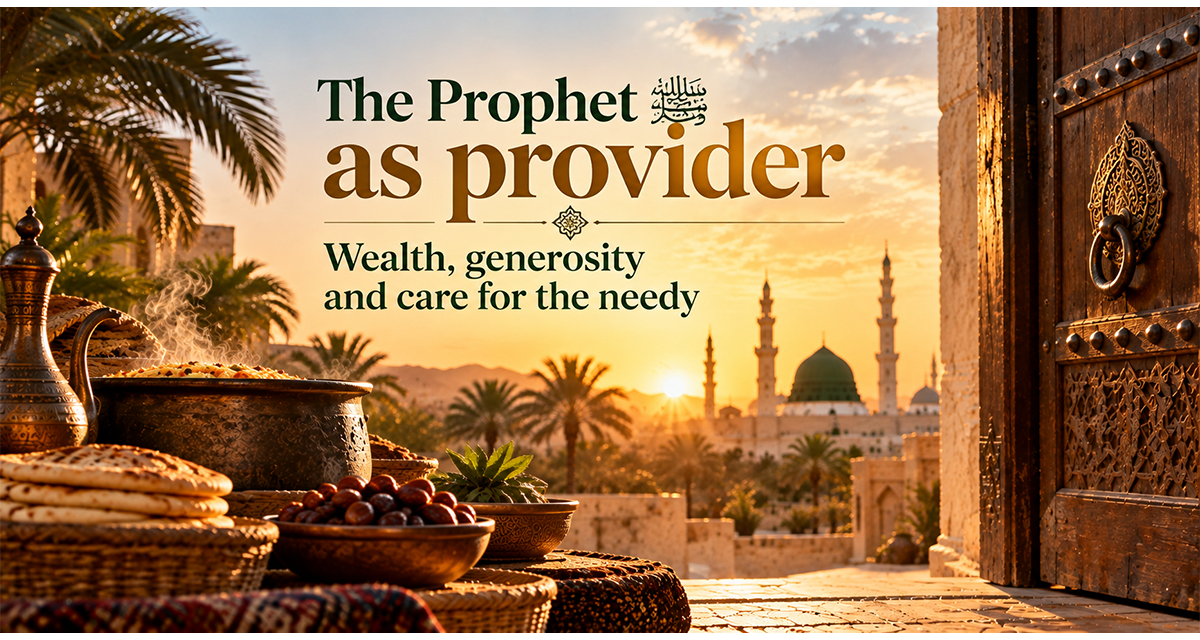

In the second part of his Quran-based argument on Prophetic wealth, the writer contends that the Prophet Muhammad ﷺ used financial independence and abundance not for luxury, but to provide for his family and serve the wider community.
By NABEEL ALKHALIDY
In Part One, we unpacked the foundational Quranic evidence showing that the Prophet Muhammad ﷺ was financially independent, active in business, and blessed with abundance.
We are routinely told that the leader of the entire Arabian Peninsula lived in a state of near-destitution, survived on plain water and dates for months on end, and left his family in crushing poverty. In this sequel, we are taking a closer look at what the Quran explicitly says about his living arrangements, his massive household generosity, and why the popular narratives of helplessness simply do not hold up under Quranic scrutiny.
He provided multiple homes (buyoot) for his wives
The Prophet’s ﷺ living quarters are often depicted as a single, tiny, cramped mud room with a reed mat. But the Quran repeatedly uses the plural word Buyoot (بُيُوت) meaning multiple houses when referring to the dwellings he owned and provided for his wives (the mothers of the believers).
Consider this pivotal verse in Sura Al-Ahzab:
“يَا أَيُّهَا الَّذِينَ آمَنُوا لَا تَدْخُلُوا بُيُوتَ النَّبِيِّ إِلَّا أَن يُؤْذَنَ لَكُمْ إِلَىٰ طَعَامٍ غَيْرَ نَاظِرِينَ إِنَاهُ وَلَٰكِنْ إِذَا دُعِيتُمْ فَادْخُلُوا فَإِذَا طَعِمْتُمْ فَانتَشِرُوا وَلَا مُسْتَأْنِسِينَ لِحَدِيثٍ ۚ إِنَّ ذَٰلِكُمْ كَانَ يُؤْذِي النَّبِيَّ فَيَسْتَحْيِي مِنكُمْ ۖ وَاللَّهُ لَا يَسْتَحْيِي مِنَ الْحَقِّ ۚ وَإِذَا سَأَلْتُمُوهُنَّ مَتَاعًا فَاسْأَلُوهُنَّ مِن وَرَاءِ حِجَابٍ ۚ ذَٰلِكُمْ أَطْهَرُ لِقُلُوبِكُمْ وَقُلُوبِهِنَّ”
“O you who have believed, do not enter the houses of the Prophet except when you are permitted for a meal, without awaiting its preparation. But when you are called, then enter; and when you have eaten, disperse without seeking to remain for conversation. Indeed, that was troubling the Prophet, and he was shy of dismissing you. But Allah is not shy of the truth. And when you ask them [his wives] for something, ask them from behind a partition. That is purer for your hearts and their hearts.” (Sura Al-Ahzab, 33:53)
Notice that Allah specifically says buyoot an-nabi (the houses of the Prophet ﷺ). These were real, established properties where each of his wives had her own dedicated home. This was a standard of provision that required substantial, ongoing financial resources.
Beyond serving as private residences, these homes were active centres of community care, continuously accommodating people who came to eat, seek hospitality, and ask for assistance. Fulfilling such a broad social and charitable role meant these spaces had to be accommodating and considerably larger than common narratives suggest. Furthermore, as the ultimate exemplar of Quranic teaching, the Prophet ﷺ dealt with complete justice among all his wives, ensuring strict equality and never favouring one household financially over another.
His homes were modern community food banks
If we take a closer look at Sura Al-Ahzab (33:53), it completely shatters the myth that the Prophet’s ﷺ family was starving or that no fire was lit in his house for months.
Look at what the Quran describes as actually happening in those houses:
Open community hubs: Companions and community members were constantly entering the Prophet’s (ﷺ) houses for meals طَعَامٍ (ta’amin). The doors were open, and his household functioned as a central feeding centre for guests, visitors, and the needy.
Massive quantities of hot food: The phrase غَيْرَ نَاظِرِينَ إِنَاهُ (ghayra nadhirina inah) means without waiting for its cooking or preparation. People would show up early and wait around for the massive cooking pots to finish! If no fire was lit in his house for months, what were all these people coming to eat? What were they waiting to finish cooking? The Quranic text proves that cooking fires were burning continuously to feed crowds.
A bustling household: The crowds were so large that after finishing their food, people would stay and chat. They overstayed their visit because it was a warm, welcoming environment. But because others were waiting outside for their turn, Allah instructed them: فَانتَشِرُوا fantashiru – move along and disperse, so others can eat and then the Prophet’s ﷺ family can rest.
Constant supply of daily necessities: The ayah notes that guests needing daily supplies مَتَاعًا (mata’an) would walk right into the food preparation areas. To protect the privacy of the Prophet’s (ﷺ) wives working in the kitchen, Allah instructed that any requests for supplies be made from behind a partition.
In modern terms, the Prophet ﷺ ran a massive, generous community kitchen and food bank out of his personal estate. His wives and household worked tirelessly to cook for and host the community daily.
A lost character trait: extraordinary gentleness and shyness
There is a deeply moving lesson buried in this same verse about the Prophet’s (ﷺ) personal character. Allah reveals:
“Indeed, that was troubling the Prophet, and he was shy of dismissing you.”
Imagine the scene: people are overstaying their welcome, crowding his home, disturbing his family’s privacy, and delaying food for others who need to eat. Yet, out of immense hospitality, grace, and profound shyness (haya’), the Prophet ﷺ could not bring himself to tell people, “Please leave, you are taking up too much space.” He was simply too polite and gentle to hurt anyone’s feelings.
Allah Himself intervened to set healthy boundaries for the community. This level of care, gentleness, and humility is a quality we sorely lack today. We live in a world quick to dismiss others coldly, yet the leader of an entire community was too polite to ask guests to step out of his living room.
Broad-scale philanthropy
The Prophet’s ﷺ financial generosity went far beyond daily kitchen meals. The Quran depicts a man entrusted with distributing massive resources to lift entire populations out of poverty.
Allah describes the vast abundance granted to him:
“إِنَّا أَعْطَيْنَاكَ الْكَوْثَرَ فَصَلِّ لِرَبِّكَ وَانْحَرْ”
“Indeed, We have granted you Al-Kawthar. So connect to your Lord and sacrifice.” (Sura Al-Kawthar, 108:1-2)
The command to perform Nahr was not a minor personal ritual. It involved slaughtering large numbers of livestock to distribute meat throughout the entire city. To feed a whole city through sacrificial meat requires serious financial capital.
You may also want to read




Furthermore, when Allah established the rules for public wealth and charity distribution, the Prophet ﷺ was responsible for managing and allocating enormous funds to support converts, pay off debts for others, and care for travellers. He was not a passive recipient of charity; he was the primary distributor of economic relief.
Refuting contradictory narrations with Quranic logic
When we contrast the Quranic account with popular historical narrations, major logical and spiritual contradictions surface.
Take, for example, the narration where Aisha mentions that the Prophet’s ﷺ neighbours among the Ansar had milk-producing camels and would send milk for them to drink. This paints a picture of a household dependent on neighbourly hand-outs.
Or consider the famous statement often preached from pulpits: “A month or two would pass and no fire was lit in the home of the Prophet.”
Now, put those claims side by side with the Prophet’s ﷺ own well-established teachings and basic Quranic principles:
The principle of family first: The Prophet ﷺ explicitly taught that the best money a person can spend is the money spent on his own family. How could the man who commanded believers to prioritise their families leave his own wives without basic food or cooking fires for two months while managing public affairs?
Strength over weakness: The Prophet ﷺ taught: “The strong believer is better and more beloved to Allah than the weak believer.” Why would he choose financial helplessness, reliance on neighbours, or extreme destitution when economic strength allows a believer to build institutions, protect the vulnerable, and give out to the needy?
A common narrative claims the Prophet ﷺ was offered a choice to be a “King-Prophet” or a “Servant-Prophet,” and he chose grinding poverty to stay humble. But true servitude to Allah does not require financial weakness. The Quran shows us that financial independence and generosity are tools of divine service, not obstacles to it.
Psychological implications
How we view the Prophet’s ﷺ financial reality isn’t just an academic history lesson; it directly impacts the collective mindset of Muslims today.
For centuries, many have been fed a defeatist, victim-centreed narrative. We were taught to romanticise poverty as a badge of spiritual honour, which led generations to subconsciously equate economic struggle with piety and wealth with spiritual compromise.
When you believe your primary role model was financially helpless, it breeds passivity. It whispers: “If the best human couldn’t build wealth or control his economic fate, why should I bother?”
If you take away just three lessons from this, let them be these:
- Poverty is never the spiritual goal. When good people build real wealth, money stops being a source of greed and becomes a powerful tool, one that creates community independence and lifts people out of hardship and poverty.
- Real asceticism (zuhd) is about capacity, not empty pockets. It isn’t about having nothing to your name. It’s about having full hands and an unattached heart, while using your money to feed, shelter, and support everyone around you without letting it own your soul.
- You can’t fulfil your role as a steward (khalifa) while remaining helpless. True stewardship takes actual capability. To stand up for justice, protect the vulnerable, feed the hungry, and build real community structures, you need resources and financial independence, not total reliance on handouts.
Nabeel M A Alkhalidy is an Islamic educator and researcher based in Australia with over 15 years of experience teaching Arabic and the Quran. His research focuses on Quranic exegesis and etymology. He also developed a unique curriculum using internal Quranic tools to uncover enriched, 21st-century interpretations.