





![Does ta’wīl mean interpretation or fulfilment? A Quranic reassessment [+video]](https://muslimviews.co.za/wp-content/uploads/2026/10/Tawil-Kaskas-360x180.webp)






![Why becoming a wealthy Muslim is commendable in Islam [+videos]](https://muslimviews.co.za/wp-content/uploads/2026/09/Muslim-Trade-Business-1-360x180.webp)




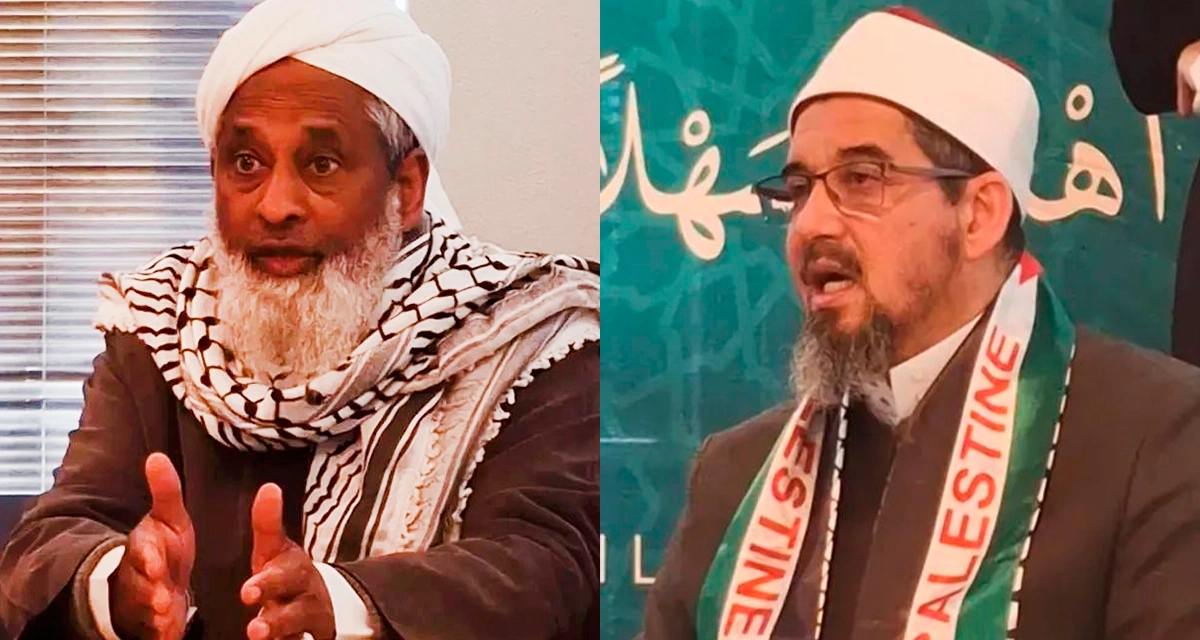

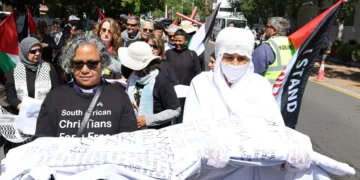
With over 100 organisations involved, the march aims to demonstrate solidarity with Gaza, demand accountability, and press for immediate action from the South African government.
By SHAKIR ACHMAT
The Muslim Judicial Council (MJC), Al Quds Foundation South Africa, and the Palestinian Solidarity Campaign (PSC) held a press conference at the MJC offices on Thursday, September 25 to outline the logistics of the mass march to Parliament.
Scheduled for Saturday, September 27, the march comes against the backdrop of an escalation in the genocidal attacks on the population of Gaza by the Israeli occupation forces.
Faizel Sayed, media liaison of the MJC, opened the press briefing by emphasising the scale and urgency of the crisis, noting that the march aims to show solidarity, raise awareness, and demand decisive government action. He added in closing: ‘We understand Saturday is a shopping day, it’s month end, but we can do that on Sunday. But right now, Gaza is calling and we need everybody out.’
Shaykh Riad Fataar, President of the MJC, addressed the humanitarian toll in Gaza, citing decades of military aggression, settlement expansion, and ethnic cleansing.
‘Palestinian babies and children are dying because of no food and water,’ Fataar said, calling for South Africa to stop trading with Israel, close the Israeli embassy in Pretoria, and implement a cultural, sporting, and academic boycott. He also urged criminalisation of South Africans participating in Israeli occupation forces.
‘From the river to the sea, Palestine will be free,’ he declared.
Professor Usuf Chikte of the Palestine Solidarity Campaign highlighted Israel’s apartheid practices and pointed to the international recognition of genocide. Drawing parallels with South Africa’s own apartheid history, he cited companies like Glencore and Amazon as financially complicit in the genocide and called for legislative action to prevent support for Israel’s military operations.
Moulana Abdul Khaliq Allie, President of the United Ulama Council of South Africa (UUCSA), echoed these sentiments, highlighting the historical roots of the Palestinian genocide and the ongoing dehumanisation, dispossession, and displacement of Palestinians, particularly in the West Bank. He criticised the international community for failing to uphold human rights and emphasised that peaceful protest and resistance are necessary to confront the apartheid-like system imposed on Palestinians.
Irene Govender of Mothers for Gaza emphasised the human cost, particularly for women and children.
‘Reports show that 20 000 children and 10 000 women have been killed. Hospitals in Gaza lack medical supplies, even painkillers,’ she said, urging governments to allow humanitarian access.
You may also want to read


A representative of Christians for a Free Palestine stressed that the struggle against Zionism is not solely a Muslim issue, framing it as a fight for universal justice. Quoting from The Bible, Amos 5:24 – ‘Let justice roll on like a river, righteousness like a never-failing stream’ – she encouraged Christians to join the march and be advocates within their communities.
Jared Sacks of South African Jews for a Free Palestine (SAJFP) outlined the organisation’s anti-Zionist work, highlighting their commitment to ending the Israeli occupation and apartheid regime in Palestine.
He shared experiences of his recent participation in the global humanitarian flotilla to Gaza, aimed at breaking the siege and delivering essential aid. Although he was unable to board the boat due to logistical issues, five South Africans, including Mandla Mandela, were risking their lives on the flotilla.
Sacks emphasised that SAJFP’s anti-Zionism is rooted in Jewish values, particularly the concept of ‘doikayt’ (hereness), which promotes the idea of building community and fostering solidarity where one lives, without dominating or oppressing others. This principle rejects the idea of an ‘ancestral homeland’.
He stressed the interconnected nature of oppression, linking the fight for justice in Palestine with struggles against racism, xenophobia, sexism and other forms of intolerance worldwide.
March logistics
Safwaan Laubscher, representing the Al Quds Foundation, provided detailed logistics for the march.
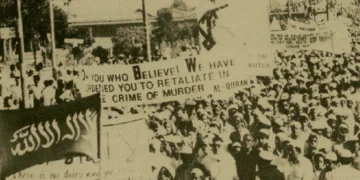
Protesters are to gather at Muir Street Mosque in District Six at 11:00, proceed down Darling Street, turn left onto Buitenkant Street, and right into Roeland Street, ending at Parliament. Here a memorandum will be handed over to a representative of the Department of International Relations and Cooperation.
Free transport
Organisers have arranged free transport via trains and buses, with attendees required to show a protest poster or Palestinian regalia to access the trains.
Participants are encouraged to arrive early to accommodate the expected large turnout. Marshals, security personnel, and emergency medical teams will be on hand throughout the march.
The coalition stressed that the march is not solely an Islamic or religious event but a call for all South Africans to stand against injustice, racism, and colonial oppression. With over 100 organisations involved, the march aims to demonstrate solidarity with Gaza, demand accountability, and press for immediate action from the South African government.
This article was edited on September 25, 2025 at 22:49 to correct Moulana Abdul Khaliq Allie’s designation.