









Muslim Views
No Result
View All Result
  • News
    • All
    • Local
    • National
    • World
    Educators weigh up South Africa’s new African-centred history curriculum

    Educators weigh up South Africa’s new African-centred history curriculum

    Artists explore mental health through “siege and sanctuary” exhibition

    Artists explore mental health through “siege and sanctuary” exhibition

    Shaikh Dien’s 1985 boycott khutbah and the modern Gaza-era BDS debate

    Shaikh Dien’s 1985 boycott khutbah and the modern Gaza-era BDS debate

    South Africa at GISC: ulama strengthen global cooperation amid shared crises

    South Africa at GISC: ulama strengthen global cooperation amid shared crises

    Are mainstream publishing media acting as censors in the UK over Palestine?

    Are mainstream publishing media acting as censors in the UK over Palestine?

    Three years on, Freedom Steps remember every Palestinian child killed

    Three years on, Freedom Steps remember every Palestinian child killed

    The life of Nabi Musa comes alive on stage

    The life of Nabi Musa comes alive on stage

    Thousands march for Palestine as Galloway and Ridley end South Africa tour

    Thousands march for Palestine as Galloway and Ridley end South Africa tour

    Quranic compass to guide global debate on AI, food security and humanity

    Quranic compass to guide global debate on AI, food security and humanity

    The remarkable story of Haneen of Gaza

    The remarkable story of Haneen of Gaza

    • National
    • World
    • Local
  • Opinion
    • All
    • Columnists
    • Discussions with Dangor
    • Editorial
    • Guest Writer
    Nine million bicycles in Beijing: Romance and memory from tradition to modernity

    Nine million bicycles in Beijing: Romance and memory from tradition to modernity

    Faith in motion: remembrance, discipline and action on the Hijra Cycle Tour

    Faith in motion: remembrance, discipline and action on the Hijra Cycle Tour

    South Africa’s multiparty supermarket and the erosion of substantive democracy

    South Africa’s multiparty supermarket and the erosion of substantive democracy

    Trump, Epstein and Netanyahu: the strange double standards of Western shame

    Trump, Epstein and Netanyahu: the strange double standards of Western shame

    Are mainstream publishing media acting as censors in the UK over Palestine?

    Are mainstream publishing media acting as censors in the UK over Palestine?

    Tribute to Comrade Moosa Kaprey: a life of struggle, faith and service

    Tribute to Comrade Moosa Kaprey: a life of struggle, faith and service

    Celebrated by many, not the few: A reply to Paula Slier

    Celebrated by many, not the few: A reply to Paula Slier

    Pillay’s defiance, Sharif’s disgrace: the prize and politics of prostration

    Pillay’s defiance, Sharif’s disgrace: the prize and politics of prostration

    Does ta’wīl mean interpretation or fulfilment? A Quranic reassessment [+video]

    Does ta’wīl mean interpretation or fulfilment? A Quranic reassessment [+video]

    Iran’s education achievements: from literacy gains to scientific eminence

    Iran’s education achievements: from literacy gains to scientific eminence

  • Features
    • All
    • 1500 Years of Prophetic Legacy
    • AWQAF SA
    • General Features
    • Imam Haron
    • Tributes
    Faith in motion: remembrance, discipline and action on the Hijra Cycle Tour

    Faith in motion: remembrance, discipline and action on the Hijra Cycle Tour

    Tribute to Comrade Moosa Kaprey: a life of struggle, faith and service

    Tribute to Comrade Moosa Kaprey: a life of struggle, faith and service

    The siege of Masjid-us-Salaam: when the mimbar faced Apartheid Casspirs

    The siege of Masjid-us-Salaam: when the mimbar faced Apartheid Casspirs

    Hijra Cycle Tour: how repetition, renewal and discipline shapes us

    Hijra Cycle Tour: how repetition, renewal and discipline shapes us

    Ebrahim Carelse: remembering an Apartheid-era killing more than 40 years on

    Ebrahim Carelse: remembering an Apartheid-era killing more than 40 years on

    The remarkable story of Haneen of Gaza

    The remarkable story of Haneen of Gaza

    Imam Haron’s legacy unites Ubuntu, faith and the struggle for justice

    Imam Haron’s legacy unites Ubuntu, faith and the struggle for justice

    Imam Haron’s martyrdom and our unfinished struggle for justice

    Imam Haron’s martyrdom and our unfinished struggle for justice

    UWC’s honorary doctorates are a triumph over petty tribalism

    UWC’s honorary doctorates are a triumph over petty tribalism

    UWC honour fully reclaims Charlotte Maxeke from apartheid-era erasure

    UWC honour fully reclaims Charlotte Maxeke from apartheid-era erasure

    Those who cheer from the sidelines and carry us through life’s journey

    Those who cheer from the sidelines and carry us through life’s journey

    Hijra Cycle Tour 2026: Why I chose to ride

    Hijra Cycle Tour 2026: Why I chose to ride

    Ebrahim Abed’s life of service to Hujaaj

    Ebrahim Abed’s life of service to Hujaaj

    Reading the Prophet: knowing the sīrah, reading ourselves

    Reading the Prophet: knowing the sīrah, reading ourselves

    The living heritage of Moulood traditions at Zandvliet

    The living heritage of Moulood traditions at Zandvliet

  • Lifestyle
    • All
    • Arts
    • Books
    • Education
    • Food
    • Health
    • Motoring
    • Sport
    • Technology
    The life of Nabi Musa comes alive on stage

    The life of Nabi Musa comes alive on stage

    Ummah Tech 2026: Building faith-driven technology for lasting impact

    Ummah Tech 2026: Building faith-driven technology for lasting impact

    The premodern Sunni roots behind modern Jihadi Salafist political thought

    The premodern Sunni roots behind modern Jihadi Salafist political thought

    Islamic thought meets modern cosmology in a compelling new book

    Islamic thought meets modern cosmology in a compelling new book

    Breaking the stigma surrounding mental health in the Muslim community

    Breaking the stigma surrounding mental health in the Muslim community

    Rooted in his faith, Ruiters says his book has a message for all South Africans

    Rooted in his faith, Ruiters says his book has a message for all South Africans

    Nabil Yasien Mohamed explores Ghazali’s enduring search for certainty

    Nabil Yasien Mohamed explores Ghazali’s enduring search for certainty

    Reading the Prophet: knowing the sīrah, reading ourselves

    Reading the Prophet: knowing the sīrah, reading ourselves

    Cape Town art exhibition explores untold histories through art and archives

    Cape Town art exhibition explores untold histories through art and archives

    Choritz captures a fierce new dystopia in The Sound of Ice

    Choritz captures a fierce new dystopia in The Sound of Ice

  • Finance
    • All
    • Islamic Finance
    Cape Town to host global leaders exploring the future of ethical Islamic finance

    Cape Town to host global leaders exploring the future of ethical Islamic finance

    Beyond the handshake: Protecting family business and the people behind it

    Beyond the handshake: Protecting family business and the people behind it

    Your will is written, but who will fund the estate?

    Your will is written, but who will fund the estate?

    The importance of the Quranic warning against riba for South African Muslims

    The importance of the Quranic warning against riba for South African Muslims

    Japan’s financial pressures and what they mean for Muslim investors

    Japan’s financial pressures and what they mean for Muslim investors

    The Prophet as provider: wealth, generosity and care for the needy

    The Prophet as provider: wealth, generosity and care for the needy

    The Prophet ﷺ was financially wealthy: debunking the myth of poverty

    The Prophet ﷺ was financially wealthy: debunking the myth of poverty

    Why becoming a wealthy Muslim is commendable in Islam [+videos]

    Why becoming a wealthy Muslim is commendable in Islam [+videos]

    Why becoming a wealthy Muslim is commendable in Islam

    Why becoming a wealthy Muslim is commendable in Islam

    Unlocking Africa’s development through Islamic finance and waqf

    Unlocking Africa’s development through Islamic finance and waqf

  • Islam
    • All
    • Eid
    • Faith and Practice
    • Family
    • Hajj and Umrah
    • Moulood
    • Quran
    • Ramadaan
    Does ta’wīl mean interpretation or fulfilment? A Quranic reassessment [+video]

    Does ta’wīl mean interpretation or fulfilment? A Quranic reassessment [+video]

    The premodern Sunni roots behind modern Jihadi Salafist political thought

    The premodern Sunni roots behind modern Jihadi Salafist political thought

    Quranic compass to guide global debate on AI, food security and humanity

    Quranic compass to guide global debate on AI, food security and humanity

    The ‘stemme’ rise: how Cape Mawlid nurtures listening, love and community

    The ‘stemme’ rise: how Cape Mawlid nurtures listening, love and community

    Scholars at Masjidul-Quds Moulood call for everyday integrity

    Scholars at Masjidul-Quds Moulood call for everyday integrity

    Prophetic legacy for a world on fire: Iḥsān, adab and agency

    Prophetic legacy for a world on fire: Iḥsān, adab and agency

    Voices of faith: youth, scholars and relics unite for Moulood-un-Nabi

    Voices of faith: youth, scholars and relics unite for Moulood-un-Nabi

    Reading the Prophet: knowing the sīrah, reading ourselves

    Reading the Prophet: knowing the sīrah, reading ourselves

    The living heritage of Moulood traditions at Zandvliet

    The living heritage of Moulood traditions at Zandvliet

    Moulood – When love stands

    Moulood – When love stands

  • Archives
  • Donate
Muslim Views
  • News
    • All
    • Local
    • National
    • World
    Educators weigh up South Africa’s new African-centred history curriculum

    Educators weigh up South Africa’s new African-centred history curriculum

    Artists explore mental health through “siege and sanctuary” exhibition

    Artists explore mental health through “siege and sanctuary” exhibition

    Shaikh Dien’s 1985 boycott khutbah and the modern Gaza-era BDS debate

    Shaikh Dien’s 1985 boycott khutbah and the modern Gaza-era BDS debate

    South Africa at GISC: ulama strengthen global cooperation amid shared crises

    South Africa at GISC: ulama strengthen global cooperation amid shared crises

    Are mainstream publishing media acting as censors in the UK over Palestine?

    Are mainstream publishing media acting as censors in the UK over Palestine?

    Three years on, Freedom Steps remember every Palestinian child killed

    Three years on, Freedom Steps remember every Palestinian child killed

    The life of Nabi Musa comes alive on stage

    The life of Nabi Musa comes alive on stage

    Thousands march for Palestine as Galloway and Ridley end South Africa tour

    Thousands march for Palestine as Galloway and Ridley end South Africa tour

    Quranic compass to guide global debate on AI, food security and humanity

    Quranic compass to guide global debate on AI, food security and humanity

    The remarkable story of Haneen of Gaza

    The remarkable story of Haneen of Gaza

    • National
    • World
    • Local
  • Opinion
    • All
    • Columnists
    • Discussions with Dangor
    • Editorial
    • Guest Writer
    Nine million bicycles in Beijing: Romance and memory from tradition to modernity

    Nine million bicycles in Beijing: Romance and memory from tradition to modernity

    Faith in motion: remembrance, discipline and action on the Hijra Cycle Tour

    Faith in motion: remembrance, discipline and action on the Hijra Cycle Tour

    South Africa’s multiparty supermarket and the erosion of substantive democracy

    South Africa’s multiparty supermarket and the erosion of substantive democracy

    Trump, Epstein and Netanyahu: the strange double standards of Western shame

    Trump, Epstein and Netanyahu: the strange double standards of Western shame

    Are mainstream publishing media acting as censors in the UK over Palestine?

    Are mainstream publishing media acting as censors in the UK over Palestine?

    Tribute to Comrade Moosa Kaprey: a life of struggle, faith and service

    Tribute to Comrade Moosa Kaprey: a life of struggle, faith and service

    Celebrated by many, not the few: A reply to Paula Slier

    Celebrated by many, not the few: A reply to Paula Slier

    Pillay’s defiance, Sharif’s disgrace: the prize and politics of prostration

    Pillay’s defiance, Sharif’s disgrace: the prize and politics of prostration

    Does ta’wīl mean interpretation or fulfilment? A Quranic reassessment [+video]

    Does ta’wīl mean interpretation or fulfilment? A Quranic reassessment [+video]

    Iran’s education achievements: from literacy gains to scientific eminence

    Iran’s education achievements: from literacy gains to scientific eminence

  • Features
    • All
    • 1500 Years of Prophetic Legacy
    • AWQAF SA
    • General Features
    • Imam Haron
    • Tributes
    Faith in motion: remembrance, discipline and action on the Hijra Cycle Tour

    Faith in motion: remembrance, discipline and action on the Hijra Cycle Tour

    Tribute to Comrade Moosa Kaprey: a life of struggle, faith and service

    Tribute to Comrade Moosa Kaprey: a life of struggle, faith and service

    The siege of Masjid-us-Salaam: when the mimbar faced Apartheid Casspirs

    The siege of Masjid-us-Salaam: when the mimbar faced Apartheid Casspirs

    Hijra Cycle Tour: how repetition, renewal and discipline shapes us

    Hijra Cycle Tour: how repetition, renewal and discipline shapes us

    Ebrahim Carelse: remembering an Apartheid-era killing more than 40 years on

    Ebrahim Carelse: remembering an Apartheid-era killing more than 40 years on

    The remarkable story of Haneen of Gaza

    The remarkable story of Haneen of Gaza

    Imam Haron’s legacy unites Ubuntu, faith and the struggle for justice

    Imam Haron’s legacy unites Ubuntu, faith and the struggle for justice

    Imam Haron’s martyrdom and our unfinished struggle for justice

    Imam Haron’s martyrdom and our unfinished struggle for justice

    UWC’s honorary doctorates are a triumph over petty tribalism

    UWC’s honorary doctorates are a triumph over petty tribalism

    UWC honour fully reclaims Charlotte Maxeke from apartheid-era erasure

    UWC honour fully reclaims Charlotte Maxeke from apartheid-era erasure

    Those who cheer from the sidelines and carry us through life’s journey

    Those who cheer from the sidelines and carry us through life’s journey

    Hijra Cycle Tour 2026: Why I chose to ride

    Hijra Cycle Tour 2026: Why I chose to ride

    Ebrahim Abed’s life of service to Hujaaj

    Ebrahim Abed’s life of service to Hujaaj

    Reading the Prophet: knowing the sīrah, reading ourselves

    Reading the Prophet: knowing the sīrah, reading ourselves

    The living heritage of Moulood traditions at Zandvliet

    The living heritage of Moulood traditions at Zandvliet

  • Lifestyle
    • All
    • Arts
    • Books
    • Education
    • Food
    • Health
    • Motoring
    • Sport
    • Technology
    The life of Nabi Musa comes alive on stage

    The life of Nabi Musa comes alive on stage

    Ummah Tech 2026: Building faith-driven technology for lasting impact

    Ummah Tech 2026: Building faith-driven technology for lasting impact

    The premodern Sunni roots behind modern Jihadi Salafist political thought

    The premodern Sunni roots behind modern Jihadi Salafist political thought

    Islamic thought meets modern cosmology in a compelling new book

    Islamic thought meets modern cosmology in a compelling new book

    Breaking the stigma surrounding mental health in the Muslim community

    Breaking the stigma surrounding mental health in the Muslim community

    Rooted in his faith, Ruiters says his book has a message for all South Africans

    Rooted in his faith, Ruiters says his book has a message for all South Africans

    Nabil Yasien Mohamed explores Ghazali’s enduring search for certainty

    Nabil Yasien Mohamed explores Ghazali’s enduring search for certainty

    Reading the Prophet: knowing the sīrah, reading ourselves

    Reading the Prophet: knowing the sīrah, reading ourselves

    Cape Town art exhibition explores untold histories through art and archives

    Cape Town art exhibition explores untold histories through art and archives

    Choritz captures a fierce new dystopia in The Sound of Ice

    Choritz captures a fierce new dystopia in The Sound of Ice

  • Finance
    • All
    • Islamic Finance
    Cape Town to host global leaders exploring the future of ethical Islamic finance

    Cape Town to host global leaders exploring the future of ethical Islamic finance

    Beyond the handshake: Protecting family business and the people behind it

    Beyond the handshake: Protecting family business and the people behind it

    Your will is written, but who will fund the estate?

    Your will is written, but who will fund the estate?

    The importance of the Quranic warning against riba for South African Muslims

    The importance of the Quranic warning against riba for South African Muslims

    Japan’s financial pressures and what they mean for Muslim investors

    Japan’s financial pressures and what they mean for Muslim investors

    The Prophet as provider: wealth, generosity and care for the needy

    The Prophet as provider: wealth, generosity and care for the needy

    The Prophet ﷺ was financially wealthy: debunking the myth of poverty

    The Prophet ﷺ was financially wealthy: debunking the myth of poverty

    Why becoming a wealthy Muslim is commendable in Islam [+videos]

    Why becoming a wealthy Muslim is commendable in Islam [+videos]

    Why becoming a wealthy Muslim is commendable in Islam

    Why becoming a wealthy Muslim is commendable in Islam

    Unlocking Africa’s development through Islamic finance and waqf

    Unlocking Africa’s development through Islamic finance and waqf

  • Islam
    • All
    • Eid
    • Faith and Practice
    • Family
    • Hajj and Umrah
    • Moulood
    • Quran
    • Ramadaan
    Does ta’wīl mean interpretation or fulfilment? A Quranic reassessment [+video]

    Does ta’wīl mean interpretation or fulfilment? A Quranic reassessment [+video]

    The premodern Sunni roots behind modern Jihadi Salafist political thought

    The premodern Sunni roots behind modern Jihadi Salafist political thought

    Quranic compass to guide global debate on AI, food security and humanity

    Quranic compass to guide global debate on AI, food security and humanity

    The ‘stemme’ rise: how Cape Mawlid nurtures listening, love and community

    The ‘stemme’ rise: how Cape Mawlid nurtures listening, love and community

    Scholars at Masjidul-Quds Moulood call for everyday integrity

    Scholars at Masjidul-Quds Moulood call for everyday integrity

    Prophetic legacy for a world on fire: Iḥsān, adab and agency

    Prophetic legacy for a world on fire: Iḥsān, adab and agency

    Voices of faith: youth, scholars and relics unite for Moulood-un-Nabi

    Voices of faith: youth, scholars and relics unite for Moulood-un-Nabi

    Reading the Prophet: knowing the sīrah, reading ourselves

    Reading the Prophet: knowing the sīrah, reading ourselves

    The living heritage of Moulood traditions at Zandvliet

    The living heritage of Moulood traditions at Zandvliet

    Moulood – When love stands

    Moulood – When love stands

  • Archives
  • Donate
No Result
View All Result
Muslim Views

Before applying true Islam, Muslims must first learn to live together

21 September 2026
in Guest Writer, Local
Reading Time: 9 mins read
A A
Before applying true Islam, Muslims must first learn to live together

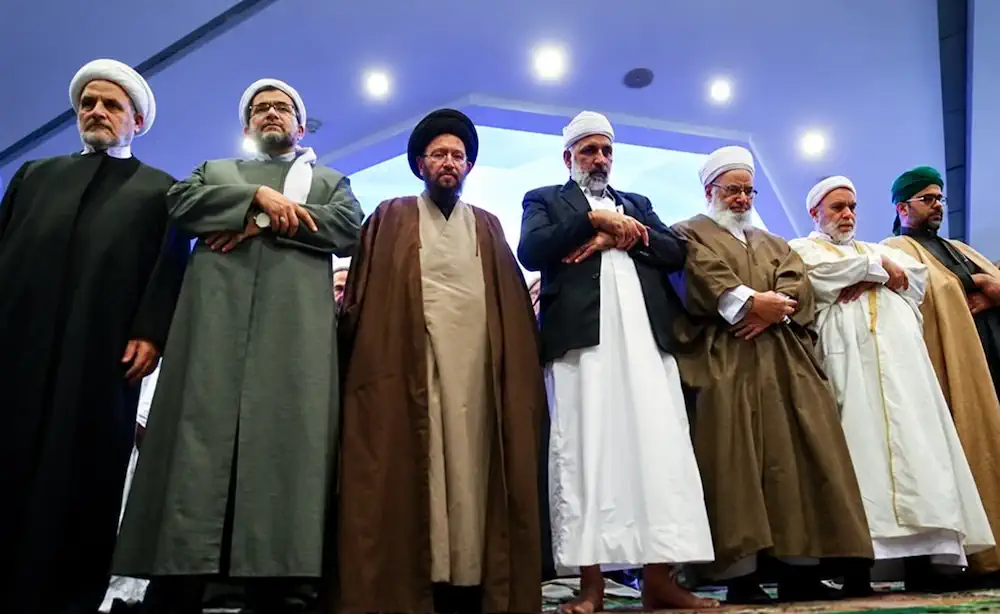
Sunni and Shia Muslims in Iraq pray together as Ramadan began on the same day for both communities in March 2023. The writer argues that such coexistence shows that profound theological difference is no cause for division or strife. Photo: Baghdad Today

Share on TwitterShare on FacebookShare on Whatsapp

By SHABODIEN ROOMANAY

Debates about applying “true Islam” often begin with law and doctrine. However, crucial questions arise first: can Muslims live with difference while building institutions rooted in justice, trust and accountability?

Also, why don’t we apply true Islam? What would an Islamic community look like? What laws should be introduced? Which version of Sharia should govern society?

But perhaps we are starting at the wrong end. Before asking how Islam should be practised by a community, we should ask a more uncomfortable question:

Can Muslims agree on what we mean by “Islam” sufficiently to apply it without turning on one another? This is not a minor theological problem. It may be the central problem of any attempt to build, develop and share an “Islamic” value system today.

Islam is one religion. Despite the Quranic command to Muslims to “… hold firmly, all together, to the rope of Allah, and do not be divided …” (Sura Ali Imran, 3:103), and “… indeed, those who have divided their religion and become sects, you, [O Muhammad], are not [associated] with them in anything …” (Sura Al An’am, 6:159), Muslims have never had one interpretation of most enquiries.

Sunni Islam itself contains the Hanafi, Maliki, Shafi’i and Hanbali schools, alongside different theological traditions and innumerable disagreements within those schools. The subsets of these schools of thought are many, each contesting with others and having developed its own correct “brand”. Within the Hanafi grouping there is a subtext to understanding the conduct, advice and way of the Prophet ﷺ. This gap is filled by regional variations and subgroups, such as Barelvi and Deobandi within the Hanafi school of thought.

Then Shi’a Islam has its own rich jurisprudential and theological traditions. Here, the Twelver, Ismaili and Zaidi traditions exist in various parts of the world. Add the Ibadi tradition and the countless movements, reformers, Sufi orders and revivalist tendencies that have shaped Muslim societies over the centuries, and the proposition that there is only one uncontested blueprint called an “Islamic movement” becomes difficult to sustain.

This diversity is not necessarily a defect. It is, in many respects, part of the history of Islamic civilisation. Perhaps the verse says it best: “Say: Each acts according to his own shākilah (way, manner, disposition), and your Lord knows best who is best guided in way.” (Sura Al Isra, 17:84)

The problem begins when difference becomes delegitimisation.

The Quran itself offers a striking corrective to the human tendency to turn difference into hierarchy. “We made you into peoples and tribes so that you may know one another,” it says, before locating human nobility not in lineage, tribe or group identity but in taqwa, Allah-consciousness and righteousness. (Sura Al Hujurat, 49:13)

That principle has implications beyond ethnicity, race and class. It should make Muslims wary of transforming their particular school, movement or inherited religious identity into the measure of another Muslim’s worth.

Justice before uniformity

The strongest case for applied Islam does not begin with punishment, dress code, apparel, length of beard or colour of female hijab. It begins with justice. The Quran commands believers to “stand firm for justice” even when the testimony is against themselves, their parents or their relatives, and whether the person involved is rich or poor. (Sura An Nisa, 4:135)

And then comes an even more demanding command: “Do not let the hatred of a people lead you to injustice. Be just; that is nearer to righteousness.” (Sura Al Ma’idah, 5:8)

This is a remarkable standard. It does not say: be just when dealing with your friends.

It does not say: be just when dealing with people who share your interpretation. It explicitly warns believers that even hostility must not become an excuse for injustice.

And the Quran is even more comprehensive: “Indeed, Allah commands justice and good conduct”, while forbidding wrongdoing and oppression. (Sura An Nahl, 16:90)

If these verses are taken seriously, then Muslims should first be concerned with whether institutions produce justice. Is the justice system fair? Are rulers accountable? Can the wealthy manipulate the law? Can a poor person obtain justice against a powerful person? Is one ethnic group superior to another? Is adherence to a particular dress code a defining quality of who is a Muslim? These are not secular questions that Islam must reluctantly answer. They are Islamic questions.

The Sunni-Shia question

The Sunni-Shia divide is the obvious test. Centuries of theological and political disagreement have produced identities that are deeply embedded in Muslim history. No conference, seminar or workshop is going to make Sunnis and Shi’a suddenly agree about questions of succession, authority, hadith or theology.

But perhaps agreement is not necessary. A Sunni and a Shi’i can disagree profoundly about theology and still agree that government should not steal from the people. They can disagree about jurisprudence and still agree that children deserve education, workers deserve fair treatment and the innocent should not be harmed. The objective should therefore not be to erase difference. It should be to prevent difference from becoming oppression.

The Quran’s language is worth remembering: humanity is deliberately described as divided into peoples and tribes “so that you may know one another”. (Sura Al Hujurat, 49:13) Difference, in the verse, is not presented as a divine mistake requiring elimination. The moral test is what human beings do with difference. Muslim history suggests that the same principle can apply to jurisprudential and theological difference. We do not need to settle every dispute before we can begin building a just society.

The same lesson can be seen closer to home in the Deobandi-Barelvi divide. Both are Sunni traditions. Both draw upon the same Quran and Prophet ﷺ. Yet their disagreements over theology, Sufism, devotional practices and religious authority have sometimes produced remarkably bitter polemics, to the point of sometimes declaring each other outside the fold.

Imagine, then, the absurdity of saying that before we can tackle poverty, corruption, education or economic injustice, Deobandis and Barelvis must first settle their theological disputes. We would be waiting forever.

There is a more productive approach: establish a common ethical framework within which different schools can coexist. And there is an important Quranic principle for such a framework: justice cannot depend upon affection.

“Be just; that is nearer to righteousness,” the Quran says, even when confronted by a people whom believers hate. (Sura Al Ma’idah, 5:8) If hatred cannot justify injustice towards an enemy, surely theological disagreement cannot justify injustice towards another Muslim.

This is where the question of takfir becomes critical. Once Muslims begin deciding that their interpretation is not merely correct but that those who disagree are outside Islam, disagreement becomes existential. The danger is not confined to one group. There have been takfiri tendencies in different periods and movements.

In parts of the modern Salafi/Wahhabi setting, critics have particularly objected to tendencies that label other Muslims as innovators, deviants or unbelievers. But we should be precise: Salafi or Wahhabi should not simply be equated with takfiri. There are important differences within those movements, and it has to be remembered that indiscriminate takfir has appeared in other Muslim traditions as well.

The real problem is the propensity to make takfir, wherever it occurs. Once someone is declared a non-Muslim, the space for coexistence becomes dangerously small.

The other propensity has been to excommunicate other Muslims from minbars, activities and occasions, and brand them persona non grata, only because they have a clashing view or have been firm on one or another principle.

The Prophet ﷺ warned against this kind of recklessness. In a well-known hadith, he said that if a man says to his fellow Muslim, “O unbeliever,” then the charge returns upon one of them. The warning is not a licence for theological doctrine; it is a warning about the gravity of declaring another Muslim outside the faith or debarring another Muslim from the broader body politic of the community.

This is consistent with the broader Prophetic insistence that religion not become an exercise in destructive extremism. The Prophet ﷺ said, “Religion is very easy,” and warned against overburdening oneself and religious extremism. The point is important.

The Islamic tradition does not require Muslims to abandon conviction. It requires them to exercise humility about their own authority to judge the faith of others.

The problem of interpretation and authority

There is another obstacle, perhaps even more serious: the community. Once Islam becomes a codified programme, somebody has to decide which interpretation of Islam becomes law.

Suppose a community adopts Hanafi jurisprudence. What happens to Shi’a? Suppose it adopts a particular Salafi interpretation. What happens to Sufis? Suppose it adopts a Barelvi understanding of devotional practice. What happens to Deobandis? Suppose the state declares one theological position orthodox.

Who appoints the scholars? Who appoints the judges? Who decides which scholar is sufficiently qualified? Who prevents the ruling grouping from using religious authority against its political opponents?

The moment we ask these questions, we discover that a select “Islamic community” does not solve the problem of interpretation. It institutionalises it. And here again the Quran offers a powerful principle: “Indeed, Allah commands justice and good conduct.” (Sura An Nahl, 16:90)

The Quran does not say that justice is suspended once a particular Muslim community practising its particular aqeedah or fiqh acquires dominant status. Indeed, the Prophet’s ﷺ own teaching places extraordinary emphasis on responsibility in authority. “Every one of you is a guardian and is responsible for his charges,” he said, explicitly including the ruler’s responsibility for those under his authority. Authority, in this conception, is not a privilege. It is a burden of accountability.

Islam should begin with the amanah. Perhaps this is where the concept of applying Islam needs to be reformulated. The first question should not be: Which aqeedah, fiqh or interpretation of Sharia should govern a community?

It should be: How do we build institutions that embody the Islamic concept of amanah – trust – where everyone is a trustee? That opens up a much richer understanding of applied Islam. And it would mean Muslims being able to disagree without hatred.

But what about Sharia? This does not mean that Sharia should disappear from the conversation. Quite the opposite. It means that Muslims should have a more serious conversation about what Sharia actually is.

You may also want to read

How colonial capital is using the DA to keep South Africa managed

How colonial capital is using the DA to keep South Africa managed

3 July 2026
Exploiting the Qunoot for political theatre

Exploiting the Qunoot for political theatre

9 March 2026
Welcoming 2023 with a special focus on the power of education

Welcoming 2023 with a special focus on the power of education

24 January 2023 - Updated on 28 August 2024
From Cape Town to Kuala Lumpur: Family celebrations and scholarly encounters

From Cape Town to Kuala Lumpur: Family celebrations and scholarly encounters

23 January 2026
Muslim Views journalist among top graduates as IPSA marks 21st anniversary

Muslim Views journalist among top graduates as IPSA marks 21st anniversary

17 September 2026
Offensive to label moulana’s language as ‘misogyny’

Offensive to label moulana’s language as ‘misogyny’

19 September 2020 - Updated on 12 July 2021

A civilisation that produced multiple schools of jurisprudence was already acknowledging that the human understanding and application of revelation involved interpretation and disagreement. Is fiqh identical to revelation? That distinction is essential. Otherwise, every disagreement becomes heresy and every attempt at reform or reinterpretation becomes an attack upon Islam itself.

Perhaps Islam would require renewed ijtihad; not an abandonment of tradition but an engagement with it. Muslim jurists need to engage seriously with constitutionalism, modern finance, artificial intelligence, biotechnology, environmental questions, international law, human rights, modern warfare and the contemporary economy.

This is not an attempt to make Islam conform to modernity. It is the recognition that every generation has to work out how eternal principles operate under its own circumstances.

The Quran does not tell believers to suspend justice when dealing with those they dislike. It tells them precisely the opposite. Even hostility must not cause them to depart from justice: “O you who believe! Stand firm for Allah, as witnesses with justice. And do not let the hatred of a people cause you to swerve from justice …” (Sura Al Ma’idah, 5:8)

A minimum Islamic consensus

If there is to be an Islam for all, perhaps it needs a minimum consensus rather than maximum uniformity. Muslims should be able to agree that corruption, torture, stealing public money and killing innocents are wrong, and that disagreement among Muslims does not automatically make one party apostate.

This is not a watered-down Islam. It may actually be a more demanding Islam because it requires Muslims to apply their principles even when it hurts their own interests. This is precisely what the Quran demands: justice even against oneself, one’s parents and one’s relatives. (Sura An Nisa, 4:135)

Adopting and enforcing a universal, codified modality to unite Muslims may create a profound irony. This could become the mechanism by which Muslims are divided against one another. The Sunni could seek to impose his interpretation on the Shi’i, and vice versa. The Deobandi could declare the Barelvi deviant. The Barelvi could return the accusation. A Salafi could declare a Sufi an innovator. A Sufi could dismiss the Salafi as a religious literalist.

Eventually, the question of who is Muslim enough becomes more important than whether Muslims are actually building a just society. At this point, something has gone badly wrong because the Quran’s challenge is not merely to form a community that agrees with itself. It is to “stand firm for justice”. (Sura An Nisa, 4:135)

The first principle should perhaps not be to create another superior sect and legislate more religion. It is to cultivate better Muslims who keep their promises, refuse corruption, treat workers fairly and understand that religious authority does not give them permission to humiliate their fellow believers.

The Quran gives us a remarkably simple test: Allah commands justice and ihsan, doing what is beautiful and good, and forbids oppression. (Sura An Nahl, 16:90) And the Prophet ﷺ gives us another: authority is responsibility.

Perhaps these two principles tell us more about Islam than endless arguments over which faction should dictate the righteous way. The real test of an Islamic society is therefore not how many Islamic laws it has on its books.

It is this: When Muslims acquire power, do they become more just?

If the answer is yes, then Islam is being applied in a meaningful sense. If the answer is no, perhaps the problem is not that we have failed to apply enough Islam. Perhaps we have failed to understand what applying Islam was supposed to mean in the first place.

Subscribe to our Newsletters

* indicates required
Choose the newsletters you'd like to receive
Advertisement

You may also want to read

Nine million bicycles in Beijing: Romance and memory from tradition to modernity
Guest Writer

Nine million bicycles in Beijing: Romance and memory from tradition to modernity

24 October 2026 - Updated on 25 October 2026
Faith in motion: remembrance, discipline and action on the Hijra Cycle Tour
FEATURES

Faith in motion: remembrance, discipline and action on the Hijra Cycle Tour

23 October 2026
Artists explore mental health through “siege and sanctuary” exhibition
News

Artists explore mental health through “siege and sanctuary” exhibition

22 October 2026
South Africa’s multiparty supermarket and the erosion of substantive democracy
OPINION

South Africa’s multiparty supermarket and the erosion of substantive democracy

22 October 2026
Trump, Epstein and Netanyahu: the strange double standards of Western shame
OPINION

Trump, Epstein and Netanyahu: the strange double standards of Western shame

21 October 2026
Are mainstream publishing media acting as censors in the UK over Palestine?
News

Are mainstream publishing media acting as censors in the UK over Palestine?

20 October 2026 - Updated on 22 October 2026
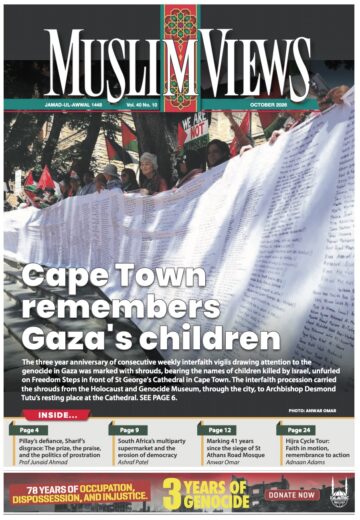
October 2026

October 2026

FILE SIZE : 59.04 MB
Download
Advertisement

Latest News

Nine million bicycles in Beijing: Romance and memory from tradition to modernity

24 October 2026 - Updated on 25 October 2026

Faith in motion: remembrance, discipline and action on the Hijra Cycle Tour

23 October 2026

Educators weigh up South Africa’s new African-centred history curriculum

23 October 2026 - Updated on 24 October 2026

Artists explore mental health through “siege and sanctuary” exhibition

22 October 2026

South Africa’s multiparty supermarket and the erosion of substantive democracy

22 October 2026

Shaikh Dien’s 1985 boycott khutbah and the modern Gaza-era BDS debate

22 October 2026
Advertisement
Advertisement
ABOUT MUSLIM VIEWS
About Us
Archives
Terms & Conditions
Privacy Policy
Contact Us
Donate to Muslim Views
NEWS
Local
National
World
OPINION
Columnists
Discussion with Dangor
Editorial
Guest Writers
FEATURES
AWQAF SA
Imam Haroon
Tributes
FINANCE
Islamic Finance
ISLAM
Eid
Faith and Practice
Family
Hajj and Umrah
Moulood
Quraan
Ramadaan
FEATURES
Arts
Books
Education
Food
Health
Motoring
Sport
Technology

© Muslim Views 2026. All Rights Reserved

Design by: theimagehouse

Loading...

[mc4wp_form id=6780]

No Result
View All Result
  • NEWS
    • Local
    • National
    • World
  • OPINION
    • Columnists
    • Discussions with Dangor
    • Editorial
    • Guest Writer
  • FEATURES
    • AWQAF SA
    • Imam Haron
    • Tributes
    • 1500 Years of Prophetic Legacy
  • LIFESTYLE
    • Arts
    • Books
    • Education
    • Food
    • Health
    • Motoring
    • Sport
    • Technology
  • FINANCE
    • Islamic Finance
  • ISLAM
    • Eid
    • Faith and Practice
    • Family
    • Hajj and Umrah
    • Moulood
    • Quran
    • Ramadaan
  • ARCHIVES
  • DONATE