












![The market-builder who restrained the market [Part 2]](https://muslimviews.co.za/wp-content/uploads/2026/08/PHOTO-2026-08-25-17-16-32-360x180.jpg)
![The merchant preceding the Prophetic mission [Part 1]](https://muslimviews.co.za/wp-content/uploads/2026/08/01-360x180.jpg)






The Muslim mortuary is expected to be completed within six months, providing capacity for six to eight bodies and reducing reliance on funeral parlours and over-stretched state facilities .
By SHAKIR ACHMAT
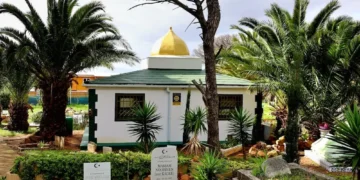
A historic milestone was reached at Mowbray Cemetery on Wednesday, November 5, 2025, as the foundation was laid for the first Muslim mortuary facility in the Cape. The event, attended by community members, religious leaders and supporters, marked the culmination of a vision decades in the making.
The ceremony, held under windy skies, underscored both the urgent need for Muslim-specific mortuary services and the challenges faced in securing a facility that aligns with Islamic principles. Organisers emphasised that the mortuary will not be used for forensic pathology or autopsies, but solely for dignified storage of Muslim bodies prior to ghusl (ritual washing) and janazah (funeral prayers).
Ayub Muhammad, a member of the cemetery board, explained: ‘We will not be performing forensics. We had many consultations with Professor Shabbir Wadee (a retired forensic pathologist). This is only a cold storage facility. We’re looking at between six and eight bodies, depending on how it comes out.’
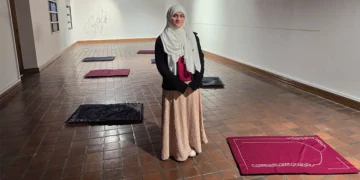
Planning began three years ago. ‘When we started this, the first thing we did was the structure we’re sitting under, because we needed a place to host people,’ said Ayub. ‘We did the salaah khana and the washroom as well. Importantly, we always wanted the mortuary because we knew there was a need. Alhamdulillah, after two years of planning, we eventually got approval in February, just before Ramadan.’
The new mortuary will feature solar power and backup generators to ensure uninterrupted operation. It is expected to be completed within six months, providing capacity for six to eight bodies and reducing reliance on funeral parlours and over-stretched state facilities.
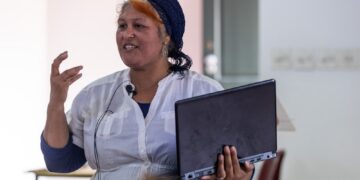
Speaking on behalf of the Muslim Judicial Council (MJC), Shaykh Riad Fataar described the project as a milestone for the Muslim community. ‘If you were to count the many favours that Allah grants, it’s innumerable — and the same applies for us as a community. Alhamdulillah, this is historical,’ he said.
You may also want to read


Shaykh Fataar highlighted that Muslim undertakers have long been unable to register professionally due to the absence of a mortuary. ‘Our undertakers cannot get qualified as undertakers because they cannot get registered unless there is a mortuary,’ he said.
He also drew attention to the plight of unclaimed Muslim bodies: ‘There are people lying in mortuaries that are Muslim that nobody knows about. They live on the streets — male and female — and nobody knows them. These bodies, at the moment, are going to non-Muslim mortuaries.’
The COVID-19 pandemic intensified these challenges, exposing the community’s vulnerability in burial logistics. ‘This preserves the dignity of the Ummah, which is all our responsibility,’ Fataar said.
Imam Mouti Saban, whose family has been involved in cemetery affairs for generations, shared a personal recollection: ‘I remember, about sixty years ago, my father woke me up on a Sunday morning. The hospital had phoned to say there’s a body that’s been in the mortuary for more than a month. If we don’t pick it up, they’re going to send it to UCT for spare parts.’
Professor Wadee, the adviser to the project, provided historical context: ‘After-hours autopsies started in 1984 when Willie van Nierkerk became Minister of Health. A concession was made that after-hours autopsies would be done for religious, cultural and ethical reasons. Unfortunately, over the last ten years, we’ve gone back to how it was then, if not worse. But we shall address that through the MJC and others.’
He also warned of the fate of unclaimed bodies: ‘If a body is not claimed, there are two options — it can be donated to the anatomy department for dissection, or it is cremated. Every four years, a tender is issued to dispose of unclaimed bodies. When I worked, the tenderer found it cheaper to cremate than to bury. I’m certain some Muslim people who died unclaimed were cremated. As Muslims, we cannot and will not agree to that.’
Advocate Shameemah Dollie Salie, speaking for the board, reflected on the project’s realisation: ‘When Allah plants a seed in our mind, that seed was planted long ago and is only taking fruit now. Alhamdulillah, it is time. We now have a storage facility that has started, and I encourage everyone to assist and sponsor the success of this project, insha Allah.’