

















![A mother’s taweez and the Cape’s interfaith traditions [+ video]](https://muslimviews.co.za/wp-content/uploads/2026/05/Michael-Weeder-Book-Launch-9May26-360x180.webp)










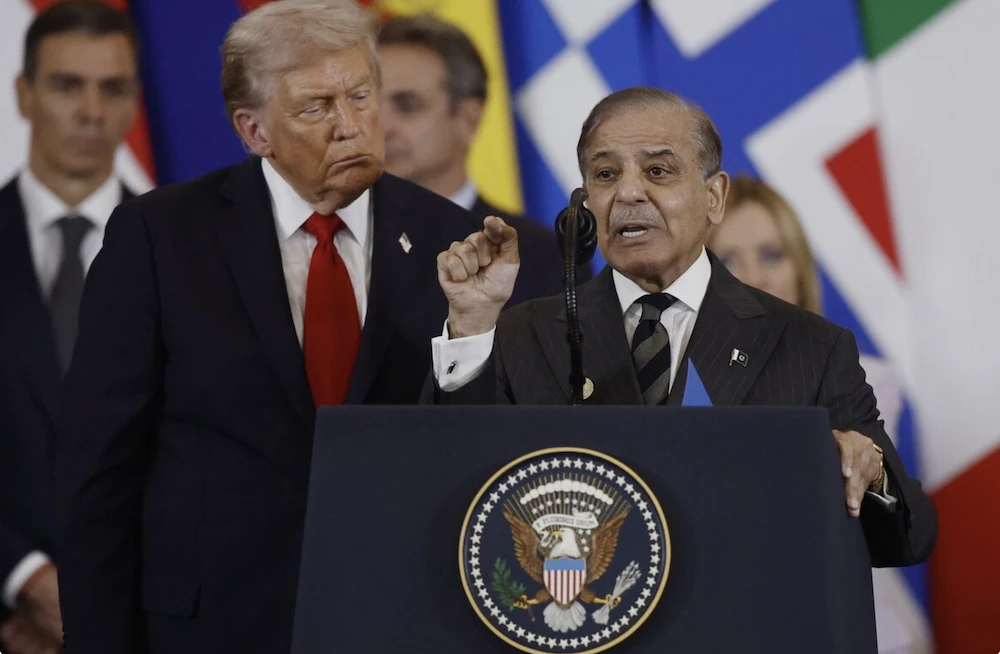

Pakistan’s claim of ‘permanent change’ is scrutinised against its political realities, exposing the gap between global posturing and domestic reform.
By PROFESSOR ZIYAD MOTALA
There are speeches that illuminate a nation’s condition, and there are speeches that conceal it beneath a varnish of borrowed pride. Shahbaz Sharif has offered the latter, proclaiming in an address on 8 April 2026 that Pakistan has “changed forever” and that the world now regards it with respect and honour because it played a mediating role in facilitating a truce between the United States and Iran. One searches in vain for evidence of this transformation anywhere beyond the choreography of flattery directed at Donald Trump, from whom this borrowed sense of honour appears to be derived.
Invoking the Qur’an to sanctify such claims only deepens the dissonance. Scripture is not a decorative prop to dignify expedience. To speak of truth, while courting approval through gestures so transparently contrived is not piety. It is performance. The sequence of events tells its own story. A tweet about peace, reportedly drafted by Trump and dutifully transmitted by Prime Minister Sharif, becomes the emblem of this supposed national renewal.
This is not statesmanship. It is supplication recast as diplomacy, a studied eagerness to please. It is, more plainly, a form of political pandering to Trump a figure widely regarded as crude, vindictive, and contemptuous of institutional restraint. To seek validation in such quarters, and to present it as national honour, is not merely misjudgment. It is a collapse of standards dressed up as success.
Had the Prime Minister announced that Pakistan was dismantling the architecture of sectarian violence, that would merit the language of permanent change. Had he confronted the feudal order that leaves vast tracts of land in the hands of a narrow oligarchy, that would signal reform. Had he acknowledged that democratic processes have been bent by military intervention and pledged their restoration through genuinely free and fair elections, that would command respect beyond Pakistan’s borders. Had he declared that Pakistan and India had reached a durable settlement on Kashmir, ending a conflict that has distorted both nations for generations, that would be a transformation that would not need to be advertised.
Instead, we are offered the spectacle of a government seeking validation abroad while avoiding candour at home. Respect is not conferred by proximity to power, still less by gestures designed to ingratiate. It is earned through difficult, often uncomfortable, domestic transformation. A nation does not become honourable because its leaders are seen to be in conversation with powerful allies. It becomes honourable when it disciplines its own institutions, curbs its own excesses, and speaks honestly to its own people.
If Pakistan were to announce a sustained campaign to expand literacy, especially for women, that would be change. If it were to end the weary cycle of family dynasties that rotate through power, jail, exile, and return with undiminished appetites, that would be reform. If it were to entrench the right to a fair trial, release Imran Khan from what are widely regarded as trumped up charges, and acknowledge that his party was widely perceived to have won the last election, that would signal a commitment to the rule of law. If it were to confront corruption not as a slogan but as a system to be dismantled, that would be progress. If it were to redefine civil-military relations so that governance resides where constitutions say it should, that would be transformation.
These are not rhetorical flourishes. They are measurable acts. They require neither applause from abroad nor validation from Washington. They require resolve. The claim that Pakistan has changed forever, on the strength of facilitating a ceasefire and echoing the language of others, reduces a nation of considerable potential to a stage upon which its leaders perform for external approval.
You may also want to read


Honour and respect do not arise from such performances. They arise from substance. They are the by-products of a state that governs itself with integrity, not one that advertises itself through borrowed lines and borrowed praise. In design, and implementation, a polity tethered to military dominance and insulated elites, corrupt to the core, cannot plausibly claim renewal. A military exists to defend the state against external enemies, not to dominate its economy or direct its political life. Where the barracks seep into the marketplace and the cabinet room, accountability withers and competence erodes.
Nor can a country plausibly claim transformation while labouring under the persistent perception that it ranks among the most corrupt in the world. That perception, fair or not, is not dispelled by proclamations or by proximity to powerful patrons. It is dispelled by prosecutions that reach the powerful, by institutions that resist capture, and by a political culture that ceases to treat public office as a private inheritance.
Until then, declarations of transformation will sound less like truth, and more like an appeal for approval from the very quarters whose favour is most eagerly sought, even at the cost of debasing oneself and diminishing the dignity of the state.
Professor Ziyad Motala is an authority in international law, constitutional law and comparative constitutional law, and professor at Howard University School of Law in Washington, DC.


