















![The market-builder who restrained the market [Part 2]](https://muslimviews.co.za/wp-content/uploads/2026/08/PHOTO-2026-08-25-17-16-32-360x180.jpg)
![The merchant preceding the Prophetic mission [Part 1]](https://muslimviews.co.za/wp-content/uploads/2026/08/01-360x180.jpg)





The resistance to the Nakba is also a resistance to the politics of spectacle. The empty glamour of Arab royalty, the staged reconciliation summits, and the oil-funded peace plans are part of the same machinery that enables genocide. It is no coincidence that while Gaza is reduced to rubble, the world’s elites gather in Davos and Doha, sipping cocktails and selling ‘stability’.
By PROFESSOR ASLAM FATAAR
Nakba as a living catastrophe
As we mark the annual commemoration of the 1948 Nakba – the Catastrophe – we remember with anguish and rage the ongoing annihilation of a people, their land, and their history. Zionism’s settler-colonial project was born not only in violence but in duplicity and racial supremacy.
The Zionist state emerged from the systematic theft of Palestinian land, the violent expulsion of over 750 000 Palestinians, and the obliteration of hundreds of towns and villages. It redefined Palestine through the eyes of a European ethno-nationalist fantasy, repopulating it with settlers while rendering its indigenous people landless, stateless, and invisible.

This foundational injustice did not end in 1948. The Nakba is not a historical episode. It is a continuing process of ethnic cleansing, occupation, and apartheid. Over the decades, Israel’s colonial architecture has only become more entrenched: the annexation of the West Bank, the construction of settlements, the imprisonment of generations without trial, the blockade and bombardment of Gaza, and the cold-blooded murder of civilians. Palestinian lives, under drones, rubble, checkpoints, and refugee camps, are continuously sacrificed at the altar of Zionist supremacy.
Sumūd and the legacy of resistance
Against this brutality, Palestinian resistance has been unrelenting. The First and Second Intifada remain towering moments in the annals of decolonial struggle, where a besieged people confronted one of the most militarised states in the world with stones, poetry, community networks, and a stubborn insistence on dignity.
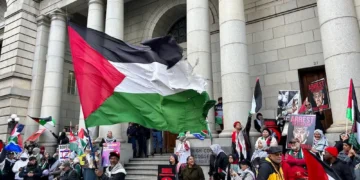
Their sumūd, their steadfastness, continues to inspire liberation movements across the globe. From Cape Town to New York and Caracas, and Jakarta to Johannesburg, millions have risen in solidarity, bearing witness to the unbroken cry: ‘Free Palestine!’
We honour the martyrs of this protracted Nakba. We remember the disappeared, the bombed, the starved, the orphaned. Their deaths compel not just mourning but mobilisation. They urge us to resist the Zionist regime, its genocidal machinery, and the imperial networks that sustain it.
The Arab royal Spectacle: Betrayal in plain sight
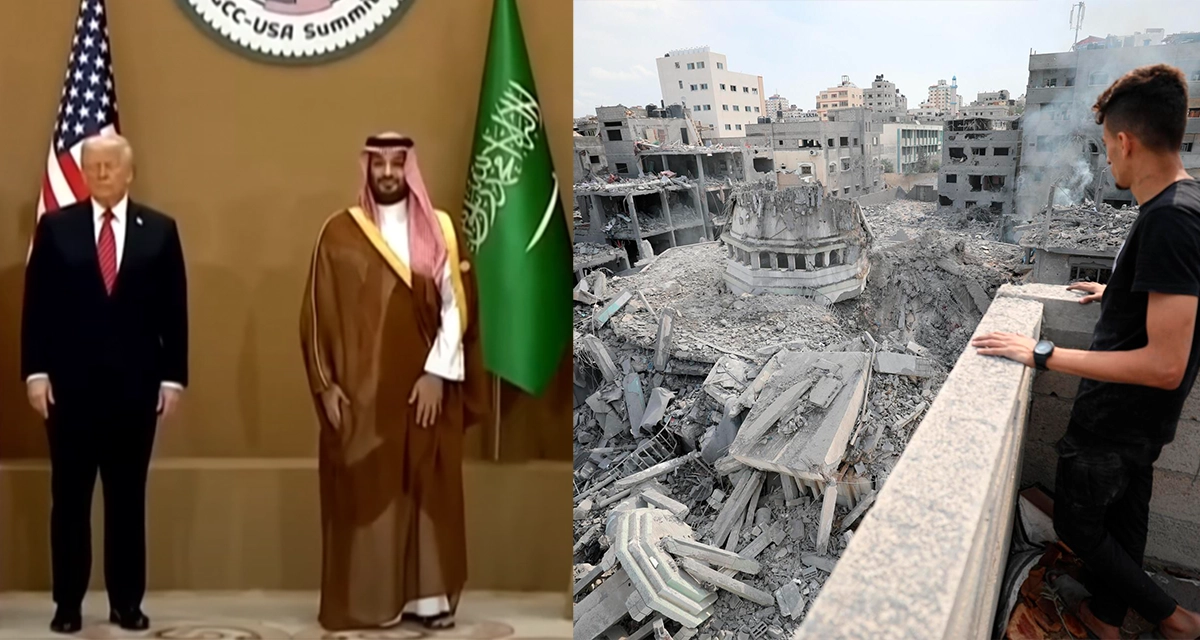
Even in this time of grief and defiance, we are confronted by a parallel and repugnant reality: the shameless spectacle of betrayal by Arab regimes. In the very week leading up to this year’s Nakba commemoration, the royal households of Saudi Arabia, the United Arab Emirate (UAE), and Qatar outdid themselves in staging grotesque displays of submission to empire.
Donald Trump – a man who moved the US embassy to Jerusalem, oversaw the Abraham Accords, enabled Netanyahu’s massacres, and welcomed a delegation of South African white supremacists to the US – was feted with obscene opulence. Gold-plated ceremonies, extravagant horse parades, laser shows, and sycophantic praise dominated media screens while Gaza lay in ruins and Palestinian blood soaked the earth.
This was not diplomacy. It was idolatry. These regimes worship not God, but the golden calf of uber-consumption without conscience. Their politics are not rooted in justice, but in manipulation, deception, and spectacle. They deploy religious symbolism as camouflage, projecting images of piety while allying themselves with war criminals and Islamophobes. They use mass media not to uplift the spirit of their people, but to project dazzling illusions that conceal the rot at their core.
False eternities and fragile economies
These monarchies rule as if eternal, shielded by oil wealth and Western protection. Yet beneath the glitz, their economic foundations are crumbling. Fossil-fuel dependence is no longer sustainable. Climate change, resource depletion, and global energy transitions threaten their model of excess and extravagance. In their desperation, they double down on repression at home and complicity abroad, accelerating their collapse.
The cultural vulgarity of their displays, diamond-encrusted mosques, skyscrapers shaped like swords, sand turned into synthetic winter resorts, cannot disguise their moral bankruptcy. Their spectacle is a lie in plain sight. They hope that we will be dazzled into silence. But we must not be.
Planetary apathy and the abandonment of the poor
Their politics are rooted in exclusion. The poor in their own societies, the working classes across the Arab world, and the vulnerable in Sudan, South Africa, Yemen, Palestine, and the Congo, all fall outside their field of vision. These elites are untroubled by famine in Darfur, refugee boats sinking in the Mediterranean, the suffering in Arab cities, or children dying under Israeli bombs. Their gaze does not stretch to the Cape Flats, to shack settlements, to the unemployed or displaced. These lives simply do not register.
They have no vision for the future of the Arab world, no commitment to the oppressed, and no desire for regional or planetary justice. They refuse to act in defence of the earth, of the displaced, of the vulnerable. Instead, they despoil the planet through carbon excess, fund proxy wars, and pour weapons into conflicts in Sudan, Libya, and Yemen, fuelling cycles of endless devastation.
They have become active agents of planetary degradation. In a world reeling from climate catastrophe, war, and mass displacement, these regimes refuse to back ecological sustainability or peacebuilding. Their alliances are with weapons manufacturers and fossil fuel barons, not with those working toward an end to war, hunger, and environmental collapse. They neither plant trees nor disarm bombs. They neither build schools nor cancel debts. They are merchants of illusion and death.
Refusing spectacle, building a global solidarity
This moment demands a global politics of refusal of spectacle, betrayal, and complicity. Against these regimes of deception, a new solidarity must rise. One that centres the poor, the colonised, the displaced. One that seeks justice for Palestinians not as a token cause but as emblematic of the broader planetary struggle against dispossession.
This is not a vision that measures progress by GDP or towering infrastructure, but by the flourishing of human and non-human life. We must envision a pro-poor politics of just living, rooted in dignity, equity, and sustainability across all borders. Let the grotesque performances of Arab royalty be our prompt to resist. Let them signal the urgent need for a planetary ethics, grounded in solidarity with the vulnerable and in active resistance to systems of domination.
The rising chorus of the people
You may also want to read



Let us be clear: the Arab street still resists. In Tunis, Algiers, Baghdad, Khartoum, and Nablus, people chant for justice. They march. They mourn. They organise. The ruling classes may sell out Palestine for surveillance tech and defence contracts, but their peoples remain unconquered. Their dreams are not brokered by Western PR firms or Emirati think tanks.
The resistance to the Nakba is also a resistance to the politics of spectacle. The empty glamour of Arab royalty, the staged reconciliation summits, and the oil-funded peace plans are part of the same machinery that enables genocide. It is no coincidence that while Gaza is reduced to rubble, the world’s elites gather in Davos and Doha, sipping cocktails and selling ‘stability’.
But the silence is cracking. Students are rising. Unions are mobilising. Artists are refusing to perform. Faith leaders are calling out injustice. A new moral horizon is forming – one in which Palestine is not erased, in which the poor are not invisible, and in which the planet’s future is not traded for arms deals.
Palestine as the cry of the Earth
The Nakba is not only a wound. It is a rallying cry. We are called not only to mourn, but to organise. Not only to remember, but to resist. Let the grotesque spectacle of Arab regimes be the spark that ignites a new, principled, pro-poor, and planetary politics of justice.
We rise in honour of all who have perished in the long Nakba. In solidarity with those resisting in Gaza’s rubble, we stand. Against betrayal and cowardice, we declare: Palestine will be free. And so too will Sudan, and Yemen, and every place where dignity is denied. And the earth, too, will breathe again.
Professor Aslam Fataar is Research Professor in Higher Education Transformation, based in the Department of Education Policy Studies, Stellenbosch University.