


![Does ta’wīl mean interpretation or fulfilment? A Quranic reassessment [+video]](https://muslimviews.co.za/wp-content/uploads/2026/10/Tawil-Kaskas-360x180.webp)










![Why becoming a wealthy Muslim is commendable in Islam [+videos]](https://muslimviews.co.za/wp-content/uploads/2026/09/Muslim-Trade-Business-1-360x180.webp)


![The market-builder who restrained the market [Part 2]](https://muslimviews.co.za/wp-content/uploads/2026/08/PHOTO-2026-08-25-17-16-32-360x180.jpg)






By ANWAR OMAR
On Heritage Day, Newlands and Claremont residents retraced streets scarred by slavery, forced removals and apartheid, reclaiming erased histories of community, faith, resistance and non-racial sport through an annual walk of remembrance.
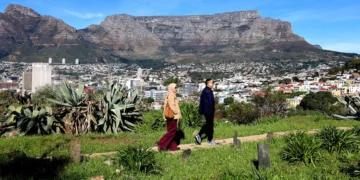
This Heritage Day, Thursday, September 24, 2026, the Newlands/Claremont Heritage, Environmental Justice and Restitution Society (NCHERS) held its fifth annual Walk of Remembrance, described by its steering committee as an act of resistance against the slow violence of erasure.
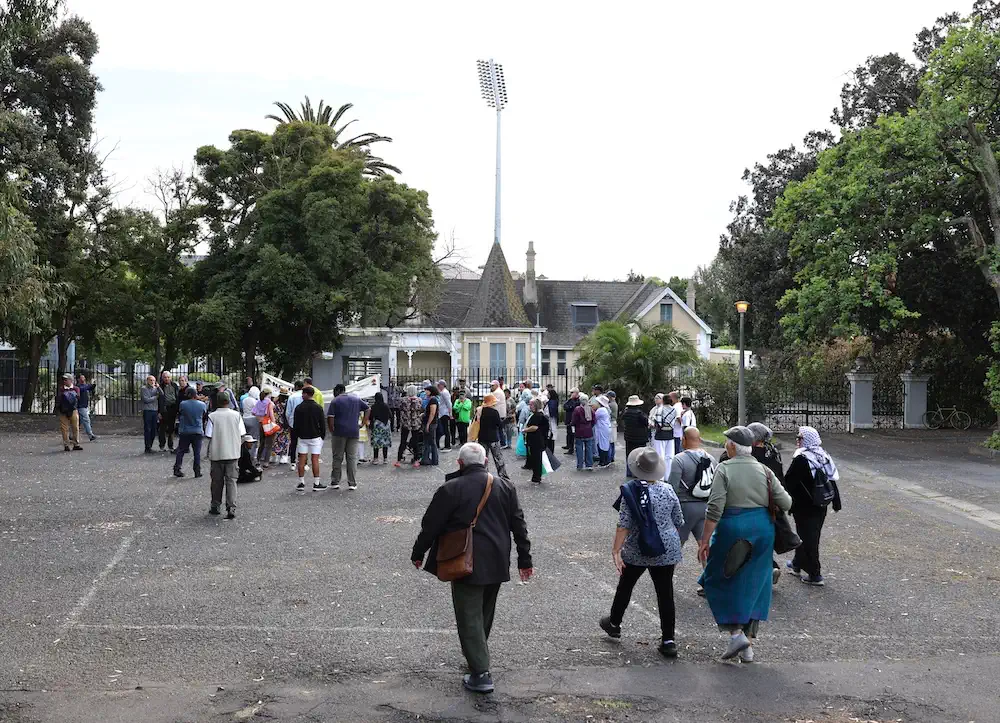
The event began at 9am with NCHERS’s Annual General Meeting at the Newlands Cricket Experience Museum, with a heritage exhibition running in parallel throughout the proceedings. At 9.30am, the walk set off from the main gate of Newlands Cricket Ground, tracing a route through streets that once held homes, schools, shops and places of worship before apartheid’s forced removals scattered the community across the Cape Flats.
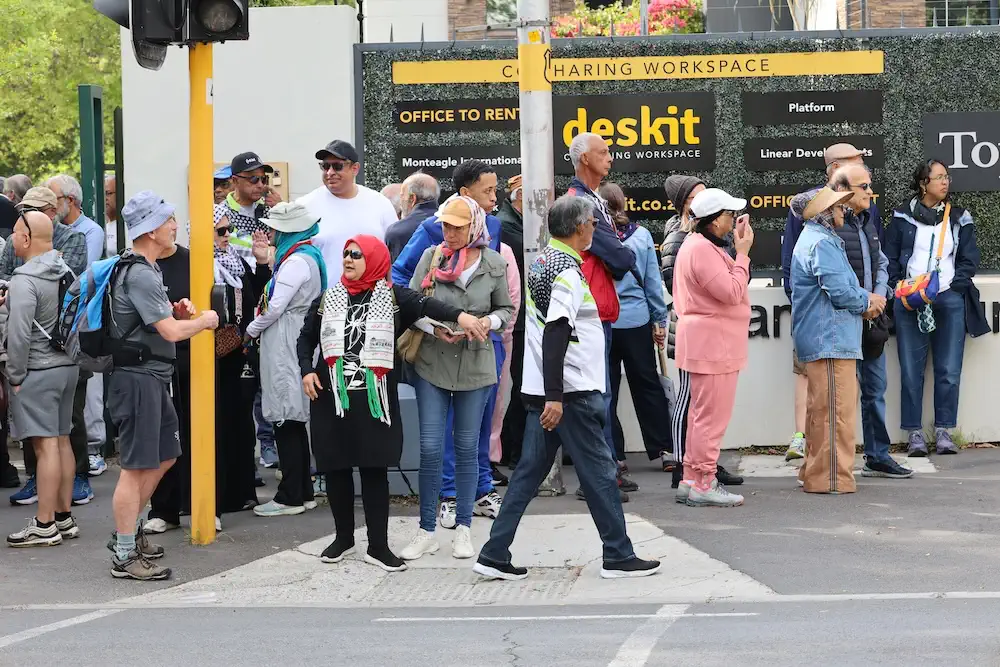
Along the way, speakers addressed the gathering at several of the route’s stops, weaving oral history, testimony and reflection into the walk. The walk culminated with a talk from journalist and author Dougie Oakes on the history of non-racial sport in South Africa.
Centuries of history
Any account of Newlands and Claremont’s dispossession must begin long before the Group Areas Act. Speaking at the Newlands Cricket Sports Complex, historian Abdu Dayaan Petersen described the area three to four hundred years ago as home to indigenous Khoi communities who moved across the Cape Peninsula for centuries and made Newlands one of their residential grounds.
Petersen traced how that changed under Dutch colonial expansion led by Jan van Riebeeck, whose administration expelled the indigenous inhabitants and established an outpost called Nieuwe Land — the origin of Newlands’ name — anchored by a farm built by enslaved people trafficked largely from Madagascar and Mozambique. Neighbouring farms emerged soon after, including Mariendal, after which part of the route is named.
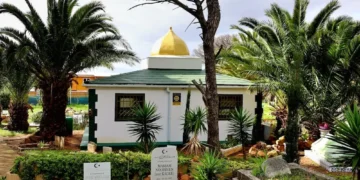
As slavery ended in the 1830s, Petersen highlighted Darius of the Cape, who won his freedom before emancipation and petitioned the governor to remove his name from the slave record, an act of agency preserved, he said, in the archival record. Darius’s descendants helped build the Claremont Main Road Mosque, whose minaret still stands on the route.
Petersen stressed that it was these formerly enslaved residents, not the settlers, who built Claremont, Wynberg and Newlands, founding businesses, churches, mosques and burial grounds, including the Stegman Road cemetery. That community was later stripped of this land and displaced onto the Cape Flats. Yet residents kept returning to worship, keeping memory alive and explaining why, Petersen argued, people could still gather today to honour that connection.
Two houses of worship, one community
That living connection is embodied in NCHERS’s own genesis, founded by two neighbouring houses of worship, St Saviour’s Anglican Church and the Claremont Main Road Masjid, testimony to a community where Christians, Muslims and others once lived in ordinary coexistence. Imam Rashied Omar of the Masjid, a NCHERS steering committee member, said that these sacred spaces remain among the few tangible threads connecting displaced families to homes they were forced to abandon, drawing many back to worship there today.
For Omar, the theological implications are profound. He cites the Quranic teaching that God made humanity into nations and tribes so people might know one another, framing diversity as divine intention, not something for planners to erase. According to him, apartheid’s spatial planning was as much a theological failure as a political one, a defiance the walk embodies.
The route: three stops, three scars
The walk followed a route with three principal stops, each carrying its own significance, where speakers addressed the gathering. Starting at Newlands Cricket Ground, the route crossed the bridge onto Main Road and passed the Claremont Main Road Mosque before turning into Draper Street.
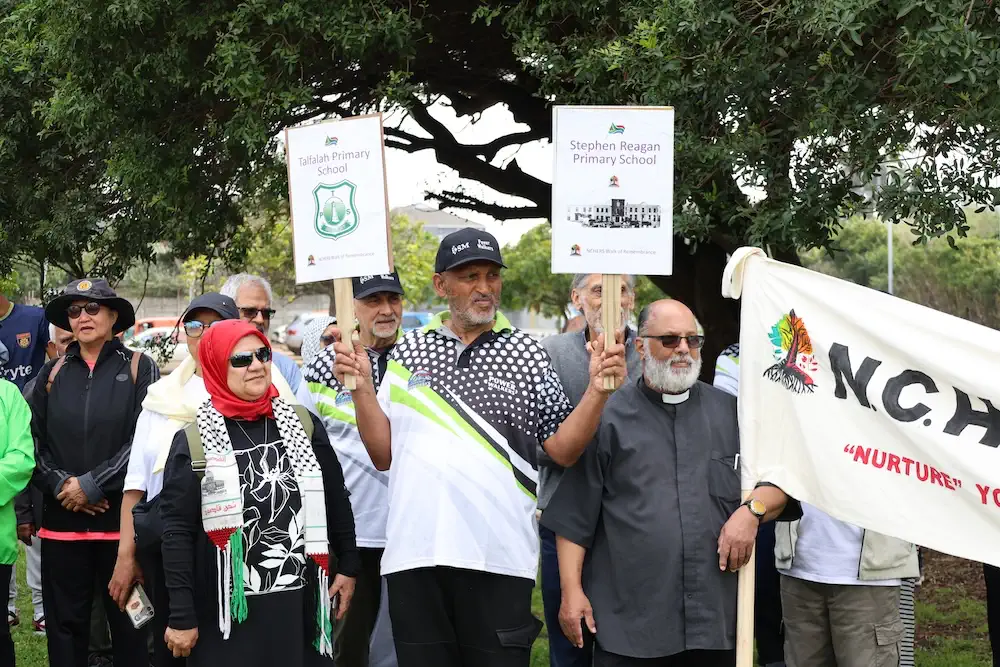
Draper Square, just off Main Road, is where former residents recalled how their families and institutions once filled the space, including Talfalah Primary School and the Orpheum Bioscope, ordinary community institutions that, in Omar’s words, dared to flourish.
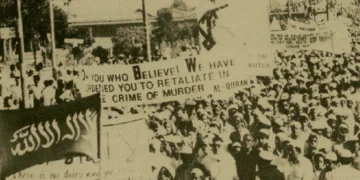
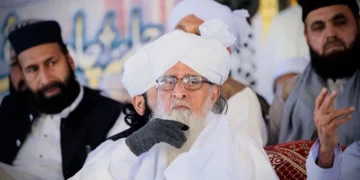
Passing beneath the subway into lower Draper Street and around by Palmyra Road, the walk reached its second stop, the Stegman Road Masjid, where the group paused to honour Imam Abdullah Haron, who resisted forced removals and the broader machinery of apartheid before he was killed in an apartheid detention cell on September 27, 1969. This year, the walk fell within days of the 57th anniversary of his death, and Haron’s youngest daughter, Fatima Haron-Masoet — now deputy chair of NCHERS — walked the route as a living reminder that this history remains woven into the fabric of the community.
The Athenaeum: an intellectual hub
Retracing the route down Stegman Road and along Palmyra Road into Mariendhal, walkers passed under the bridge to reach the Cape Town Athenaeum, an institution that bore witness to resistance through learning. During the 1960s and into the early 1970s — a period of house arrests, bannings and imprisonment — the Athenaeum was an intellectual hub for the Teachers’ League of South Africa and the wider Non-European Unity Movement (NEUM).
Speaking outside the building, Yusuf Adams recalled it as home to the South Peninsula Educational Fellowship (SPEF), one of several NEUM cultural bodies. SPEF used lectures, film, poetry and art to build political awareness beyond school curricula, linking local struggles to liberation movements worldwide. Adams credited much of its depth to Dawood Parker, whose personal library opened that world to those who gathered there.
Among the Teachers’ League’s towering figures was RO Dudley, whose philosophy of non-collaboration and boycott challenged apartheid rigorously. It is a matter of continuity, Omar has noted, that Dudley’s son, Russell Dudley, now chairs NCHERS alongside deputy chair Fatima Haron-Masoet. This tradition has largely been written out of South Africa’s liberation story and, in Omar’s words, is a form of erasure — one the work of NCHERS tries to correct.
You may also want to read





The legacy of Hassan Howa
The walk’s start and end at Newlands Cricket Stadium carry their own layered history, bound up with Hassan Howa, the anti-apartheid sports administrator and founder of the non-racial South African Council on Sport.
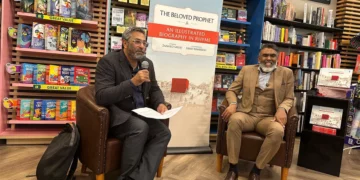
The commemoration culminated with journalist Dougie Oakes, author of Howa’s biography, No Normal Sport, speaking at the Newlands Cricket Experience Museum on Howa’s life and the wider history of resistance through sport. Oakes described a relationship with Howa dating to his own days as a junior cricketer, through his later reporting on non-racial cricket, to writing the biography, a project he insisted would not be a “sweetheart book”, growing from 12 planned chapters to more than 20.
Howa remains most closely tied to the cry “no normal sport in an abnormal society”, a phrase Oakes explained has a disputed origin, but one so fitting to his advocacy that it became linked to him. Oakes pointed to Howa’s persistence against long odds as his defining lesson. He challenged the apartheid sporting establishment, conscious that the fight would be long, and built a movement around it. Oakes recalled Howa’s refusal of life membership from Western Province Cricket, and his refusal to ever set foot at Newlands again, a stubbornness his sons carried forward.
That the walk began and ended at a ground Howa refused to visit was, in its own way, a fitting reminder that the struggle for justice was waged on every terrain, and that Newlands remains a site where race and belonging were fiercely contested.
A community reaffirmed
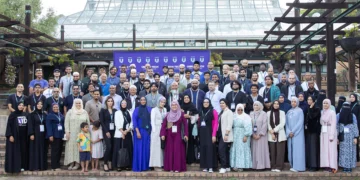
The walk drew residents, former residents and members of the wider public back to an area many still consider home in spirit, even if they no longer live there. NCHERS called on the community to remember the sons and daughters of Claremont and Newlands, to honour the legacies of Imam Abdullah Haron, RO Dudley and Hassan Howa, and to affirm, with each year’s walk, that what was unjustly taken must be identified, remembered and, one day, restored.