































![The market-builder who restrained the market [Part 2]](https://muslimviews.co.za/wp-content/uploads/2026/08/PHOTO-2026-08-25-17-16-32-360x180.jpg)
![The merchant preceding the Prophetic mission [Part 1]](https://muslimviews.co.za/wp-content/uploads/2026/08/01-360x180.jpg)












PROFESSOR ASLAM FATAAR
IN 2026, the world will commemorate the 400th anniversary of the birth of Shaikh Yusuf al-Maqassari, a towering figure in Islamic scholarship, resistance and the transoceanic exchange of ideas.
Born in South Sulawesi, Indonesia, he became a revered Sufi leader and an unwavering opponent of colonial oppression. His exile by the Dutch East India Company (VOC) led him to Ceylon and, ultimately, the Cape of Good Hope, where he became a foundational figure in South Africa’s Islamic heritage.
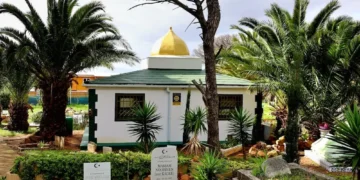
Shaikh Yusuf’s life exemplifies resilience in the face of colonial domination. His intellectual journey took him across the Indian Ocean, shaping his legacy as a scholar, political leader and spiritual guide. His exile to the Cape in 1694 was intended to silence him, but instead, it catalysed the establishment of Islam in South Africa. His tomb in Faure, outside Cape Town, remains a symbol of spiritual continuity and resistance, drawing visitors from across the world.
Early life and intellectual journey
Shaikh Yusuf was born on July 3, 1626 in the Sultanate of Gowa, an influential Islamic kingdom in eastern Indonesia.
His early education in Sulawesi introduced him to Islamic jurisprudence, theology and Sufism. Seeking deeper knowledge, he embarked on a journey that took him through Aceh, India, Yemen and the Haramayn (Makkah and Madinah), where he studied under some of the most prominent scholars of the time.
In the Middle East, he joined the Khalwatiyah Sufi order under Shaikh Ayyub al-Khalwati, absorbing teachings that would later inform his spiritual and political leadership. His exposure to the Naqshbandiyah and Qadiriyah orders further expanded his understanding of Sufi practices and their role in fostering social cohesion and resistance.
Return to Indonesia and anti-colonial struggle
In1667, Shaikh Yusuf returned to Indonesia, settling in Banten, a thriving port city and a centre of Islamic learning.
Sultan Ageng Tirtayasa appointed him Shaikh al-Islam, strengthening his influence at the royal court. During this period, he played a crucial role in uniting resistance efforts against the Dutch, who sought to control the spice trade and weaken indigenous Muslim polities.
The VOC, recognising his ability to mobilise opposition, viewed him as a serious threat. In 1683, after Sultan Ageng was captured, Shaikh Yusuf resisted but was eventually arrested and exiled to Batavia (Jakarta). The Dutch, fearing his enduring influence, transferred him to Ceylon (Sri Lanka) in 1684, where he continued to write and teach, maintaining his resistance networks.
Exile to the Cape of Good Hope
In 1694, the VOC moved Shaikh Yusuf to the Cape of Good Hope to isolate him from the Southeast Asian world. However, he became a beacon of faith and defiance rather than being silenced. Settled in Zandvliet (now Faure), he gathered a community of exiles, enslaved people and indigenous converts. His presence catalysed the spread of Islam in the Cape, establishing a foundation for what would become a resilient Muslim community.
At a time when enslaved people and political exiles were systematically oppressed, Shaikh Yusuf’s teachings provided a spiritual refuge and a source of identity. His Sufi practices centred on dhikr (remembrance of God) and communal solidarity. They helped cultivate a sense of resistance and hope among the disenfranchised. His influence extended beyond religious practice, shaping cultural traditions and social structures that endured long after he died in 1699.
You may also want to read



A transoceanic legacy
Shaikh Yusuf’s impact is felt across continents.
In Indonesia, he is honoured as a national hero for his resistance against colonialism. His writings, which include reflections on Sufi philosophy and the unity of being (Wahdat al-Wujud), continue to influence Islamic scholarship.
In South Africa, his tomb remains a pilgrimage site, symbolising Islam’s enduring presence in the region.
His life exemplifies the interconnectedness of the early modern (16th to 18th century) Indian Ocean world, where scholars, traders and resistance leaders navigated transregional networks of knowledge and power. His journey – from Sulawesi to Banten, Aceh, the Arabian Peninsula, Ceylon and the Cape – illustrates how intellectual and spiritual traditions transcended national boundaries, shaping diverse Muslim communities.
Commemorating 400 Years
As 2026 approaches, commemorations of Shaikh Yusuf’s 400th anniversary should provide an opportunity to reflect on his legacy. At a time when issues of displacement, identity and resistance remain globally relevant, Shaikh Yusuf’s life offers enduring lessons. His legacy reminds us of the power of faith in confronting oppression, the resilience of communities in exile, and the transformative potential of knowledge. Four centuries after his birth, his story inspires those seeking justice, dignity and spiritual enlightenment