



Muslim Views
No Result
View All Result
  • News
    • All
    • Local
    • National
    • World
    The greatest monuments are not in stone, but in lives transformed

    The greatest monuments are not in stone, but in lives transformed

    Mass march to Parliament planned to combat xenophobia and Afrophobia

    Mass march to Parliament planned to combat xenophobia and Afrophobia

    How Sanef is helping journalists build mental resilience

    How Sanef is helping journalists build mental resilience

    Awqaf SA strengthens water security at Rahima Moosa Hospital

    Awqaf SA strengthens water security at Rahima Moosa Hospital

    Bo-Kaap forum reveals first steps to tackle gentrification

    Bo-Kaap forum reveals first steps to tackle gentrification

    The Sunnah as a way of being: The path to complete humanity

    The Sunnah as a way of being: The path to complete humanity

    Amaanat chief must account for R646m of payments in civil claims

    Amaanat chief must account for R646m of payments in civil claims

    Politicians debate: Who owns the Cape?

    Politicians debate: Who owns the Cape?

    Cape Town’s interfaith leaders confront hard truths

    Cape Town’s interfaith leaders confront hard truths

    Lessons from the leadership workshop

    Lessons from the leadership workshop

    • National
    • World
    • Local
  • Opinion
    • All
    • Columnists
    • Discussions with Dangor
    • Editorial
    • Guest Writer
    More than a game, or the Clash of Titans

    More than a game, or the Clash of Titans

    An empire battered, bluffing and buying time

    An empire battered, bluffing and buying time

    India’s Israeli mirror: A template for moral decline

    India’s Israeli mirror: A template for moral decline

    Notes from the launch of the School of Solidarity

    Notes from the launch of the School of Solidarity

    From green claims to verified impact through environmental risk-sharing

    From green claims to verified impact through environmental risk-sharing

    Integrity versus opportunism in activism

    Integrity versus opportunism in activism

    Mendelsohn-Choritz: Why this vindictive action?

    Mendelsohn-Choritz: Why this vindictive action?

    How colonial capital is using the DA to keep South Africa managed

    How colonial capital is using the DA to keep South Africa managed

    Europe’s summer heatwave exposes the cost of global energy extraction

    Europe’s summer heatwave exposes the cost of global energy extraction

    Xenophobia: There is no human being who is illegal

    Xenophobia: There is no human being who is illegal

  • Features
    • All
    • 1500 Years of Prophetic Legacy
    • AWQAF SA
    • General Features
    • Imam Haron
    • Tributes
    The greatest monuments are not in stone, but in lives transformed

    The greatest monuments are not in stone, but in lives transformed

    Legacy of educator Haji Mogamat Rashad Jedaar lives on

    Legacy of educator Haji Mogamat Rashad Jedaar lives on

    Reclaiming agency: From ritual to action Part 3

    Reclaiming agency: From ritual to action Part 3

    June 16, the Call of Islam, and the many rivers of liberation

    June 16, the Call of Islam, and the many rivers of liberation

    Reclaiming agency: From ritual to action Part 2

    Reclaiming agency: From ritual to action Part 2

    Reclaiming agency: From ritual to action Part 1

    Reclaiming agency: From ritual to action Part 1

    Goolam Hoosain Abed: The last of the famous sporting family departs

    Goolam Hoosain Abed: The last of the famous sporting family departs

    Abdullah Ibrahim crafted a magnificent new culture for South Africa

    Abdullah Ibrahim crafted a magnificent new culture for South Africa

    The hidden heritage of racial ‘passing’

    The hidden heritage of racial ‘passing’

    The Commonwealth war graves at the Mowbray Muslim Cemetery

    The Commonwealth war graves at the Mowbray Muslim Cemetery

    Honouring a chess giant: The legacy of Dr Shabier Bhawoodien

    Honouring a chess giant: The legacy of Dr Shabier Bhawoodien

    Mapping national and provincial heritage at the Mowbray Muslim Cemetery

    Mapping national and provincial heritage at the Mowbray Muslim Cemetery

    Reclaiming Nordic solidarity in South Africa’s liberation

    Reclaiming Nordic solidarity in South Africa’s liberation

    Abdeyah da Costa and the dihlīz of Dorp Street

    Abdeyah da Costa and the dihlīz of Dorp Street

    A life dedicated to Qur’an education and madrasah teaching

    A life dedicated to Qur’an education and madrasah teaching

  • Lifestyle
    • All
    • Arts
    • Books
    • Education
    • Food
    • Health
    • Motoring
    • Sport
    • Technology
    More than a game, or the Clash of Titans

    More than a game, or the Clash of Titans

    Help Ruqaya Ismail represent SA at the Commonwealth Fencing Championship

    Help Ruqaya Ismail represent SA at the Commonwealth Fencing Championship

    Goolam Hoosain Abed: The last of the famous sporting family departs

    Goolam Hoosain Abed: The last of the famous sporting family departs

    Abdeyah da Costa and the dihlīz of Dorp Street

    Abdeyah da Costa and the dihlīz of Dorp Street

    A mother’s taweez and the Cape’s interfaith traditions [+ video]

    A mother’s taweez and the Cape’s interfaith traditions [+ video]

    Inaugural Islamic Expo to be hosted in Cape Town

    Inaugural Islamic Expo to be hosted in Cape Town

    Imraan Buccus on faith, activism and SA’s political crisis

    Imraan Buccus on faith, activism and SA’s political crisis

    The Book of Mercy: A powerful Ramadan read on compassion in Islam

    The Book of Mercy: A powerful Ramadan read on compassion in Islam

    UpScrolled and the rise of ethical Muslim tech in a censored digital world

    UpScrolled and the rise of ethical Muslim tech in a censored digital world

    Armien Jabaar and a lifetime of cricketing excellence

    Armien Jabaar and a lifetime of cricketing excellence

  • Finance
    • All
    • Islamic Finance
    Today’s two-pot withdrawal could threaten tomorrow’s retirement security

    Today’s two-pot withdrawal could threaten tomorrow’s retirement security

    War clouds gather over the Islamic finance boom

    War clouds gather over the Islamic finance boom

    Israel and the perfect storm of global economic isolation

    Israel and the perfect storm of global economic isolation

    AI needs an ethical compass, say Islamic finance researchers

    AI needs an ethical compass, say Islamic finance researchers

    From green claims to verified impact through environmental risk-sharing

    From green claims to verified impact through environmental risk-sharing

    Amaanat chief must account for R646m of payments in civil claims

    Amaanat chief must account for R646m of payments in civil claims

    The $6 trillion shift in global Islamic Finance

    The $6 trillion shift in global Islamic Finance

    The ultimate Shariah Wealth Report: A free Islamic inheritance calculator

    The ultimate Shariah Wealth Report: A free Islamic inheritance calculator

    Muslims must ensure their savings do not finance war

    Muslims must ensure their savings do not finance war

    Banking that works for every family

    Banking that works for every family

  • Islam
    • All
    • Eid
    • Faith and Practice
    • Family
    • Hajj and Umrah
    • Moulood
    • Quran
    • Ramadaan
    Can our mosques become the heart of the Ummah?

    Can our mosques become the heart of the Ummah?

    Karbala – between obligation and inability

    Karbala – between obligation and inability

    16 June 1976: Qibla’s call to conscience

    Reclaiming our future – drawing lessons from Karbala and Soweto 1976

    Karbala, Gaza and xenophobia: Why history still matters today

    Karbala, Gaza and xenophobia: Why history still matters today

    Adnaan Adams (right) addressing the congregation at Masjidut Taqwa in Newfields Estate, Cape Town, on Friday, June 12. (Photo: Supplied)

    Reflecting on a khutbah and the community it seeks to serve

    The panellists at the Muslim Personal Law symposium at the University of Cape Town on June 8, clockwise from top right: Professor Fatima Seedat, Ayesha Royker, Rehema Namukose and Khensani Motlhante. (Photos: Anwar Omar)

    Advancing gender justice in Muslim Personal Law

    What do we owe the Earth?

    What do we owe the Earth?

    Hajj, human frailty and the compassion of Allah

    Hajj, human frailty and the compassion of Allah

    At Hajj we gather pebbles, but the devils remain standing

    At Hajj we gather pebbles, but the devils remain standing

    The Prophet’s enduring call against racism and inequality

    The Prophet’s enduring call against racism and inequality

  • Archives
  • Donate
Muslim Views
  • News
    • All
    • Local
    • National
    • World
    The greatest monuments are not in stone, but in lives transformed

    The greatest monuments are not in stone, but in lives transformed

    Mass march to Parliament planned to combat xenophobia and Afrophobia

    Mass march to Parliament planned to combat xenophobia and Afrophobia

    How Sanef is helping journalists build mental resilience

    How Sanef is helping journalists build mental resilience

    Awqaf SA strengthens water security at Rahima Moosa Hospital

    Awqaf SA strengthens water security at Rahima Moosa Hospital

    Bo-Kaap forum reveals first steps to tackle gentrification

    Bo-Kaap forum reveals first steps to tackle gentrification

    The Sunnah as a way of being: The path to complete humanity

    The Sunnah as a way of being: The path to complete humanity

    Amaanat chief must account for R646m of payments in civil claims

    Amaanat chief must account for R646m of payments in civil claims

    Politicians debate: Who owns the Cape?

    Politicians debate: Who owns the Cape?

    Cape Town’s interfaith leaders confront hard truths

    Cape Town’s interfaith leaders confront hard truths

    Lessons from the leadership workshop

    Lessons from the leadership workshop

    • National
    • World
    • Local
  • Opinion
    • All
    • Columnists
    • Discussions with Dangor
    • Editorial
    • Guest Writer
    More than a game, or the Clash of Titans

    More than a game, or the Clash of Titans

    An empire battered, bluffing and buying time

    An empire battered, bluffing and buying time

    India’s Israeli mirror: A template for moral decline

    India’s Israeli mirror: A template for moral decline

    Notes from the launch of the School of Solidarity

    Notes from the launch of the School of Solidarity

    From green claims to verified impact through environmental risk-sharing

    From green claims to verified impact through environmental risk-sharing

    Integrity versus opportunism in activism

    Integrity versus opportunism in activism

    Mendelsohn-Choritz: Why this vindictive action?

    Mendelsohn-Choritz: Why this vindictive action?

    How colonial capital is using the DA to keep South Africa managed

    How colonial capital is using the DA to keep South Africa managed

    Europe’s summer heatwave exposes the cost of global energy extraction

    Europe’s summer heatwave exposes the cost of global energy extraction

    Xenophobia: There is no human being who is illegal

    Xenophobia: There is no human being who is illegal

  • Features
    • All
    • 1500 Years of Prophetic Legacy
    • AWQAF SA
    • General Features
    • Imam Haron
    • Tributes
    The greatest monuments are not in stone, but in lives transformed

    The greatest monuments are not in stone, but in lives transformed

    Legacy of educator Haji Mogamat Rashad Jedaar lives on

    Legacy of educator Haji Mogamat Rashad Jedaar lives on

    Reclaiming agency: From ritual to action Part 3

    Reclaiming agency: From ritual to action Part 3

    June 16, the Call of Islam, and the many rivers of liberation

    June 16, the Call of Islam, and the many rivers of liberation

    Reclaiming agency: From ritual to action Part 2

    Reclaiming agency: From ritual to action Part 2

    Reclaiming agency: From ritual to action Part 1

    Reclaiming agency: From ritual to action Part 1

    Goolam Hoosain Abed: The last of the famous sporting family departs

    Goolam Hoosain Abed: The last of the famous sporting family departs

    Abdullah Ibrahim crafted a magnificent new culture for South Africa

    Abdullah Ibrahim crafted a magnificent new culture for South Africa

    The hidden heritage of racial ‘passing’

    The hidden heritage of racial ‘passing’

    The Commonwealth war graves at the Mowbray Muslim Cemetery

    The Commonwealth war graves at the Mowbray Muslim Cemetery

    Honouring a chess giant: The legacy of Dr Shabier Bhawoodien

    Honouring a chess giant: The legacy of Dr Shabier Bhawoodien

    Mapping national and provincial heritage at the Mowbray Muslim Cemetery

    Mapping national and provincial heritage at the Mowbray Muslim Cemetery

    Reclaiming Nordic solidarity in South Africa’s liberation

    Reclaiming Nordic solidarity in South Africa’s liberation

    Abdeyah da Costa and the dihlīz of Dorp Street

    Abdeyah da Costa and the dihlīz of Dorp Street

    A life dedicated to Qur’an education and madrasah teaching

    A life dedicated to Qur’an education and madrasah teaching

  • Lifestyle
    • All
    • Arts
    • Books
    • Education
    • Food
    • Health
    • Motoring
    • Sport
    • Technology
    More than a game, or the Clash of Titans

    More than a game, or the Clash of Titans

    Help Ruqaya Ismail represent SA at the Commonwealth Fencing Championship

    Help Ruqaya Ismail represent SA at the Commonwealth Fencing Championship

    Goolam Hoosain Abed: The last of the famous sporting family departs

    Goolam Hoosain Abed: The last of the famous sporting family departs

    Abdeyah da Costa and the dihlīz of Dorp Street

    Abdeyah da Costa and the dihlīz of Dorp Street

    A mother’s taweez and the Cape’s interfaith traditions [+ video]

    A mother’s taweez and the Cape’s interfaith traditions [+ video]

    Inaugural Islamic Expo to be hosted in Cape Town

    Inaugural Islamic Expo to be hosted in Cape Town

    Imraan Buccus on faith, activism and SA’s political crisis

    Imraan Buccus on faith, activism and SA’s political crisis

    The Book of Mercy: A powerful Ramadan read on compassion in Islam

    The Book of Mercy: A powerful Ramadan read on compassion in Islam

    UpScrolled and the rise of ethical Muslim tech in a censored digital world

    UpScrolled and the rise of ethical Muslim tech in a censored digital world

    Armien Jabaar and a lifetime of cricketing excellence

    Armien Jabaar and a lifetime of cricketing excellence

  • Finance
    • All
    • Islamic Finance
    Today’s two-pot withdrawal could threaten tomorrow’s retirement security

    Today’s two-pot withdrawal could threaten tomorrow’s retirement security

    War clouds gather over the Islamic finance boom

    War clouds gather over the Islamic finance boom

    Israel and the perfect storm of global economic isolation

    Israel and the perfect storm of global economic isolation

    AI needs an ethical compass, say Islamic finance researchers

    AI needs an ethical compass, say Islamic finance researchers

    From green claims to verified impact through environmental risk-sharing

    From green claims to verified impact through environmental risk-sharing

    Amaanat chief must account for R646m of payments in civil claims

    Amaanat chief must account for R646m of payments in civil claims

    The $6 trillion shift in global Islamic Finance

    The $6 trillion shift in global Islamic Finance

    The ultimate Shariah Wealth Report: A free Islamic inheritance calculator

    The ultimate Shariah Wealth Report: A free Islamic inheritance calculator

    Muslims must ensure their savings do not finance war

    Muslims must ensure their savings do not finance war

    Banking that works for every family

    Banking that works for every family

  • Islam
    • All
    • Eid
    • Faith and Practice
    • Family
    • Hajj and Umrah
    • Moulood
    • Quran
    • Ramadaan
    Can our mosques become the heart of the Ummah?

    Can our mosques become the heart of the Ummah?

    Karbala – between obligation and inability

    Karbala – between obligation and inability

    16 June 1976: Qibla’s call to conscience

    Reclaiming our future – drawing lessons from Karbala and Soweto 1976

    Karbala, Gaza and xenophobia: Why history still matters today

    Karbala, Gaza and xenophobia: Why history still matters today

    Adnaan Adams (right) addressing the congregation at Masjidut Taqwa in Newfields Estate, Cape Town, on Friday, June 12. (Photo: Supplied)

    Reflecting on a khutbah and the community it seeks to serve

    The panellists at the Muslim Personal Law symposium at the University of Cape Town on June 8, clockwise from top right: Professor Fatima Seedat, Ayesha Royker, Rehema Namukose and Khensani Motlhante. (Photos: Anwar Omar)

    Advancing gender justice in Muslim Personal Law

    What do we owe the Earth?

    What do we owe the Earth?

    Hajj, human frailty and the compassion of Allah

    Hajj, human frailty and the compassion of Allah

    At Hajj we gather pebbles, but the devils remain standing

    At Hajj we gather pebbles, but the devils remain standing

    The Prophet’s enduring call against racism and inequality

    The Prophet’s enduring call against racism and inequality

  • Archives
  • Donate
Muslim Views
Advertisement

Reclaiming agency: From ritual to action Part 1

24 June 2026 - Updated on 26 June 2026
in FEATURES, Guest Writer
Reading Time: 8 mins read
A A
Reclaiming agency: From ritual to action Part 1

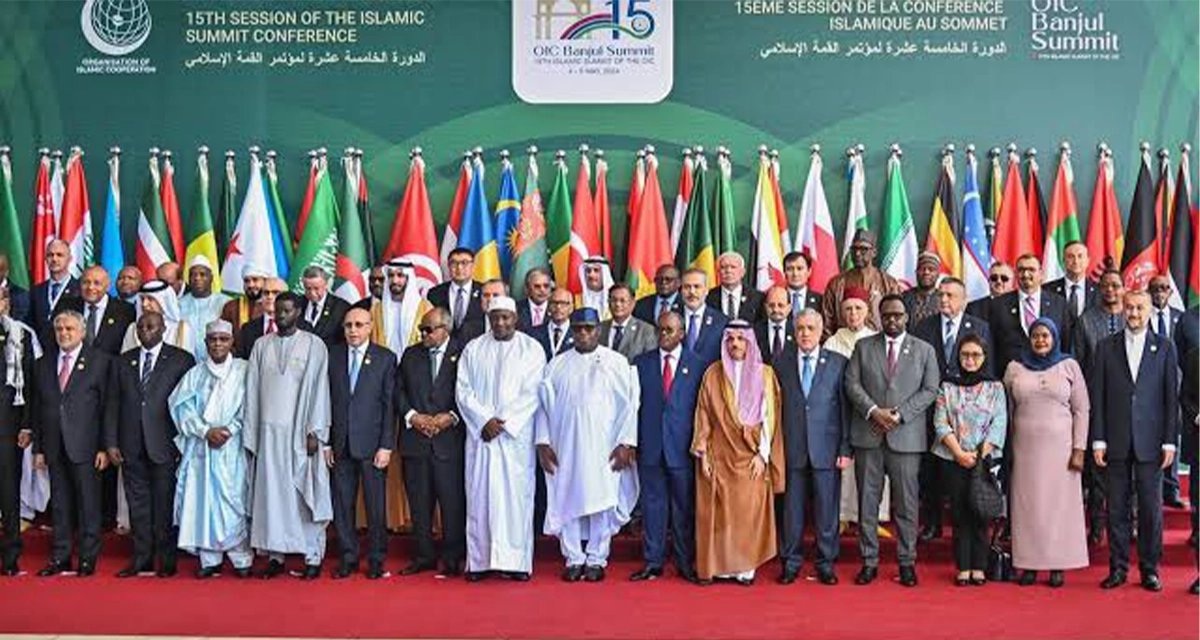
The Doha Summit of Arab and Islamic leaders in 2025. Citing the inaction of the 57 members of the Organisation of Islamic Cooperation (OIC), the writer asks the pertinent question: ‘Why can 57 states feel one wound and still not act as one body? Why are nearly two billion Muslims, sitting on a quarter of the earth’s landmass and much of its energy, unable to protect one besieged strip of land 25 miles long?’ (Photo: OIC)

Share on TwitterShare on FacebookShare on Whatsapp

DR ISMAIL ADAM PATEL asks the searing question: in light of the ongoing genocide in Gaza, how does the Ummah convert grief into organised action? In this first of a three-part series he sketches the ‘landscape’ and names the challenge.

Part One
Opening — The Two Prayers

I want to begin with an uncomfortable observation. Every Friday, in tens of thousands of masjids across the world, the khateeb raises his hands and prays for the people of Gaza, for the liberation of Masjid al-Aqsa, for the Ummah in its weakness. Hundreds of millions of sincere hands rise. And then we go home.

For over two years we have watched a genocide livestreamed. A genocide no one can claim they did not see. And the dominant emotion in our communities is not, I think, ignorance. It is anguished helplessness. We feel everything and we move nothing.

So, my question is not ‘do we care?’ We obviously care. My question is harder. Why does so much feeling produce so little force? Why are nearly two billion Muslims, sitting on a quarter of the earth’s landmass and much of its energy, unable to protect one besieged strip of land 25 miles long?

And I want, at the very outset, to warn against the easy answer. The one we are handed by others and have learned to repeat about ourselves: that something is wrong with us. That we are backward, or broken, or not yet ready. That answer is a trap, and I intend to dismantle it.

We feel everything and we move nothing. That gap — between our emotion and our force — is the subject of this discussion.

I am not here to add to our grief. We have enough. I am here to argue two things at once.

First, that the grief is being wasted and that the very size of that wasted feeling is the proof of how much power we are sitting on. Helplessness on this scale is not weakness. It is strength that has not yet been organised.

Second, that the Eurocentric order can neither absorb us nor erase us, and it is that failure of Eurocentrism, not ours, that drives everything they do to us.

Hold that second sentence. It tells us that our problem is not that we are small. It is that we are large enough to unsettle a world order that has no settled place for us as we are.

If hundreds of millions can be moved to raise their hands on the same morning for the same wound, then the raw material of the greatest civil force on earth is already in the room. We are not short of energy. We are short of conversion, from our grief and feeling into force. And conversion is something we can learn.

Dr Ismail Adam Patel addressing Muslim scholars and activists in Johannesburg on June 18, 2026. (Photo: Radio Islam)

The Landscape — Naming the Challenge Honestly

Let me lay out the terrain plainly, because we cannot fix what we are too polite to name. The Ummah today faces not one crisis but many. I want to touch on five. They look like five separate misfortunes. They are not. They are five faces of a single structure: a Eurocentric world order that presents itself as universal, neutral, the natural way of things, but which is in truth a particular European arrangement that cannot abide a Muslim political identity standing on its own terms.

This is what scholars call coloniality. This is not the old colonialism of flags and garrisons, which has formally ended, but the deeper hierarchy of who is allowed to be a subject of history and who is permitted only to be its object. These are not five problems, and you can add many other factors to these. They are one structure, reacting to us.

First, Gaza — and what it revealed. Tens of thousands of Palestinians killed, the majority women and children; an entire territory reduced to rubble; and famine engineered as a weapon. The war expanded to reach toward Masjid al-Aqsa itself.

And here is the lesson that should sit in this South African room with particular weight: when the institutions of the Muslim world fell silent, it was South Africa, not the OIC, not the Arab League, not the 57 Muslim states, that walked into the International Court of Justice and said the word genocide.

The conscience of the Ummah was defended at the world’s highest court by a country where Muslims are two per cent of the population. Let that chastise and inspire us in equal measure.

That a single middle-power state did what 57 could not is the most hopeful fact of this decade, because it proves the obstacle was never capacity. It was will. And will is the one resource no enemy can confiscate. What South Africa did, others can copy.

Second, the algorithm. While we grieve, the ground beneath us is being re-engineered. Artificial intelligence is not a neutral tool arriving to help us. In Gaza, AI target-generation systems were reportedly used to mark human beings for death at industrial speed. In Xinjiang, facial recognition and predictive policing track the Uyghur faithful by their beards and their prayer. In India, the same technologies map and profile Muslim neighbourhoods. And the large language models the whole world now consults were shown, in peer-reviewed study, to complete the sentence ‘two Muslims walked into a…’ with violence two times out of three, a rate the AI systems apply to no other group.

For the first time, Islamophobia is being written into the source code of the century — and almost none of that code is being written by us.

But code is not scripture. It is written by people, and it can be written by us. The same youthful, hyper-connected Ummah that the algorithm profiles is also the largest pool of digital talent on the planet. The frontier of ribat in this century is the dataset, the model, the platform. And understand what the model actually encodes: when it completes ‘two Muslims walked into a…’ with violence, it is not malfunctioning. It is working perfectly and faithfully reproducing a particular Western way of seeing that has been trained to pass itself off as the view from nowhere, as simple objectivity. That is coloniality made executable.

So our task is not merely to ask for fairer treatment from someone else’s machine. It is to author. We were authors of knowledge once, when Europe borrowed its numerals, its optics and its medicine from us. Nothing forbids us being authors again. That frontier is wide open, and it rewards exactly what we have in abundance: young minds.

Third, the resurgent right. Across Europe, the United States, India, and even here in Africa, a politics that treats the Muslim as the enemy within has moved from the fringe to the centre. In Germany, a party watched by its own intelligence services as extremist doubled its vote to become the official opposition. In Britain, recorded anti-Muslim hate reached its highest level on record. Hijab bans, masjid restrictions, surveillance programmes that put an entire faith under suspicion, travel bans and immigration crackdowns explicitly aimed at us. This is not a collection of accidents. It is an organised identity politics that needs the Muslim as its useful villain.

The Eurocentric order does not merely happen to dislike Islam. It requires us. A civilisation uncertain of what it now believes steadies itself by pointing at what it is against. We have been cast as the constitutive outsider, the figure the West needs in order to feel like a coherent ‘we’ at all. That is why no amount of moderation ever earns acceptance: the role was never about our conduct. It was about their need.

You may also want to read

Die Afhaal: A Cape Muslim wedding practice that centres dignity, consent and care

Die Afhaal: A Cape Muslim wedding practice that centres dignity, consent and care

12 January 2026 - Updated on 13 January 2026
Waqf as empowerment of communities and development

Waqf as empowerment of communities and development

21 August 2020 - Updated on 2 June 2021
Ideological lines will be transcended when building a government of national unity

Ideological lines will be transcended when building a government of national unity

14 June 2024 - Updated on 28 August 2024
South Africans join historic Gaza flotilla in bold act of solidarity

South Africans join historic Gaza flotilla in bold act of solidarity

8 September 2025
The impact of the Divorce Amendment Act for Muslims

The impact of the Divorce Amendment Act for Muslims

13 June 2024 - Updated on 14 June 2024
Could the aftermath of the lockdown be used to spark renewal?

Could the aftermath of the lockdown be used to spark renewal?

13 May 2021 - Updated on 12 July 2021

Yet every demagogue who builds his career on our name has just told us something: that we are not marginal to history. They, in fact, announce that we are central enough to be feared. They organise against us because our presence is permanent and growing. Fear is a backhanded confession of our significance. And the answer to organised contempt is not to shrink; it is to out-organise it. This is what South Africa’s own history proves the morally serious oppressed can do to the powerful.

Fourth, beneath all of these — our own paralysis. Fifty-seven states. Summits that issue statements. Normalisation deals signed over the heads of the very people being bombed. Lebanon, Syria, Iran, Yemen, Tunisia and Doha are struck, and it produces no sanction, no embargo, no suspension of ties, no deterrent of any kind.

Now, the easy analysis stops here and calls us docile. I will not give you that version, because it is the colonised mind blaming itself for its own chains. Ask instead: why can 57 states feel one wound and still not act as one body? Because they were never built to. The nation-state map of the Muslim world is itself the colonial settlement. These are borders drawn in European chancelleries precisely to break a single Ummah into 57 manageable pieces, each small enough to be patronised, played off, or bought. The summit fails not because Muslims are weak by nature, but because the very container we are asked to act through was engineered to make ummatic action impossible.

We are not a docile people. We are a dismembered one — cut into 57 pieces by a map we did not draw. And what was cut by design can be sewn back by design.

Notice the good news hiding in the hardest sentence. If our paralysis is built into a container designed by others, then the cure is not to beg that container to work. It is to begin acting as one body anyway. We need to rise beneath the states, across the borders, through the networks of conscience that no chancellery can redraw. We do not need 57 governments to agree. We can begin to act as a single political subject ourselves, tonight, without anyone’s permission. The reflex of acting together is the one part of this whole landscape that is already fully inside our own hands.

And fifth — our disunity. Let me be careful about this word. I am not calling for uniformity. Two billion Muslims of dozens of ethnicities in as many countries will not, and need not, be uniform. Nor is unity merely the respect or celebration of differences.

So, what is unity? Unity is when we come to share the same language — and by language I mean a shared common sense of concern. When we hear about Gaza, about al-Aqsa, or the suffering of a Muslim, no one should have to knock on our door and ask us to act. We should act on our own impulse, as a natural reaction.

Consider two images. If you burn your hand, your other hand does not wait to be asked before it moves towards the wound. It moves before thought. That is unity. The Prophet Muhammad (SAW) described the Ummah as one body, not one neighbourhood, not one tribe: one body. A body that must be told its own hand is burning has already lost something deeper than politics. Or consider a mother whose child is in danger on the other side of the world. She does not wait for a news bulletin to confirm her concern. She already knows what needs to be done. That doing before being told is what ummatic unity actually means — not that we agree on everything, but that when certain pain reaches us, we turn to action without needing to be marshalled.

But here is the thing about common sense: it can be trained. The Friday we began with already proves the nerve is alive. It shows the whole body still feels the one wound. We do not have to manufacture the feeling; it is already there. We only have to school it into reflex, household by household, masjid by masjid. Unity of feeling we already possess. Unity of response is the habit we now build.

Dr Ismail Adam Patel is the founder of the UK-based NGO, Friends of Al-Aqsa, and former visiting research fellow at the University of Leeds. He is a leading voice on Palestinian liberation and pivotal in mobilising civil society. His works include A Brief History of Palestine (Al-Aqsa Publishers, 2023), Madīna to Jerusalem: Encounters with the Byzantine Empire (Kube Publications, 2005), The Muslim Problem: From British Empire to Islamophobia (Palgrave Macmillan, 2024), and Treasures of the Holy Sanctuary (Turath Publications, 2026). He is committed to exploring decolonial thought and advancing Critical Muslim Studies.

This is a transcript of a speech given Dr Ismail Adam Patel to Muslim scholars and activists at Monarch Hotel in Rosebank, Johannesburg on June 17, 2026. The event was hosted by Jamiat Ulama South Africa

Coming in Part Two

In Part Two of this series, Dr Ismail Adam Patel examines what he describes as the twin challenges facing the Ummah: the privatisation of Islam and the transformation of a revolutionary faith into what he terms a ‘sedative Islam’. He argues that coloniality confined Islam to the private sphere while discouraging its role as a public force for justice and social transformation.

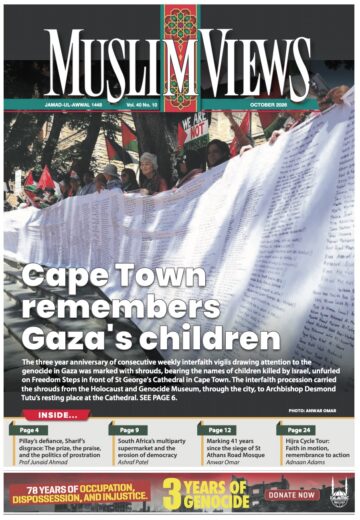
Click here to read Part 2, and here to read Part 3.

Subscribe to our Weekly Newsletter

* indicates required
Advertisement

You may also want to read

More than a game, or the Clash of Titans
Guest Writer

More than a game, or the Clash of Titans

17 July 2026 - Updated on 19 July 2026
The greatest monuments are not in stone, but in lives transformed
Tributes

The greatest monuments are not in stone, but in lives transformed

16 July 2026 - Updated on 19 July 2026
An empire battered, bluffing and buying time
OPINION

An empire battered, bluffing and buying time

13 July 2026 - Updated on 16 July 2026
India’s Israeli mirror: A template for moral decline
OPINION

India’s Israeli mirror: A template for moral decline

9 July 2026
Notes from the launch of the School of Solidarity
OPINION

Notes from the launch of the School of Solidarity

9 July 2026 - Updated on 10 July 2026
Legacy of educator Haji Mogamat Rashad Jedaar lives on
Tributes

Legacy of educator Haji Mogamat Rashad Jedaar lives on

7 July 2026 - Updated on 8 July 2026
June 2026

June 2026

FILE SIZE : 19 MB
Download
Advertisement

Latest News

Today’s two-pot withdrawal could threaten tomorrow’s retirement security

20 July 2026

More than a game, or the Clash of Titans

17 July 2026 - Updated on 19 July 2026

The greatest monuments are not in stone, but in lives transformed

16 July 2026 - Updated on 19 July 2026

War clouds gather over the Islamic finance boom

14 July 2026

Israel and the perfect storm of global economic isolation

14 July 2026

Mass march to Parliament planned to combat xenophobia and Afrophobia

14 July 2026
Advertisement
Advertisement
Next Post
Karbala – between obligation and inability

Karbala – between obligation and inability

The inscription that shamed an empire: The pulse of life and the poverty of power

The inscription that shamed an empire: The pulse of life and the poverty of power

Thank you, Israel, for overplaying the empire’s hand

Thank you, Israel, for overplaying the empire’s hand

Reclaiming agency: From ritual to action Part 2

Reclaiming agency: From ritual to action Part 2

ABOUT MUSLIM VIEWS
About Us
Archives
Terms & Conditions
Privacy Policy
Contact Us
Donate to Muslim Views
NEWS
Local
National
World
OPINION
Columnists
Discussion with Dangor
Editorial
Guest Writers
FEATURES
AWQAF SA
Imam Haroon
Tributes
FINANCE
Islamic Finance
ISLAM
Eid
Faith and Practice
Family
Hajj and Umrah
Moulood
Quraan
Ramadaan
FEATURES
Arts
Books
Education
Food
Health
Motoring
Sport
Technology

© Muslim Views 2026. All Rights Reserved

Design by: Rashaad Sallie

Loading...
No Result
View All Result
  • NEWS
    • Local
    • National
    • World
  • OPINION
    • Columnists
    • Discussions with Dangor
    • Editorial
    • Guest Writer
  • FEATURES
    • AWQAF SA
    • Imam Haron
    • Tributes
    • 1500 Years of Prophetic Legacy
  • LIFESTYLE
    • Arts
    • Books
    • Education
    • Food
    • Health
    • Motoring
    • Sport
    • Technology
  • FINANCE
    • Islamic Finance
  • ISLAM
    • Eid
    • Faith and Practice
    • Family
    • Hajj and Umrah
    • Moulood
    • Quran
    • Ramadaan
  • ARCHIVES
  • DONATE