































![The market-builder who restrained the market [Part 2]](https://muslimviews.co.za/wp-content/uploads/2026/08/PHOTO-2026-08-25-17-16-32-360x180.jpg)
![The merchant preceding the Prophetic mission [Part 1]](https://muslimviews.co.za/wp-content/uploads/2026/08/01-360x180.jpg)










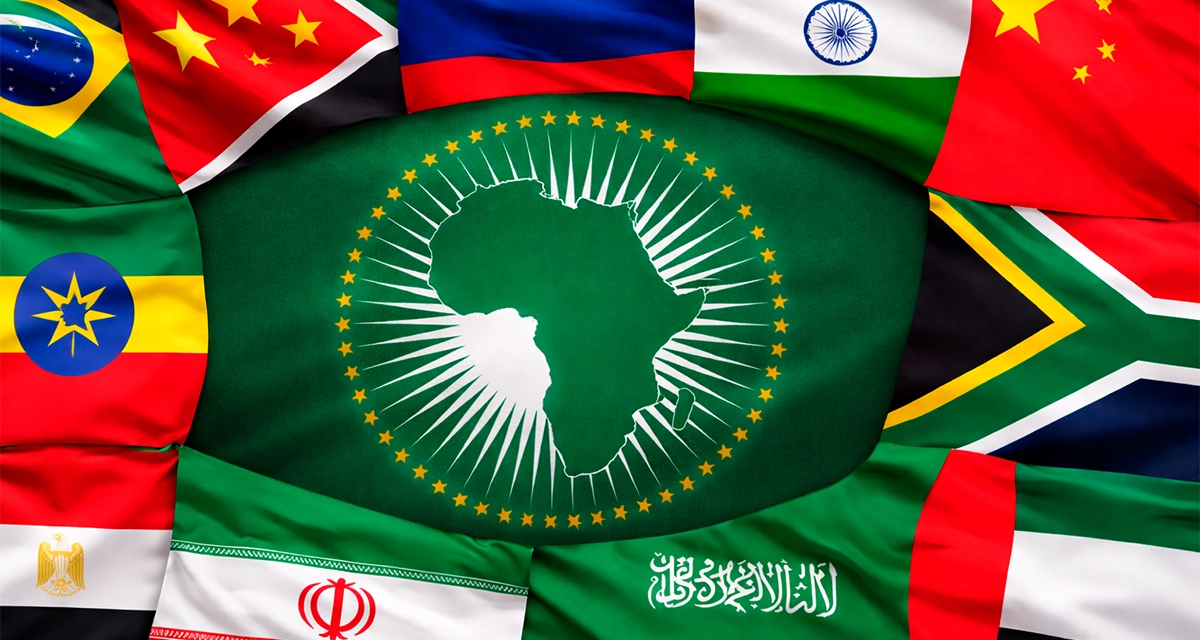

As Africa recalibrates after the G20, BRICS emerges as a key partner in advancing AU 2026 priorities, climate resilience and Global South multilateralism.
By ASHRAF PATEL
Africa’s G20 is done and dusted. Like a teenage dream it got a rude awakening as realpolitik hit hard amidst Trump 2.0. Overall Africa’s G20 programme outcomes were ‘more symbolism than substance’. With no deals on African debt nor progress on peace and fair trade, Africa enters a complex geopolitical world.
The BRICS bloc steps in, deepening partnership potential. Current realpolitik means that US and EU increased military budgets, huge cuts in development aid and trade wars mean that the BRICS bloc offers substantive development potential. But can African nations leverage these benefits? Let’s unpack.
BRICS is an anchor of multilateralism and, with the African Union (AU), Association of Southeast Asian Nations (ASEAN) and Group of 77 (G77), are natural partners. BRICS giants have achieved structural transformation and industrialisation and are scaling in global technology value chains. These also have lessons for many emerging nations in Africa.
Aligning with Africa’s 2026 priorities – water and sanitation and regional integration
As the African Union meets in its 39th Extraordinary Meeting, Africa faces a profound water and sanitation crisis, with over 400 million people lacking access to basic drinking water and more than 700 million without safely managed sanitation. The 2026 AU Theme of the Year emphasises sustainable water availability and safe sanitation as essential to achieving the AU’s Agenda 2063, fostering economic growth, social development and climate resilience. Addressing Africa’s water and sanitation challenges demands the comprehensive, integrated and people-centred approach that defines Agenda 2063’s philosophy of African ownership and African solutions.
The African Union’s 2026 priorities and Theme of the Year are: ‘Assuring Sustainable Water Availability and Safe Sanitation Systems’. Key focus areas include advancing climate resilience ahead of COP30, enhancing infrastructure, accelerating the African Continental Free Trade Area (AfCFTA) for economic growth, and maintaining peace and security.
Water and sanitation: The AU is prioritising sustainable water management, improved sanitation systems and water efficiency to foster development and health across the continent.
BRICS nations have committed to infrastructure development in declarations on water and climate investments and have endorsed the World Health Organization’s (WHO) declaration on health for all, providing a firm anchor for development support. India’s progress on mass sanitation implementation over the past decade is noteworthy, and much co-operation in this area can be leveraged for African nations.
Climate change and environment: Building on the 2025 African Climate Summit, 2026 initiatives focus on climate-resilient development and environmental protection.
From floods in Mozambique, Limpopo and KwaZulu-Natal (KZN) to droughts in Zimbabwe, BRICS nations have positioned climate change as a core anchor. Brazil’s leadership of COP30 through the Belém Declaration, Russia as a nuclear technology partner, and China’s green superpower status and support for loss and damage funds are hallmarks of BRICS nations. A range of climate resilience technologies and disaster management systems from BRICS core nations can assist Africa. From solar to water repairs to artificial intelligence (AI) and sustainability, leading BRICS nations have the technological co-operation will to assist.
Economic integration in 2026: The agenda focuses on the implementation of the AfCFTA, fostering trade, and developing infrastructure through the Programme for Infrastructure Development in Africa (PIDA) to create jobs and boost economic growth.
The AfCFTA has now been operating for five years and intra-continental trade remains low. China’s 2025 offering of duty-free access to African nations is a huge boost. The BRICS New Development Bank is already investing and can complement the AU’s PIDA programme going forward.
Peace and security in the AU in 2026: The AU is prioritising conflict resolution, mediation and enhancing regional security mechanisms to address ongoing conflicts.
You may also want to read





Peace and security remain elusive in Africa with the mushrooming of wars and conflicts. Many are vulnerable to great power competition. Here BRICS nations’ stated commitment to multilateralism is positive, but individual BRICS nations such as the United Arab Emirates’ (UAE) role in the Sudan civil war is problematic – and presents an opportunity for BRICS nations to develop new norms for peace and security. Another opportunity is support for African peacekeepers.
Health and social development: The AU seeks to strengthen health systems, particularly sustainable financing for malaria and enhancing social welfare.
Health and social development are key foundations for BRICS co-operation. The pandemic treaty at the WHO is a huge boost for developing nations. BRICS nations, China and Russia, assisted Africa during Covid-19. Challenges such as affordable intellectual property (IP) for health technology and pandemic preparedness are standing programmes where BRICS nations have capacity to scale. Investment in human capital development and rural health is an area where BRICS nations can enhance support in the context of United States Agency for International Development (USAID) cuts.
An example is Egypt’s Gypto Pharma City, a large-scale pharmaceutical hub north of Cairo. Local production can reduce import dependency, increase self-sufficiency in healthcare, and provide a high-value industrial avenue. Egypt’s focus on building a robust pharmaceutical ecosystem aligns with the need for African countries to develop medical and pharmaceutical industries that meet domestic needs and integrate into the global supply chain. South Africa can tap into these fellow BRICS partnerships to make AfCFTA a reality.
Institutional reform at the AU
The 2026 budget sees increased self-financing, reflecting a commitment to institutional reform and reducing reliance on international partners.
The AU has long been criticised for being donor-dependent, and some level of autonomy is welcome. However, AU reforms should deepen self-generated resourcing. There is a need to boost African peacekeeping as US budget cuts to the United Nations (UN) become a new reality. Many UN agencies based in Nairobi face major cuts.
African digitalisation
The integration of digital technologies and AI into key sectors like energy and transport is a priority for infrastructure development.
Africa’s industrialisation is lagging behind other developing regions. This renewed focus aims to address fundamental local challenges such as economic diversification, job creation and the energy transition, and also aligns with global megatrends such as digitalisation and green industrialisation.
The BRICS model of digital industrialisation is relevant. Investment in AI capacity and human capital development, as well as broadband and connectivity in line with the AU Digital Transformation Strategy 2030, are critical in order to boost education and economic development. AI strategies can only succeed if the basic and intermediate infrastructures such as energy and broadband are in place. Here the BRICS model is more compelling and relevant for Africa.
As the 39th Ordinary Session of the Assembly of Heads of State and Government in February 2026 finalises these initiatives, 2026 is a turning point for Global South multilateralism. Hence a new BRICS–Africa narrative and partnerships in the Global South are needed.
This is an opportune time for a new African Union–BRICS Partnership Forum, underpinned by a new charter which can be a prime mover as Global South co-operation grows in a brave new world.
Ashraf Patel is a senior research associate at the Institute for Global Dialogue (IGD) in South Africa, specialising in global governance, multilateralism, the political economy of the Global South, development justice and international relations, particularly in the context of BRICS and G20 engagement.