




![Does ta’wīl mean interpretation or fulfilment? A Quranic reassessment [+video]](https://muslimviews.co.za/wp-content/uploads/2026/10/Tawil-Kaskas-360x180.webp)












![Why becoming a wealthy Muslim is commendable in Islam [+videos]](https://muslimviews.co.za/wp-content/uploads/2026/09/Muslim-Trade-Business-1-360x180.webp)




Her activism has come at a steep price. She’s faced a smear campaign. She’s also been called a ‘self-hating Jew’ and ‘Hamas terrorist’, received death and rape threats, and endured physical assaults, including being spat on, shouted at, and pushed in public spaces.
By AZIZ YOUNIS
Megan Choritz, a 60-year-old South African Jewish woman raised under Apartheid, has become a powerful symbol of resistance against Zionism, despite facing immense personal and professional costs, including threats, harassment, and the derailment of her career.
From her modest home in Cape Town, she candidly shares her journey from being a beloved figure in her Jewish community to one of South Africa’s most vocal anti-Zionist activists, a transformation that came with a steep price: alienation from her community, physical and verbal abuse, and relentless threats. Yet, her commitment to Palestinian rights remains unwavering.
Roots of rebellion under Apartheid
When asked about the origins of her rebellious spirit, Choritz reflects, ‘I’m 60 years old, and I feel every one of those years now.’
She recounts a complex childhood in Johannesburg during Apartheid, the racial segregation system that governed South Africa from 1948 to 1994. Apartheid, an Afrikaans term meaning ‘separateness,’ was a legalised system of racial discrimination that divided the population into four groups – White, African (Black), Coloured (mixed-race), and Indian – each with different rights. Whites enjoyed full privileges, while others were systematically denied basic freedoms, from housing and education to where they could sit on a bus.
Growing up in a middle-class, Zionist Jewish household during Apartheid was, in Choritz’s words, ‘a truly strange thing.’ Her family was dysfunctional, she recalls, and while her father acknowledged Apartheid’s injustices, he did little to challenge them. This contradiction – recognising injustice but remaining complicit – was common among white liberal families who were aware of the system’s brutality but rarely willing to sacrifice their privileges or face the consequences of active resistance.
Choritz’s family history added another layer of complexity. Many relatives, including her great-aunt, uncle, and grandmother, gradually immigrated to Israel. Her parents had also lived in a kibbutz through the Zionist youth movement Habonim before her birth but returned to South Africa because her mother disliked life there. This back-and-forth between South Africa’s Apartheid and Israel’s policies planted early seeds of doubt in young Megan’s mind.
‘There was always this disconnect between what was happening in South Africa and what was happening in Israel,’ she explains.
At her Jewish high school, Choritz felt uneasy with the religious and Zionist education she received. ‘I was always deeply uncomfortable with much of the religious and Zionist teachings, but I didn’t know how to articulate why,’ she recalls. Though she couldn’t fully explain it at the time, this discomfort marked the beginning of her political awakening.
Two key influences shaped her consciousness: anti-Apartheid teachers, including an English teacher whose son was detained without trial, and, ironically, a trip to Israel meant to reinforce her Zionist identity. Instead, discussions with her Israeli-born cousin during the trip solidified her anti-Zionist stance. ‘That trip to Israel, meant to strengthen my Zionism, had the opposite effect,’ she reveals.
Theatre as political expression and life’s classroom
After graduating from the University of Cape Town in 1986 with a Bachelor of Arts and a performance diploma in theatre, Choritz embarked on a four-decade artistic career.
Starting as an actress, she later founded her own improvisational theatre troupe, which evolved into Improv, a company specialising in industrial theatre and corporate workshops.
Improv wasn’t just a career – it was a training ground for life. When asked about the connection between Improv and activism, Choritz lights up: ‘Improv is all about spontaneity and responding in the moment. Activism needs that too – whether it’s a protest, a quick decision to write something, or assessing a situation on the fly.’
Her theatre work earned her the title ‘Dean of Improv’ in South Africa, along with prestigious awards like the 2009 Fleur du Cap for theatrical innovation and the Audience Choice Award at the Sports Theatre that same year. She also wrote notable plays, including The Rhino Woman (1993), co-authored with Melinda Ferguson, which won the IGI Life Pick Award at the Windybrow Arts Festival.
In 2007, Choritz launched her blog, Megan’s Head, initially a platform for theatre reviews and commentary. Over time, it evolved into a Substack where she passionately writes about Gaza and Palestinian rights, blending art with activism.
From theatre to literature: The birth of lost property
During the COVID-19 lockdown, Choritz transitioned to fiction writing, joining an online writing group and moving from short stories to her debut novel, Lost Property (2023). The novel follows Lyn, whose marriage unravels after a shocking discovery about her husband, Mark. Through therapy, Lyn revisits her Johannesburg childhood under Apartheid, shaped by her complex parents, Merle and Larry, and her nanny, Dora, against a backdrop of social and political turmoil.
Choritz describes the novel as ‘close to the bone,’ blending autobiographical and fictional elements. ‘All the emotions are real and come from my life,’ she says, while maintaining a line between reality and fiction. The novel earned critical acclaim and a nomination for the 2025 Dalro-Can Themba Award, one of South Africa’s top literary prizes. However, its success became a double-edged sword as her political stances intensified.
October 7, 2023: A turning point
The events following October 7, 2023, transformed Choritz’s life. ‘I was never a comfortable opponent,’ she says. ‘I was always vocal about my anti-Zionism, but it was ignored or swept under the rug by the Zionist Jewish community here.’ Her views, while longstanding, were tolerated as theoretical until Gaza’s events changed everything. ‘This current, vile, exposed, Nazi-like genocide meant my voice had to be louder. I became utterly intolerable to Zionists,’ she says sharply.
Reconciling Jewish identity with anti-Zionism
Choritz’s story is complex, particularly in how she reconciles her Jewish identity with her fierce opposition to Zionism. ‘Being Jewish has nothing to do with Zionism,’ she states firmly. ‘It’s a culture, a set of religious and ethical beliefs. My Jewishness comes through in my writing, my theatre, even parts of film and TV.’ Her Jewish identity has grown more meaningful since standing as an anti-Zionist Jew. ‘I’m compelled, as a Jew and a South African, to speak against injustice that contradicts my culture and faith,’ she explains.
She condemns Zionism unequivocally: ‘Zionism is a colonial, supremacist, racist, ethno-nationalist evil. Jews don’t need a special homeland. We may be unique, but we’re not more special than anyone else.’
The heavy cost: From ‘kapo’ to death threats
Choritz’s activism has come at a steep price. She’s faced a smear campaign, with one of the most painful labels being ‘kapo,’ a term rooted in the Holocaust, referring to Jewish prisoners in Nazi camps who supervised others for minor privileges. The term accuses her of betraying her Jewish community and collaborating with Israel’s ‘enemies’. She’s also been called a ‘self-hating Jew’ and ‘Hamas terrorist’, received death and rape threats, and endured physical assaults, including being spat on, shouted at, and pushed in public spaces, particularly in Jewish-heavy areas like Sea Point and Gardens in Cape Town.
When asked what keeps her going, she responds without hesitation: ‘My stance is non-negotiable. That’s why I can’t deal with Zionists at all.’
Family rifts and a new community
Her activism has deeply strained family ties. In one of her writings, she notes that some relatives likely live in ‘stolen Palestinian homes,’ revealing the personal pain she faces. ‘Most days, I’m fine, supported by my new community: South African Jews for a Free Palestine, pro-Palestinian activists, and my interfaith community of anti-Zionist Christians, Muslims, and others,’ she says. But some days are harder. ‘Today, my heart is broken because I find no comfort from family who share my stance,’ she admits, her voice heavy with emotion.
Despite this, Choritz has found a new home in communities like South African Jews for a Free Palestine. She speaks warmly of Dr Imtiaz Sooliman from Gift of the Givers, Africa’s largest relief organisation, who has supported her and recognises the distinction between Jewishness and Zionism. ‘He calls us the Jewish community, and I love that,’ she says. This community embodies the Jewish principle of tikkun olam (repairing the world), which she sees as universal across faiths.

Art as resistance, writing as testimony
For Choritz, art and politics are inseparable. ‘Creating art, whether literature or otherwise, can’t be separated from an artist’s worldview,’ she says. ‘We create to change hearts and minds.’ Since October 7, her writing has been consumed by Gaza. ‘Every poem I’ve tried to write is about the genocide. I’m stuck in it – the evil men do,’ she confesses. Her Substack posts, like ‘The Brutality of the Coloniser,’ reflect the emotional depth of her political writing.
The Literary Festival controversy: ‘Not Zionist enough’
A defining moment came in April 2025, when Choritz was excluded from a Jewish literary festival. Her publisher’s submission of Lost Property was met with silence, followed by an admission that her politics were ‘too extreme’ for their ‘neutral, literary’ event. In response, Choritz staged a protest outside the Holocaust Museum in Gardens, Cape Town, where the festival was held, with a sign reading, ‘Not Zionist Enough for the Jewish Literary Festival.’
‘That day was a turning point,’ she recalls. ‘I kept it secret until that morning, and I think the organisers were mortified.’ Her protest went viral on social media, garnering widespread support. However, festival organizers called the police, and her protest companion was physically assaulted, his phone deliberately broken. Choritz remains unsurprised by the ‘iron grip of Zionism’ on South Africa’s Jewish community, where questioning the status quo leads to silencing or exclusion.
Apartheid and Israel: A painful comparison
As a white South African who lived through Apartheid, Choritz offers a unique perspective on comparing it to Palestine. ‘Israel has always been, and still is, an Apartheid system, but worse,’ she says. ‘You can’t be anti-Apartheid and Zionist – it’s cognitive dissonance.’ She argues that Zionism’s demand for a Jewish homeland inherently means a ‘racist, supremacist’ state on Palestinian land, making it ‘Apartheid, but worse.’
A message to Palestine
At the end of our conversation, we asked Choritz for a message to Palestinians in Gaza and the West Bank. She paused, sighed deeply, and said: ‘Dear Palestinians, you are in my heart and thoughts every moment, even in my dreams. I’m sorry we’ve failed to help you so far. I promise to keep fighting for a free, democratic Palestine for all who wish to be part of it. I hope this happens in my lifetime. From the river to the sea, Palestine will be free.’
Ongoing activism and future vision
You may also want to read


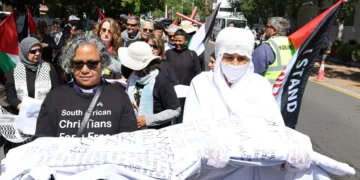
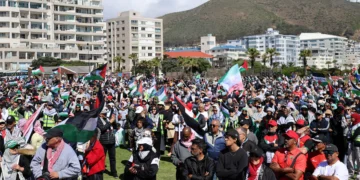
Choritz remains a committed activist, despite the costs. She’s active with South African Jews for a Free Palestine and participates in solidarity events, including a prominent role in the June 2025 Global March for Gaza, which she called a potential ‘game-changer.’ In August 2025, she spoke at an interfaith Women’s Day forum on ‘Speaking Truth to Power,’ earning recognition as a voice for progressive causes beyond Palestine.
Her vibrant online presence, described on Instagram as ‘actress, writer, improviser, director, vegan, anti-racist, tarot reader, anti-Zionist,’ reflects her multifaceted identity. Through art, writing, and activism, Megan Choritz continues to challenge injustice, embodying the belief that to repair the world, one must first confront its wrongs.
Aziz Younis is a Palestinian multimedia journalist based in South Africa. He is a regular contributor to Al Jazeera Arabic.
- This article was published in Arabic and is reprinted with the writer’s permission.