










![Does ta’wīl mean interpretation or fulfilment? A Quranic reassessment [+video]](https://muslimviews.co.za/wp-content/uploads/2026/10/Tawil-Kaskas-360x180.webp)


















![Why becoming a wealthy Muslim is commendable in Islam [+videos]](https://muslimviews.co.za/wp-content/uploads/2026/09/Muslim-Trade-Business-1-360x180.webp)







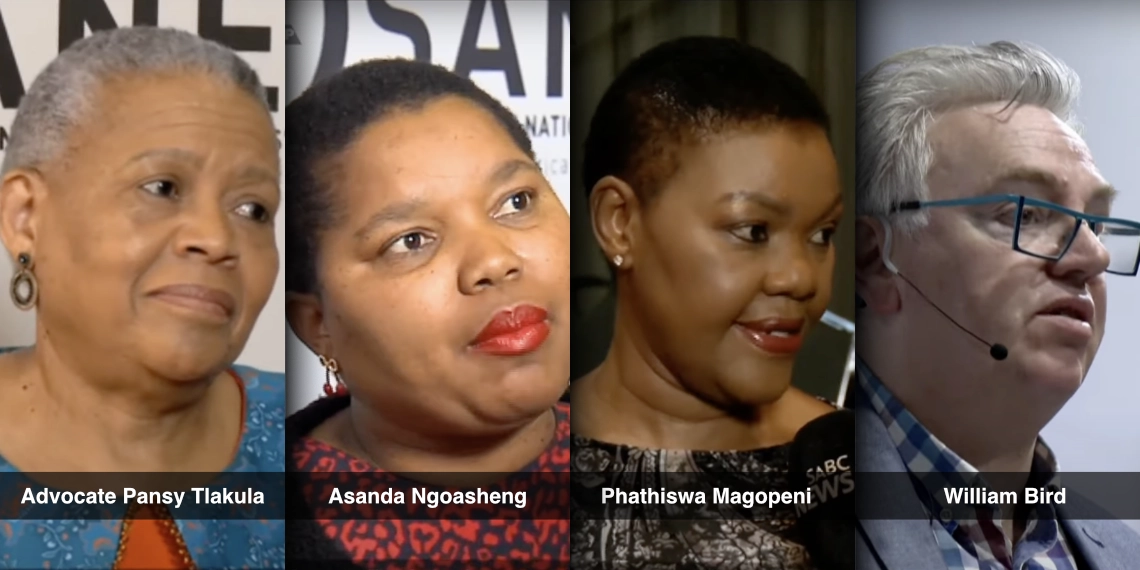

The inaugural M20 Summit was convened in Johannesburg on September 1 and 2, 2025 by the South African National Editors’ Forum (SANEF) and Media Monitoring Africa (MMA). MAHMOOD SANGLAY reports and offers an analysis of the summit.
The event concluded with the Johannesburg Declaration, a call to prioritise information integrity, media freedom, and sustainable journalism. Held alongside the G20, the summit brought together over fifty international media organisations, civil society groups, academics, and policymakers. Organisers positioned it as a strategic intervention during South Africa’s G20 presidency, amid escalating threats to press freedom and media viability.
The declaration warned of a global crisis marked by disinformation, shrinking civic space, and targeted attacks on journalists—especially women and those in conflict zones. It affirmed journalism as a vital public good, indispensable to democracy and informed decision-making. Delegates pledged to uphold ethical journalism, combat AI-driven disinformation, demand fair compensation from tech firms, and push for reforms to address collapsing media revenue models. They also called for protection of children’s digital rights, support for women journalists, and action against climate disinformation.
Information integrity was consistently framed as the bedrock of democratic life. Delegates warned that deepfakes, algorithmic amplification, and the unchecked spread of falsehoods threaten not only elections but also social cohesion and economic stability. A climate policy brief highlighted how disinformation campaigns—often funded by fossil fuel interests—delay policy action, distort civic debate, and erode trust in science. Attacks on environmental journalists and the media’s financial crisis compound these threats, underscoring the need for the G20 to integrate information integrity into its climate and energy tracks.
Journalist safety was another urgent concern. A paper led by Prof Glenda Daniels of Wits University documented the alarming rise in killings, kidnappings, and harassment of reporters, with Gaza identified as the deadliest conflict zone for journalists in decades. Nearly 200 journalists have been killed there since October 2023. Delegates condemned the impunity enjoyed by perpetrators of violence against the press and called for a coordinated international response to protect journalists both in war zones and in digital spaces, where online harassment and sexualised abuse are rampant.
Photo SABC NEWS
Artificial intelligence was debated as both a disruptive and exploitative force. Dr Anya Schiffrin of Columbia University presented a paper on intellectual property, warning that generative AI firms routinely extract and monetise journalistic content without permission or payment. This practice, coupled with AI-generated search tools that divert traffic from news sites, threatens to erode journalism’s already fragile business model. Delegates urged the development of binding frameworks to secure copyright protection, ensure transparency in how content is used, and create systems of fair compensation for news organisations. This issue is particularly urgent for the Global South, where vulnerabilities in technology governance and deployment are most acute.
Media viability emerged as a central theme. Two complementary briefs revealed the extent of the crisis: independent outlets in 160 out of 180 countries reported operating at the brink of collapse. Traditional revenue models based on advertising have been decimated by the dominance of Google and Meta, while the rise of generative AI threatens to further reduce referral traffic. UNESCO has described this as an ‘extinction event’ for journalism. Delegates called on the G20 to support innovative funding models, reform competition law to address platform dominance, and create regulatory frameworks that protect editorial independence. The debate highlighted that journalism cannot be saved by innovation alone but requires systemic reforms to confront market failure and political manipulation.
Africa’s position in the global AI economy was brought to the fore in a policy paper on power, politics, and AI. It argued that Africa occupies one of the most vulnerable positions, supplying low-paid labour for data labelling while lacking sovereignty over data and languages. The danger, it said, is that AI governance could entrench digital colonialism, leaving African countries dependent on foreign technologies that do not reflect their priorities or cultural contexts. Strengthening the capacity of African media to monitor AI governance and corporate behaviour was presented as essential to democratic oversight. Delegates urged the G20 to ensure that AI frameworks respect linguistic diversity, cultural rights, and the principle of fair participation.
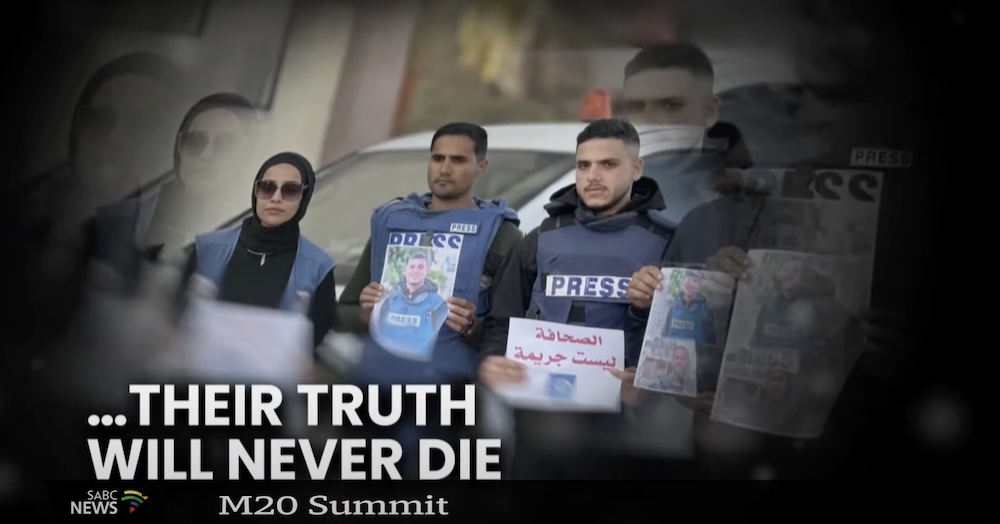
Photo SABC NEWS
Opening the summit, Minister Solly Malatsi drew on the iconic photograph of Hector Pieterson during the Soweto uprising to remind delegates that truthful information can topple injustice and change the course of history. He described information integrity as the ‘invisible infrastructure of democracy,’ warning that disinformation supercharged by AI threatens not only free elections but also markets, economies, and social cohesion. He argued that independent media are the foremost guardians of truth and essential to society’s progress.
The closing communiqué echoed this sentiment, insisting that journalism must be recognised by the G20 as foundational to solidarity, equality, and sustainability. It called for journalism to be treated not as a peripheral concern but as a central pillar of global governance.
Strengths and weaknesses
The summit’s strength lay in its holistic framing. By treating journalism as a public good, it elevated the debate beyond sectoral concerns to the level of democracy, peace, and human rights. It wove together diverse issues—safety, AI, climate, gender equity, and media funding—into a coherent narrative, giving the impression of a global movement rather than isolated struggles. The explicit recognition of Gaza as the most dangerous place in the world for journalists gave the proceedings moral urgency, while the focus on African perspectives ensured that the Global South was not sidelined. The combination of normative frameworks such as the Windhoek+30 Declaration and the UN Global Principles on Information Integrity gave the summit’s recommendations legitimacy and intellectual depth.
The Johannesburg Declaration, while rhetorically powerful, is not enforceable. Without mechanisms for implementation, its influence depends entirely on whether the G20 integrates the proposals into its programmes.
The funding crisis, though extensively documented, did not yield sufficiently concrete solutions: levies on tech platforms, dedicated global funds, or structured subsidies were discussed in principle but not formalised. The risk remains that voluntary measures will fail to resolve systemic underfunding.
Similarly, while the call for fair compensation for journalistic IP is compelling, there is little clarity on how this could be enforced against trillion-dollar technology companies. The tension between journalism as a public good and journalism as a site of geopolitical competition was also evident. The summit itself warned against media being reframed as a tool of power politics, yet the risk remains acute within the G20, where member states have competing interests.
You may also want to read




A call to action for the G20
The summit was both a defensive and an offensive move. It sought to shield journalism from existential threats while asserting its role as essential infrastructure for democracy and development. The challenge now is whether the G20 in November will heed this message. If the summit’s proposals are absorbed into global policy, Johannesburg 2025 may be remembered as the moment when journalism re-entered the global governance agenda not as a supplicant but as a recognised pillar of democracy and human dignity.