








![Does ta’wīl mean interpretation or fulfilment? A Quranic reassessment [+video]](https://muslimviews.co.za/wp-content/uploads/2026/10/Tawil-Kaskas-360x180.webp)











![Why becoming a wealthy Muslim is commendable in Islam [+videos]](https://muslimviews.co.za/wp-content/uploads/2026/09/Muslim-Trade-Business-1-360x180.webp)






Why shariah-compliant finance is our path to liberation
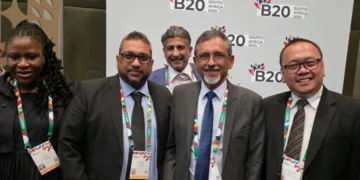
By MOGAMAT ALI SALIE
‘Debt is the new slavery,’ a phrase often repeated in economic circles, resonates deeply when we consider the reality of conventional finance.
In South Africa, households spend almost 75% of their disposable income on servicing debt, according to the South African Reserve Bank. For many, it is not an exaggeration to say that their financial future is mortgaged to the bank.
The conventional system, built on interest (riba), thrives on dependency. A simple home loan of R1-million at 12 percent interest over 20 years will cost nearly R3 million in repayments. That extra R2-million is not value created; it is wealth extracted from families and funnelled into financial institutions. This is the silent economic slavery that keeps people from building true generational wealth.
Why Islamic finance matters
The Qur’an warns against riba, describing it as unjust and exploitative. But beyond religious obligation, shariah-compliant finance offers practical liberation. It replaces the adversarial relationship of lender and borrower with partnership.
Take a diminishing musharakah home finance model: the bank and family co-own the property. As the family gradually purchases the bank’s share, ownership transfers. There is no compounding interest, no inflated repayments — only fair and transparent partnership.
For businesses, models like mudarabah (profit-sharing) and musharakah (joint partnership) ensure that risk and reward are shared. As Dr. Mahmoud El-Gamal, a global authority on Islamic finance, puts it: ‘Islamic finance aligns capital with the real economy. It insists on transactions tied to assets, risk-sharing, and ethical responsibility — principles conventional finance abandoned long ago.’
Practical pathways for South African Muslims
The challenge, of course, is moving from theory to practice.
South Africa’s Muslim community, estimated at over two percent of the population, is well-positioned to pioneer shariah-compliant alternatives that not only serve Muslims but offer ethical models for the wider society.
1. Takaful (mutual protection):
Instead of traditional insurance, where profits enrich shareholders, takaful pools members’ contributions to cover losses collectively. Malaysia’s takaful industry, now worth over US$3-billion, demonstrates its viability. Locally, if 10 000 Cape Town families contributed just R500 per month into a takaful pool, within a year we would mobilise R60 million — funds that could also be channelled into micro-investments and job creation.
2. Community investment funds:
Mosques and civic organisations can establish shariah-compliant cooperative funds. These can finance halal businesses, housing cooperatives, or bursaries for students. The Muslim community in Durban has already shown the power of pooled resources through successful waqf-based projects that provide housing and education. Imagine scaling this nationally.
3. Entrepreneurship support:
Small businesses are the lifeblood of our economy, yet many fail because of debt burdens. By funding entrepreneurs through musharakah partnerships, investors share in both risks and profits. This nurtures resilience. For example, a group of Cape Town professionals recently formed a cooperative investment vehicle to back halal food ventures. Instead of charging interest, they receive dividends — and the businesses remain debt-free.
From consumers to producers
The story of South African Muslims has always been one of resilience and enterprise. From traders on the Cape Flats to exporters representing South Africa abroad, we have proven our entrepreneurial spirit. Yet, too often, we remain consumers in a financial system designed to exploit us.
By pooling our resources, embracing takaful, and financing one another ethically, we can flip the script: from consumers to producers, from debtors to partners. This is not utopian thinking; it is happening globally. The global Islamic finance industry is projected to surpass US$4 trillion by 2027. South Africa, with its sophisticated financial sector and vibrant Muslim community, should not lag behind.
Reclaiming economic dignity
Our Prophet Muhammad (peace be upon him) laid the foundations of a just economy in Madinah through partnership, fairness, and shared responsibility. Fourteen centuries later, those same principles can liberate us from the chains of economic slavery.
You may also want to read




The question is not whether Islamic finance works – it does. The question is whether we, as a community, have the courage to embrace it fully. The tools are there: musharakah, mudarabah, murabaha, and takaful. The capital is there: millions in savings and zakah contributions waiting to be mobilised. The need is urgent: families and entrepreneurs are suffocating under debt.
The choice is ours. Will we continue feeding a system that extracts and enslaves? Or will we build one that empowers and liberates?
The key to our economic dignity is already in our hands. It is time we used it.

Mogamat Ali Salie is co-founder of MuslimFin, a fintech business that is specifically focused on educating and directing Muslims and non-Muslims on Shariah-compliant finance. For more information visit muslimfin.com.