





















![The market-builder who restrained the market [Part 2]](https://muslimviews.co.za/wp-content/uploads/2026/08/PHOTO-2026-08-25-17-16-32-360x180.jpg)
![The merchant preceding the Prophetic mission [Part 1]](https://muslimviews.co.za/wp-content/uploads/2026/08/01-360x180.jpg)








The Kinderlê reburial of Khoi and San ancestral remains signals a turning point in South Africa’s journey towards restorative justice, memory, and reconciliation.
By ANWAR OMAR & SAALIEGAH ZARDAD
Deep in the arid landscape north of Steinkopf, 70 kilometres from the Namibian border, lies Kinderlê, a site whose name bears the imprint of tragedy.
This Provincial Heritage site, declared in 2003, holds profound historical and ethical significance. It is where one of the most tragic events of 19th-century indigenous South Africa unfolded – the tragic demise of 32 Nama children.
On Monday, March 23, 2026, with the reburial of 63 Khoi and San ancestral remains within the Kinderlê precinct, this site has been transformed from a Provincial Heritage site to a site of national and international significance by linking a historical tragedy with contemporary initiatives aimed at healing and reconciliation. Additionally, it sets a precedent for ongoing dialogues about the management of human remains, especially in relation to the Prestwich Memorial.

Naming memory in the language of trauma
The name Kinderlê, as a site of collective memory, is particularly significant in a context where there is a lack of historical documentation. It is a site where the land itself is witness to past tragedies and historical acts of violence.
As our nation continues to confront the legacies of slavery, colonialism and apartheid, Kinderlê challenges the dominant narratives that have sanitised and erased the experiences of indigenous communities
Kinderlê, meaning ‘the place where children lie’ or ‘the resting place of children’, is not simply a descriptive label, but also a linguistic tribute embedded into the history of a landscape that has long been relegated to the margins of our national consciousness. Naming the site Kinderlê was a direct response to this tragedy, ensuring that the memory of these young lives is permanently etched into the landscape, functioning as a ‘moral geography’ of remembrance, inextricably linking language, land, and loss.
As our nation continues to confront the legacies of slavery, colonialism and apartheid, Kinderlê challenges the dominant narratives that have sanitised and erased the experiences of indigenous communities. In this way, the events around Kinderlê are a form of intangible heritage, inextricably linked to the language and historical experience of the indigenous people of that region and, as such, must be recognised alongside its tangible counterpart.
The historical context of Kinderlê
In the mid-19th century, the region that currently comprises the Northern Cape and southern parts of Namibia was inhabited by the Nama people, who formed part of the broader Khoi cultural group. The Nama were pastoralists, and their way of life revolved around the domestication of sheep and cattle.
Living alongside them in the same region were the San, who were hunter-gatherers and whose way of life was increasingly being threatened by the encroachment of the colonial frontier. These were two of the first indigenous communities impacted by the onslaught of colonialism, which led to competition for land and other resources, resulting in structural factors that contributed to conflicting relations between these two communities.
The tragedy that unfolded in Kinderlê in 1867, in which 32 Nama children were tragically killed, has left its indelible mark on the collective memory of the region in general and the Nama people in particular. According to historical accounts, whilst the Nama community attended a church service, a group of San launched an attack, killing 32 defenceless children. Many view this incident as an act of vengeance, while others perceive it as a desperate act of survival under extremely difficult colonial circumstances. What is, however, evident is the fact that these children fell victim to a broader context of disruption and chaos, as colonial expansion shattered communities’ cohesion and escalated competition for resources.
The Kinderlê tragedy was not an isolated act of violence. It resulted from a catastrophic collapse of an entire people’s civilisation. By 1867, the San of the Northern Cape had been hunted, starved, enslaved and pushed off their ancestral lands for generations. The events at Kinderlê took place within a broader context of colonial violence so comprehensive that it amounted to ethnic cleansing and genocide.
Both the San and the Nama were victims of the same colonial onslaught in different ways – victims of a system that was destroying indigenous life across the region. For the San, the colonial onslaught was direct and exterminatory, whereas for the Nama the impact was more structural and incorporative, designed to extract their land and labour for the colonial project. In essence, the San experienced ethnic cleansing and genocide, while the Nama experienced a combination of ethnic cleansing and forced integration into colonial systems.
However, this distinction was not absolute or permanent. The trajectory of colonial violence against the Nama, and even more starkly against the Herero, intensified over time. This culminated in the genocide of 1904–1908 under German colonial rule in present-day Namibia, a process widely recognised by historians and formally acknowledged by the German government in 2021, more than 100 years after its occurrence.


Reburial, repatriation, and a moment of reconciliation
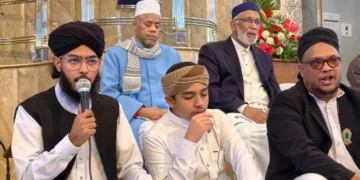
Last week, a new chapter in the history of Kinderlê commenced. In a solemn ceremony officiated by President Cyril Ramaphosa, 63 Khoi and San ancestral remains were reburied within the Kinderlê precinct. Six of these remains were repatriated from the ‘Museum of Things’ at the Hunterian Museum in Glasgow, Scotland, and the rest were stored in South African museums for more than a century.
The reburial of these human remains is part of a broader process aimed at redressing colonial-era practices of looting graves, body snatching, and the pseudo-scientific study of indigenous bodies. For decades, the indigenous bodies of Khoi and San were illegally exhumed from their graves without their consent, desecrating their dignity, identity, and humanity.
Commenting on this, the SAHRA chairperson, Elodie Tlhoaele, declared:
‘What was projected by colonialists as “civilised scientific research” was executed in an extremely barbaric manner.’


Amid the reburial ceremony, a solitary San revivalist was observed calling for unity and reconciliation. At the same time, he lamented the ongoing mismanagement of water resources, which he claims is gradually eliminating the indigenous presence in the region, more so than the Kinderlê tragedy of 1867. In attendance were several indigenous leaders, including 93-year-old Queen Katrina, the last living speaker of the N|uu indigenous language. Prior to the reburial, the Khoi and the San communities entered into a reconciliation agreement, indicating a collective commitment to unity and reconciliation.

President Cyril Ramaphosa, as the guest of honour at the reburial, confirmed that the recognition of the Khoi and the San communities and their leaders is imminent. The reburial of the Khoi and the San ancestral remains was facilitated by the Department of Sport, Arts and Culture (DSAC), Iziko Museums of South Africa, and the South African Heritage Resources Agency (SAHRA).
You may also want to read


Kinderlê reburial: A precedent and its implications for Prestwich Memorial
The reburial of these 63 ancestral remains at Kinderlê has implications that resonate far beyond the Northern Cape. It establishes a significant national benchmark and precedent for how South Africa may address other contested collections of human remains, particularly those at the Prestwich Memorial in Cape Town.
The Prestwich site holds the remains of thousands of individuals discovered during an urban development in the early 2000s, many who are believed to be enslaved persons, indigent individuals, and members of historically marginalised groups. For many years, debates have centred around the ethics of curation as opposed to reburial, the involvement of descendant communities, and the adequacy of memorialisation practices.
In her feature entitled ‘A restless legacy: the forgotten dead of Prestwich Place’, Dr Bonita Bennett, the former director of the District Six Museum who currently serves as a member of its board of trustees, relates how many of those who were involved in the project are experiencing a restless unease about the storage of the human remains in cardboard boxes in an above-ground ossuary since 2008. Instead of Prestwich Memorial becoming a place of remembrance and dignity, it has become a place of unremembering and humiliation.
The reburial of 63 human remains at Kinderlê offers a clear ethical and procedural model that demonstrates that:
• Repatriation processes and reburial initiatives can be community-led and culturally grounded.
• Consultation processes, reconciliation, and ceremonial practices are essential to restoring dignity; and
• Heritage practice should transcend preservation towards achieving restorative justice.
In this way, Kinderlê reshapes the national discourse by challenging institutions to reconsider whether the continued housing of human remains, no matter how respectfully curated, can truly substitute the spiritual and cultural necessity of burial. Thus, the precedent set at Kinderlê may be the catalyst for renewed dialogue around the future of the Prestwich remains, encouraging a shift towards reburial, recognition, and healing.
The Kinderlê example is not perfect, and there are concerns about consultation with indigenous communities in the Northern Cape and the cultural sensitivity around the reburial process. Nevertheless, it provides a model that can be built on and improved going forward.
Transforming heritage status: From provincial to national significance
Although Kinderlê has been a Provincial Heritage site since 2003, recent developments invite a reassessment of its place within South Africa’s heritage landscape. Under the National Heritage Resources Act (1999), sites of exceptional national significance may be declared National Heritage sites.
The Kinderlê site is no longer only about a singular historical event; it has become a multi-layered heritage landscape. The site increasingly meets the threshold of exceptional national significance due to its association with indigenous historical trauma and memory under colonial pressure, the reburial of local and repatriated ancestors, its linguistic significance as a placename that encodes historical experiences, and its role in advancing reconciliation and restorative justice. This evolving status reflects a broader shift towards recognising sites of pain and marginalised histories as central, not peripheral, to the national narrative and collective memory.
Towards recognition, unity, and national healing
Kinderlé can now be viewed as a symbol of national conscience with several layers of historical, cultural, and ethical significance, which necessitates a more deliberate and integrated approach to its meaning and commemoration. Its evolving significance may now require it to be elevated to a National Heritage site, not merely as an administrative adjustment, but as a recognition of its profound relevance to South Africa’s collective memory and identity. This requires a process of memorialisation that is inclusive to ensure that the traditions and perspectives of the Khoi and San people are integrated into the interpretation and preservation of the site holistically.
At the same time, the recognition of Khoi and San communities and their leadership cannot be separated from the heritage discourse surrounding Kinderlê. The recent commitments by President Ramaphosa, and the calls for greater unity among indigenous groups, amplify the need for a cohesive and collaborative approach that strengthens representation and restores dignity. Kinderlê has become more than just a symbolic historical site; it has the potential to evolve as a platform for rebuilding relationships, both within and between communities, as well as with the state.
Conclusion
Equally important is the integration of Kinderlê into the national narratives of restorative justice and human rights in South Africa. Its story challenges dominant historical narratives and insists on the inclusion of indigenous experiences that have long been marginalised. Kinderlê demands remembrance, not as a passive form of reflection, but as an active, dignified form of engagement in the ongoing pursuit of justice and reconciliation. Through education, public history, and heritage practices, the Kinderlê approach has the potential to reshape how the nation remembers its past, engages with its present, and plans for its future.
ANWAR OMAR is a South African Heritage Resources Agency (SAHRA) councillor. A founding member of the Salt River Heritage Society, Omar holds a master’s degree in Conservation and the Built Environment from the University of Cape Town (UCT).
SAALIEGAH ZARDAD is a researcher and writer whose work focuses on heritage, cultural landscapes and post-apartheid spatial justice. Her current research engages with heritage impact assessment processes and questions of intangible cultural heritage, living heritage, community meaning and public decision-making in relation to the Oude Molen Precinct in Pinelands, Cape Town, and other redevelopment plans.