
















![The market-builder who restrained the market [Part 2]](https://muslimviews.co.za/wp-content/uploads/2026/08/PHOTO-2026-08-25-17-16-32-360x180.jpg)
![The merchant preceding the Prophetic mission [Part 1]](https://muslimviews.co.za/wp-content/uploads/2026/08/01-360x180.jpg)






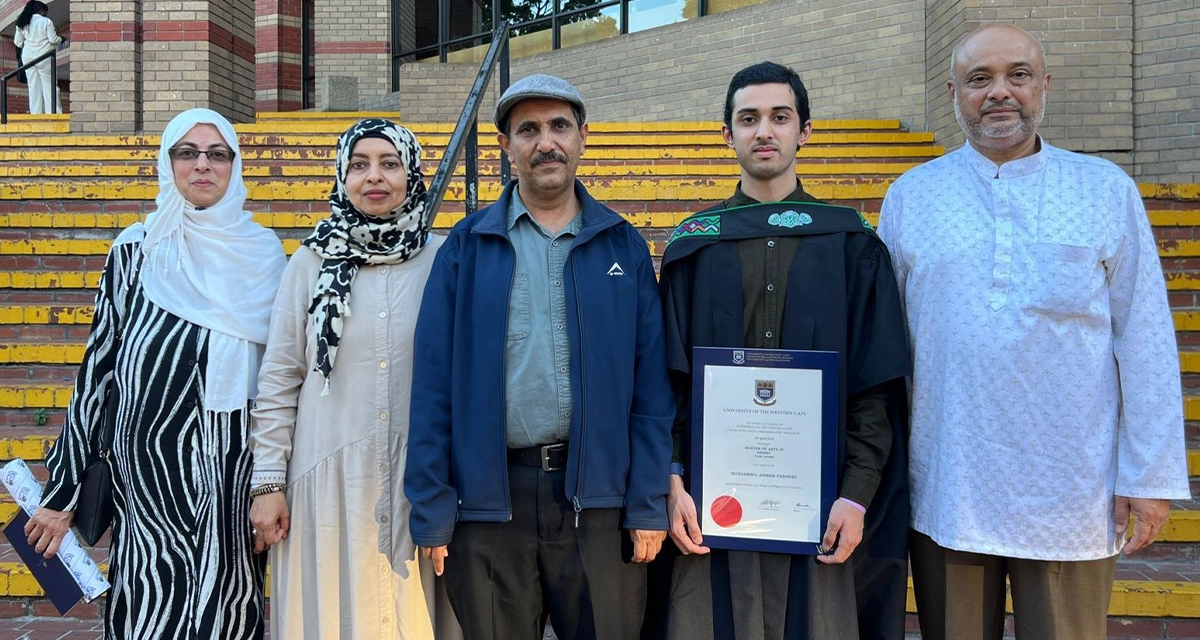

Cape Town’s Hafidh Muzammil Ahmed Farooki graduated cum laude with a master’s degree in Arabic from the University of the Western Cape, turning a lifelong connection to the Qur’an into an inspiring academic journey.
By NONTOBEKO AISHA MKHWANAZI
On a Friday afternoon in Cape Town, somewhere between the khutbah and the closing du’a, Hafidh Muzammil Ahmed Farooki realised something had changed.
For the first time, he understood everything the imam was saying. No translation, guessing or fragments – just pure understanding.
That moment carried the weight of a long journey filled with uncertainty about his future and questions about where his strengths truly lay.
Earlier this month, Cape Town-born and -raised 25-year-old Hafidh Farooki graduated cum laude with a master’s degree in Arabic from the University of the Western Cape (UWC).
In an interview, Hafidh Farooki explained that his academic journey did not begin easily. He spent four years outside mainstream schooling completing hifdh. When he returned to formal education, the adjustment was demanding.
‘I struggled a lot with academics in high school. But with guidance from good teachers, I managed to find my feet,’ he said.
As a child, his ambitions were far removed from grammar and classical texts. He wanted to become an astronaut. Astronomy fascinated him, and physics became one of his favourite subjects, even though it was challenging.
Arabic was already part of his life at the time, but he had not yet imagined it as a serious field of study. While in high school, he completed a one-year Arabic programme as an extramural activity. He later hoped to deepen his studies in places such as Tarim or Mauritania.
For Hafidh Farooki, hard work and contribution to society through volunteer work is a responsibility that reflects commitment to service and community upliftment, and this even earned him the 2018 Prophet Muhammad (SAW) Award for excellence from the International Peace College South Africa (IPSA).
When the opportunity to study abroad and to study astronomy at university did not materialise, he remained committed to continuing his education. He enrolled for a Bachelor of Arts in Islamic Studies at IPSA, where his academic direction began to change.
During his studies, he encountered the teaching of Islamic Peace College of SA (IPSA) Head of Postgraduate Department, Professor Belqes Al-Sowaidi, an experience he describes as decisive.
‘Her way of teaching ignited a passion in me for wanting to continue with Arabic,’ he said.
He followed her advice to continue into honours and later master’s degree study. In 2022, he graduated cum laude as a top achiever in attaining the Bachelor of Arts in Islamic Studies at IPSA and received a merit award in recognition of his performance.
Over time, Arabic moved from being a requirement of study to becoming the centre of his intellectual life. As he met scholars who worked primarily in Arabic, the importance of the language became increasingly clear.
‘When I met Arabic-speaking scholars who were highly knowledgeable, I realised that I needed Arabic if I wanted to benefit from them. Most of the classical Islamic texts are in Arabic,’ he said.
His engagement with the Qur’an also deepened as his understanding of the language developed.
‘It makes me ponder about the meanings of the verses when I am reciting the Qur’an,’ he explained.
You may also want to read


Moments of unexpected responsibility confirmed his progress. During a visit by a Mauritanian scholar to Cape Town, he was asked, without preparation, to assist with translation for someone attending a gathering. He was able to translate the exchange with confidence.
On another occasion, he realised that he could follow an entire khutbah without relying on explanation. Participation in an international Arabic debate hosted by the Qatar Foundation further strengthened his confidence in engaging the language in academic settings.
Like many postgraduate students, Hafidh Farooki also faced difficulty during the early stages of his thesis. His research focused on translation studies, a field in which he had no formal background. He responded by building the necessary foundations through sustained reading and consultation with mentors.
‘I had to do a lot of reading to teach myself the foundational concepts,’ he said.
He credits the motivation of UWC Associate Professor of Applied Linguistics and Translation Studies and IPSA Board member, Professor Tawffeek Mohammed, and the encouragement of Prof Al-Sowaidi for helping him remain focused during demanding stages of research. Working alongside other researchers and participating in writing groups also helped him maintain discipline and momentum.
Although Arabic became central to his academic work, his earlier interest in astronomy continues to shape his scholarly goals. He hopes to translate classical Islamic texts on astronomy, written in Arabic, into English so that these works can become more accessible to wider audiences. In this way, an early fascination with the sciences remains connected to his present research interests.
In addition, Hafidh Farooki said studying Arabic is closely tied to intention.
‘I think studying Arabic becomes easier once you have a concrete goal. For me, the goal was to translate classical Arabic texts from the golden age of Islam and to understand the Qur’an, and I think anyone else who fears taking this journey should be motivated by the fact that one day they will understand the Qur’an,’ he said.
He also emphasised the importance of mentorship and family support.
‘Always take the advice of your teachers. Find a mentor who can guide you and always be grateful to your parents who provide you with the opportunity to study.’
Hafidh Farooki hopes his journey encourages young Muslims not to see Arabic as distant or difficult, but as a language that becomes accessible through patience, guidance and clear intention. His experience shows that excellence is not reserved for those who begin with confidence, but for those who remain committed to learning over time.
As many young people prepare to begin their examinations next month, his story stands as a reminder that perseverance through difficulty can lead to unexpected doors opening. It is his hope that learners facing pressure and uncertainty draw strength from the example of steady effort, trust in their abilities and commitment to their goals.