





















![The market-builder who restrained the market [Part 2]](https://muslimviews.co.za/wp-content/uploads/2026/08/PHOTO-2026-08-25-17-16-32-360x180.jpg)
![The merchant preceding the Prophetic mission [Part 1]](https://muslimviews.co.za/wp-content/uploads/2026/08/01-360x180.jpg)

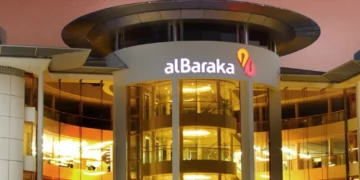










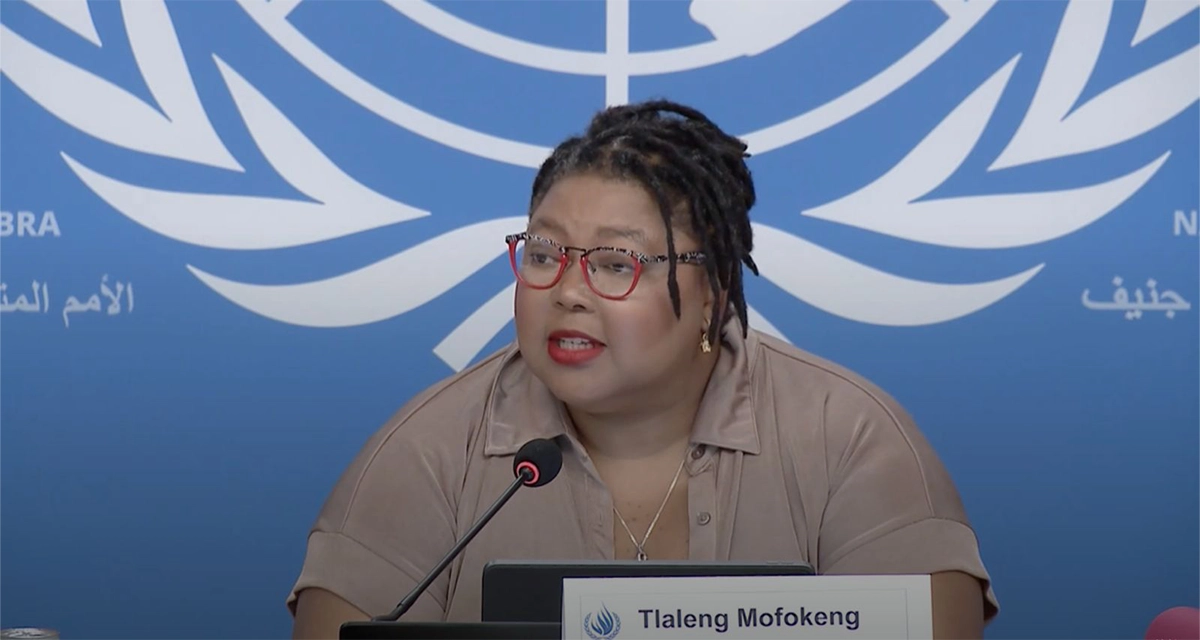

Dr Tlaleng Mofokeng concludes her United Nations mandate with a report examining medicide, reproductive genocide and attacks on healthcare in Gaza, Sudan and other conflict zones.
By HASSEN LORGAT
Dr Tlaleng Mofokeng officially ended her United Nations (UN) mandate as Special Rapporteur on the Right to Health on July 31 – a moment South Africans should be proud of. Yet, the day before, a local newspaper sought to garner negative mileage from her departure by reporting another bout of spurious complaints. Her final report was released under the heading: A Compendium on Medicide: A Sub-text to Reproductive Genocide – A Public Health Crisis.
Dr T, as she is popularly known, did not get distracted. Over the years, she kept her focus on the genocides of Palestinians and of the Sudanese people. She is unwavering in her statement that Israel is deliberately destroying the ability of Palestinians to have children and receive healthcare by attacking hospitals, doctors and patients. On Sudan, the report calls for an immediate ceasefire, protection of medical personnel and facilities, and punishment of those responsible.
This report is powerful and deserves deeper scrutiny for its immense contribution to human rights activists and scholars. Instead of examining her work, the South African Jewish Report (SAJR) once again chose to focus on her private life.
Tali Feinberg “reported” a complaint by UN Watch – a bogus non-governmental organisation (NGO) that Spinwatch confirms is a front for the Israeli government. This complaint against Dr Mofokeng is for agreeing to be the Economic Freedom Fighters’ (EFF) Joburg mayoral candidate in the November 2026 elections. It alleges she violated her role as UN Special Rapporteur on the right to health, wrongly stating that her mandate lasts until August 2026 and questioning her impartiality.
UN Watch previously inspired its ally, the South African Zionist Federation (SAZF), to launch a complaint to the Health Professions Council of South Africa (HPCSA). The HPCSA allegedly found Dr Mofokeng guilty of misconduct over social media comments about the Israeli Prime Minister and a UN Watch official. The SAZF’s press release – headlined “HPCSA sanctions UN Special Rapporteur Dr Tlaleng Mofokeng for unprofessional conduct” – was uncritically parroted by the Sunday World on October 29, 2025, without giving her a voice. The case is widely seen as a political attack lacking jurisdiction, since she was not practising as a doctor and enjoyed UN immunity. She is challenging the ruling in the High Court. Many observers believe the HPCSA itself is in flux and the allegations will not survive.
A compendium on medicide released
None of this matters now. The so-called NGO has money and energy to burn and distract us. The Special Rapporteur on Health’s report details all her other reports contributing to these 22 pages. Her perspective – as she explains in this complete compendium – applies an anti-racist and anti-colonial approach to show how health violations are deeply gendered. She argues that “structural racism, coloniality and gender-based discrimination function as determinants of health inequities” – meaning these forces directly cause unfair health outcomes. Her goal is to “contribute to new knowledge sharing” by connecting the right to health with broader systems of oppression.
The report defends international law – a system the Global Right despises. The US government, for instance, is trying to dismantle the International Criminal Court (ICC) to shield Benjamin Netanyahu from prosecution. Footage released after Senator Lindsey Graham’s death (July 2026) shows him rallying cross-party support for that effort on Israel’s behalf.
The 22-page report is a must-read and touches on the failures of international law and institutions to protect the right to health. She concludes that “attacking healthcare (in Gaza, Sudan, or anywhere) breaks those laws – and there must be consequences.” She reminds us that these attacks persist even when UN Security Council Resolution 2286, which condemned attacks on healthcare and called for an end to impunity, states that parties must comply with International Humanitarian Law, respect civilian lives, ensure accountability, and reverse the culture of impunity (2024).
You may also want to read


Her contribution to health studies revolves around the concept of medicide, which, simply put, is the genocide of medical personnel, systems and infrastructure. The report details the deliberate and systematic targeting of hospitals, medical workers and patients by state and non-state actors. This framework positions healthcare workers as frontline protectors of the right to health and life, and as meaningful actors in genocide prevention. In addition, it helps to explain how people’s health and lives are systematically annihilated in ways that may constitute war crimes or crimes against humanity. This happens despite the Genocide Convention (1948), particularly Article II(c), where the destruction of health contributes to destroying a group, which may serve as evidence of genocidal intent.
To investigate these claims, international jurisprudence is useful, as is documenting – as she does – the unprecedented attacks on the right to health in conflicts she identified in Gaza/Occupied Palestinian Territory, the Democratic Republic of the Congo (DRC), Haiti and Sudan. The forms of attacks are well known: bombing, looting, occupation and vandalisation of health facilities; harassment, kidnapping, injury and killing of healthcare workers; and destruction of humanitarian organisations, including NGOs.
Of Sudan’s humanitarian crisis, which we must not ignore, Dr Mofokeng reveals that over half the population faces acute hunger. Over 12 million are displaced, and healthcare is largely destroyed. There is widespread sexual violence – in particular, rampant rape and exploitation during attacks – with little or no medical care available (destroyed and under-resourced), and severe societal stigma for survivors. To keep society together, local groups using the nafeer tradition provide food, medicine and legal aid where institutions have collapsed. In all this, it seems that the regular peace deals are not rooted in reality and fail to end the war on people, particularly women.
As I am about to discuss violations of reproductive rights, it is important to point out that this concept was refined with the experiences of the sordid, humiliating violations of women’s rights in Sudan.
She writes: “The sheer scale of sexual violence documented in Sudan is staggering. Sexual violence against women – including rape, gang-rape, sexual exploitation and abduction for sexual purposes, as well as allegations of enforced marriages and human trafficking for sexual purposes across borders – occurred mostly in the context of invasions of cities and towns, attacks on displacement sites or civilians fleeing conflict-affected areas, and during the prolonged occupation of urban areas.”
Reproductive rights under public scrutiny
As a trained gynaecologist and medical scholar, Dr Tlaleng Mofokeng defined reproductive genocide as deliberate policies and practices that:
• Target reproductive health, choices and capacity
• Involve mass imprisonment, psychological warfare, collective punishment, ethnic cleansing and sexual violence. The report notes that the violence includes “bodily desecration (for the living and dead)”, which alludes to how the Israeli regime keeps the bodies of many deceased Palestinian activists without a valid moral or just reason.
• Restrict healthcare access by manipulating resources
• Exert control over a community’s ability to reproduce and sustain future generations
These findings are echoed in other UN investigations, such as:
• UN Special Committee (November 2024): Concluded that Israel’s warfare methods in Gaza are consistent with the characteristics of genocide.
• UN Commission of Inquiry (March 2025): Documented systematic sexual, reproductive and gender-based violence alongside the deliberate destruction of healthcare infrastructure.
• United Nations Population Fund (UNFPA): Estimated that 55,000 pregnant women trapped in Gaza face severe hunger, malnutrition and a complete lack of adequate maternal care.
• International Court of Justice (ICJ) Opinion: Highlighted violations including forcible transfer, racial discrimination and apartheid, and the denial of Palestinian self-determination.
She draws on these experiences in Gaza and Sudan, but the SAJR is blind to her full mandate simply because she told the fugitive of international law, Netanyahu, to end the genocide. The genocide did not upset this so-called NGO, but her words of condemnation of Netanyahu did.
The Special Rapporteur is unapologetic about the cases of Dr Hussam Abu Safiya, Dr Adnan Al-Bursh and other healthcare workers who were harassed, kidnapped and tortured by occupation forces – which she asserts is part of a pattern to annihilate the right to health in Gaza. The figures she documents do not go away because the media has dropped its gaze from the genocide and land-grabbing in Gaza and the West Bank. The stark facts remain as evidence of medicide: over 686 health attacks were documented in Gaza between October 7, 2023, and May 7, 2025, she writes, affecting 122 health facilities and 180 ambulances. Her use of Forensic Architecture’s Cartography of Genocide platform is revealing, as it is a seminal reference about the detailed documentation of the genocide in Gaza.

“We must address the global health impact of the living legacy of racism, apartheid, slavery, colonialism and oppressive structures through anti-coloniality and anti-racism frameworks.”
She ends with a universal call for a real and immediate ceasefire so that people in need can be helped. Importantly, she says that no one must be permitted to attack hospitals, doctors or nurses. Nor must they deny the people of Gaza – who are suffering – the right to food, water and medicine; these must be provided to all who need them now. Pregnant women, new mothers and people with mental health problems need special care. With Israel clearing up the evidence, the report calls for independent investigators to be allowed to enter war zones to document crimes.
She supports the importance of building and replacing destroyed facilities with permanent hospitals, setting up interim measures to supply clean water and medicine, and deploying medical specialists to conflict zones like Sudan, Gaza, DRC and Haiti.
It is justice and redress that she calls for when she ends: “We must address the global health impact of the living legacy of racism, apartheid, slavery, colonialism and oppressive structures through anti-coloniality and anti-racism frameworks.”
Hassen Lorgat is part of the Data Centres, Surveillance, Control Working Group, an activist collective associated with CSOs 4 Tailings Justice. He has worked in the trade union movement and anti-apartheid sports movement led by the South African Council on Sports (SACOS). He is active with the SA BDS Coalition. He is writing in his personal capacity.


