

































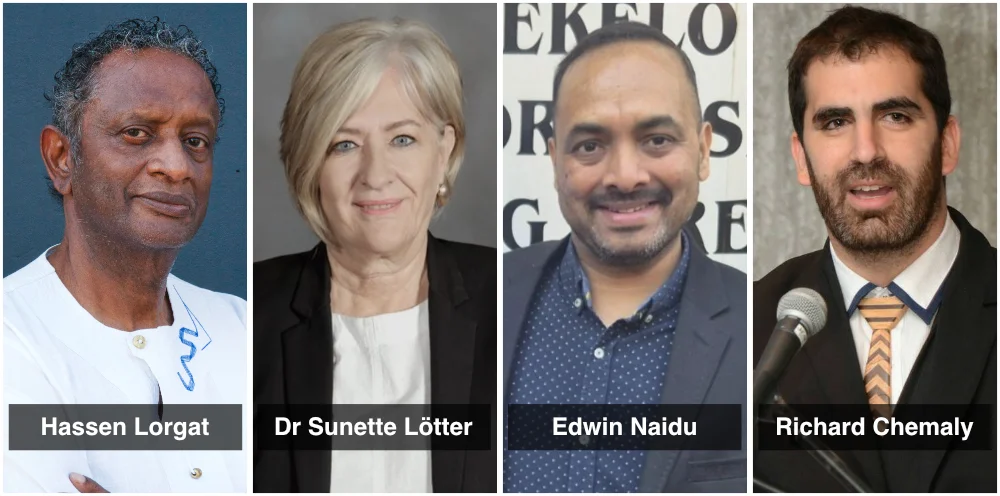

By HASSEN LORGAT
When the South African Zionist Federation invoked Hassen Lorgat’s successful complaint against the SABC in its case against 702, it affirmed a vital principle: broadcasting standards and precedents must apply consistently to all complainants.
On the morning of September 16, 2026 I woke up to the news that the South African Zionist Federation (SAZF) was quoting me favourably. I smiled and wondered whether it had come around to supporting the principle of one person, one vote in a unified state in Israel-Palestine. But no, the reason was more mundane.
Its media release concerned BCCSA Adjudication No 24/A/2026. The SAZF welcomed the Broadcasting Complaints Commission of South Africa’s (BCCSA) “ruling in our complaint against 702, following a broadcast in which the term ‘Zionist entity’ was repeatedly used to describe Israel without appropriate challenge or context”.
It noted that the BCCSA had found in the SAZF’s favour and ordered 702 to broadcast an apology. It went further, stating:
“Of particular significance, the Commission relied on the precedent established in Lorgat v SABC (SAfm), BCCSA Case No 16/2025. It is a useful reminder that broadcasting standards and the precedents that uphold them apply consistently – irrespective of the political perspective of the complainant.
Precedent works both ways.
For this discussion, I will not enter the debate about whether Israel is a Zionist entity. Instead, I will focus on the ruling cited by the SAZF and its significance.
It was brought with the support of various human rights organisations, particularly the People’s Media Consortium (PMC), Media Review Network (MRN), Palestine Solidarity Alliance (PSA), Palestine Solidarity Campaign Cape Town (PSC) and South African Jews for a Free Palestine (SAJFP).
The ruling was unanimous. Commissioners Edwin Naidu and John Chemaly formally concurred with Dr Sunette Lötter’s evaluation and ruling. Their concurrence strengthened the reprimand against the SABC, particularly through their shared interpretation of Clause 13.1 of the BCCSA Code.
During our media advocacy after the ruling, we highlighted the extensive evidence supporting our arguments across a series of programmes. Readers familiar with the details may skip this list:
- On October 3, 2025, SABC News’s The Agenda and SAfm’s Update at Noon interviewed Ariel Seidman about Israel’s detention of flotilla activists.
- On October 3 and 4, 2025, SAfm’s The National Pulse and The Weekend View featured excerpts from the Seidman interview while discussing the flotilla and public responses to it.
- On October 6, 2025, SAfm’s First Take SA interviewed Rolene Marks about South Africans detained in Israel.
Dr Lötter, chairperson of the BCCSA tribunal, weighed the arguments advanced by the complainants, particularly those presented by the powerful SAZF and the organisations I have mentioned.
The ruling confirmed that there had been “a clear breach of its duty to the public”. It serves as a permanent record of the broadcaster’s failure, regardless of attempts by SABC apologists to downplay the outcome. It is, therefore, ironic that those who did not regard the ruling as significant are now using it as part of an organising strategy.
Lötter’s ruling and a deeper look
It is worth noting that, in this case, Dr Lötter crossed her own Rubicon. She had been a panellist in an earlier case, led by Professor Kobus van Rooyen, that I lost: Lorgat v SAfm, Case No 22/2013. That tribunal refused to entertain the international context as being in the “public interest”.
I will return to that matter, but in the more recent case, the BCCSA confined itself narrowly to Clause 13 in relation to the Gaza flotilla incident.
Put simply, the BCCSA found that:
- The SABC interviewed only Israeli representatives in the programmes under consideration.
- The subsequent Palestinian interview was not about the flotilla incident and was not broadcast in a comparable time slot.
- This failed to meet the requirement for the timely and balanced presentation of opposing views.
The SABC was reprimanded and urged to ensure future compliance with Clause 13.1.
A new love for the Lorgat ruling
We have observed that the SAZF has embarked on a concerted campaign targeting several media organisations. I am not as convinced as some of my comrades that this amounts to an abuse of the process, but the BCCSA and its new commissioners must remain vigilant.
New blood often brings fresh energy, but it may also bring naivety and disregard for history.
The BCCSA’s new commissioners appear enthusiastic. However, they may inadvertently be giving those whom we have criticised for dominating public discourse with pro-Zionist views another opportunity to capture space and arguments they are losing on the ground.
The 702 apology
The 702 apology was read by Siyabonga Motha. It centred on his, or the station’s, assertion that the term “Zionist entity” is a political expression used primarily by critics of Israel to refer to the State of Israel while denying it international recognition.
The term was reportedly used repeatedly by academic Jessica Breakey, who spoke on behalf of the Global Sumud Land Convoy.
The SAZF celebrated the outcome with the declaration: “We took 702 to the BCCSA and we won.”
Concluding trends
I can only hope that the Zionist Federation and its members, including the South African Jewish Board of Deputies, accept their defeats alongside their victories. It is unfortunate that some of their supporters, such as the South African Jewish Report, chose instead to leave the Press Council when they were reportedly facing expulsion.
To the BCCSA commissioners, I say: welcome to this immense responsibility in the service of the public. Colleagues, you would do well to revisit the case we brought and the ruling that followed.
In several instances, we demonstrated how marginalised voices had been minimised or written out of the script. This continues daily, whether in reporting on anti-immigrant discourse or on the genocide in Gaza and occupied Palestine.
The ruling constituted a reprimand of the SABC. The broadcaster was put on terms and warned not to repeat the conduct.
At the time, I argued that the ruling presented an opportunity for public-service broadcasting to renew itself.
You may also want to read




Renewal?
I argued that the purpose of this and similar complaints was to educate citizens through public media spaces where audiences and producers could interact, rejecting the passive consumption of dominant narratives.
I sincerely believe that public broadcasting, as well as open debate on commercial radio and television stations, must be understood as part of the commons and as a public good requiring secure funding and independent governance.
I also addressed the SABC’s underfunding. We can see the consequences in how it reports – or fails to report – South Africa’s genocide case before the International Court of Justice. More reporting of this nature is required.
I argued that the SABC remains vulnerable to external pressure and accusations of “speaking from both sides of its mouth” on the genocide: acknowledging it while simultaneously platforming opposing views in the name of “balance”, even when this creates false equivalence.
While presenting the BCCSA case from Ghana, I argued that journalists are not neutral umpires. When the facts are clear, they must report the truth instead of giving equal weight to false claims.
In the face of genocide, neutrality is impossible. Ethical journalism and solidarity with victims must underpin coverage. This was what my case was about. Yet all the broadcaster received was a firm warning.
A recording of the hearing exists, and the new commissioners should listen to it.
We must remain vigilant and work together to prevent the powerful from rewriting or selectively reinterpreting the ruling. Media equity and justice require a long and inclusive process, not a once-off intervention.
https://muslimviews.co.za/sabc-censured-for-pro-zionist-bias-on-flotilla-incident-interviews/