


















![The market-builder who restrained the market [Part 2]](https://muslimviews.co.za/wp-content/uploads/2026/08/PHOTO-2026-08-25-17-16-32-360x180.jpg)
![The merchant preceding the Prophetic mission [Part 1]](https://muslimviews.co.za/wp-content/uploads/2026/08/01-360x180.jpg)








By SHAKIR ACHMAT
‘One of them shouted at me, “Good to see Muslims walking here.” I smiled, as I was taught to greet people who engage with me. Then he said, “We will kill all of you”.’
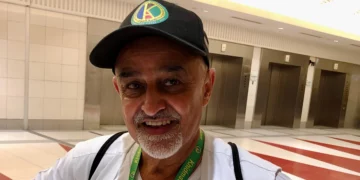
For decades, Mohammed Ali Naroth has been swimming at Camps Bay, a beach long scarred by the racial divisions of the Apartheid era.
But his Sunday morning routine of braving the icy waters of the Atlantic Ocean was marred when he was subjected to racist abuse followed by a death threat from a Zionist.
Almost a year later, following charges laid by Naroth, the Cape Town Magistrate’s Court handed down judgment on September 12, 2025, finding Stefen Dimitrov guilty. He was given a five-year suspended sentence for intimidation and harassment.
The matter came to court nearly after a year of persistence, with Naroth pressing for accountability despite reluctance from police and ongoing harassment by Dimitrov.
For Naroth, the outcome was bittersweet.
‘I am strangely content with the Zionist perpetrator being found guilty and given a five-year suspended sentence,’ he reflected.
On September 28, 2024, Naroth was approached on the Camps Bay strip by three men – one elderly and two younger. What began as a seemingly casual greeting quickly escalated into open hostility.
‘One of them shouted at me, “Good to see Muslims walking here.” I smiled, as I was taught to greet people who engage with me. Then he said, “We will kill all of you”.’
The men boxed him in, one ahead and one behind, while the speaker, later identified as Dimitrov, walked alongside, staring him down. Recognising the tactic as intimidation designed to provoke a fight, Naroth refused to retaliate.
‘They wanted me to react so they could attack me. I refused to give them that satisfaction,’ he said.
When the men walked away, Naroth decided to press charges for intimidation.
At the Camps Bay police station, however, Naroth was met with indifference. The officer on duty told him there were no vans available and suggested he should call private security if it happened again.
‘He asked me if there were any witnesses, as though I was the aggressor. I walked out really angry,’ Naroth recalled.
Only after returning with a lawyer, three witnesses, and the registration numbers of the perpetrators’ vehicles did police finally log the case. Naroth also requested CCTV footage from nearby businesses, including Woolworths and Starbucks, to corroborate his account.
In the weeks that followed, the intimidation did not stop. Naroth described being stalked, photographed, and glared at while visiting the tidal pool.
He said Dimitrov continued to harass him and even gestured at a group of people of colour at a local café.
‘No place for racists in our country. I am tired of being asked what I did to provoke these men. My only “sin” is that I am African, of colour, and Muslim,’ Naroth said.
He questioned the disparity in police responses.
‘If three black men had walked up to a white man and said, “Nice to see white people here, we’re going to kill all of you,” would the police have acted the same way? Or would it still be called “freedom of speech”?’
Naroth sees his ordeal as part of a broader struggle against racism and oppression.
‘I fought Apartheid, I fought for freedom, and I oppose neo-colonialism. We will never be colonised or suffer abuse again,’ he declared.
Chikte: ‘Hold the City and Western Cape Government accountable’
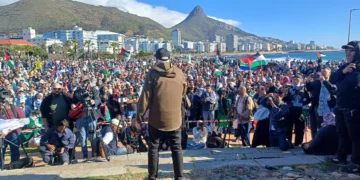
Professor Usuf Chikte, coordinator of the Palestine Solidarity Committe in Cape Town, condemned the racially and religiously motivated assault on Naroth in Camps Bay, calling the suspended sentence given to the perpetrator a failure of justice. He said Camps Bay has become a hotspot for Islamophobic abuse, racial profiling, and anti-Palestinian harassment, worsened by political inaction from the City of Cape Town and Mayor Geordin Hill-Lewis.
Chikte raised concern over FF Plus councillor Paul Jacobson’s inflammatory conduct and highlighted the area’s history of exclusion, comparing it to Apartheid-era racism. He urged civil society to hold the City and Western Cape Government accountable, push for stronger hate-crime protections, and defend the right to protest and show solidarity with Palestine.
You may also want to read
![UpScrolled, TikTok and the weapons of war [+video]](https://muslimviews.co.za/wp-content/uploads/2026/01/Main-resized-120x86.webp)


![‘I am disgusted with myself’ says American conservative [+video]](https://muslimviews.co.za/wp-content/uploads/2024/12/Featured-Image-120x86.webp)
He stressed that silence in the face of such injustices betrays South Africa’s legacy of resistance against Apartheid.
Naroth’s account highlights not only the persistence of racism in South Africa but also the failure of law enforcement to protect victims fairly. For him, this case represents more than a personal battle – it is a call for accountability, justice, and recognition that hate-driven intimidation cannot be dismissed in a democratic society.
This article was updated on September 19, 2025 at 7:06am to include comments by Professor Usuf Chikte.