







![Does ta’wīl mean interpretation or fulfilment? A Quranic reassessment [+video]](https://muslimviews.co.za/wp-content/uploads/2026/10/Tawil-Kaskas-360x180.webp)











![Why becoming a wealthy Muslim is commendable in Islam [+videos]](https://muslimviews.co.za/wp-content/uploads/2026/09/Muslim-Trade-Business-1-360x180.webp)





![How Hollywood reveals US empire strategy [+videos]](https://muslimviews.co.za/wp-content/uploads/2026/04/W-movie-scene-MAIN.webp)

How Hollywood, media, and films like W. reveal US global strategy, propaganda, and the shaping of public opinion around Iran and empire.
By HASSEN LORGAT
We all grew up on the cowboys and crooks Hollywood served up—John Wayne and his ilk. Many of those stories pitted ‘cowboys’ against ‘Indians’, coaxing us to side with the ‘brave white men’, the pioneers.
But we grew up, too, and our sympathies increasingly shifted towards the indigenous owners of the land and the bravery of Geronimo and others. Still, Hollywood wasn’t entirely a force for bad stuff or right-wing ideology only. Some filmmakers and actors have used their platforms to explain, in their own small way, how US power functions and how it attempts to reshape our world.
Today, most of us recognise Hollywood as an integral part of the US empire’s ‘ideological state apparatus’. At its most effective, it serves as ‘soft power’, globalising American values, culture, and political ideologies. In the age of AI, gaming, and social media, the landscape has become almost too complex to navigate—with or without popcorn. It has become a deadly horror show with inexplicable ratings. We must ask: what happens when that apparatus is weaponised through memes, misinformation, and disinformation?
A recent Listening Post segment invites us to look at how both the US and Israel are deploying memes and mass media in their confrontation with Iran.
The segment offers sharp insights into the ‘gamification of war’, showing how this profit- and ideology-driven machine was employed by Trump to help sell an unjust and illegal war to the world. The producers invite us to go ‘beyond traditional tactics’, noting that both the US and Iran are increasingly using memes, AI-driven animations, and ‘trash-talk’ mockery designed for maximum virality. Interestingly, the editors suggest that Iran’s straightforward reporting often beats the Western hype.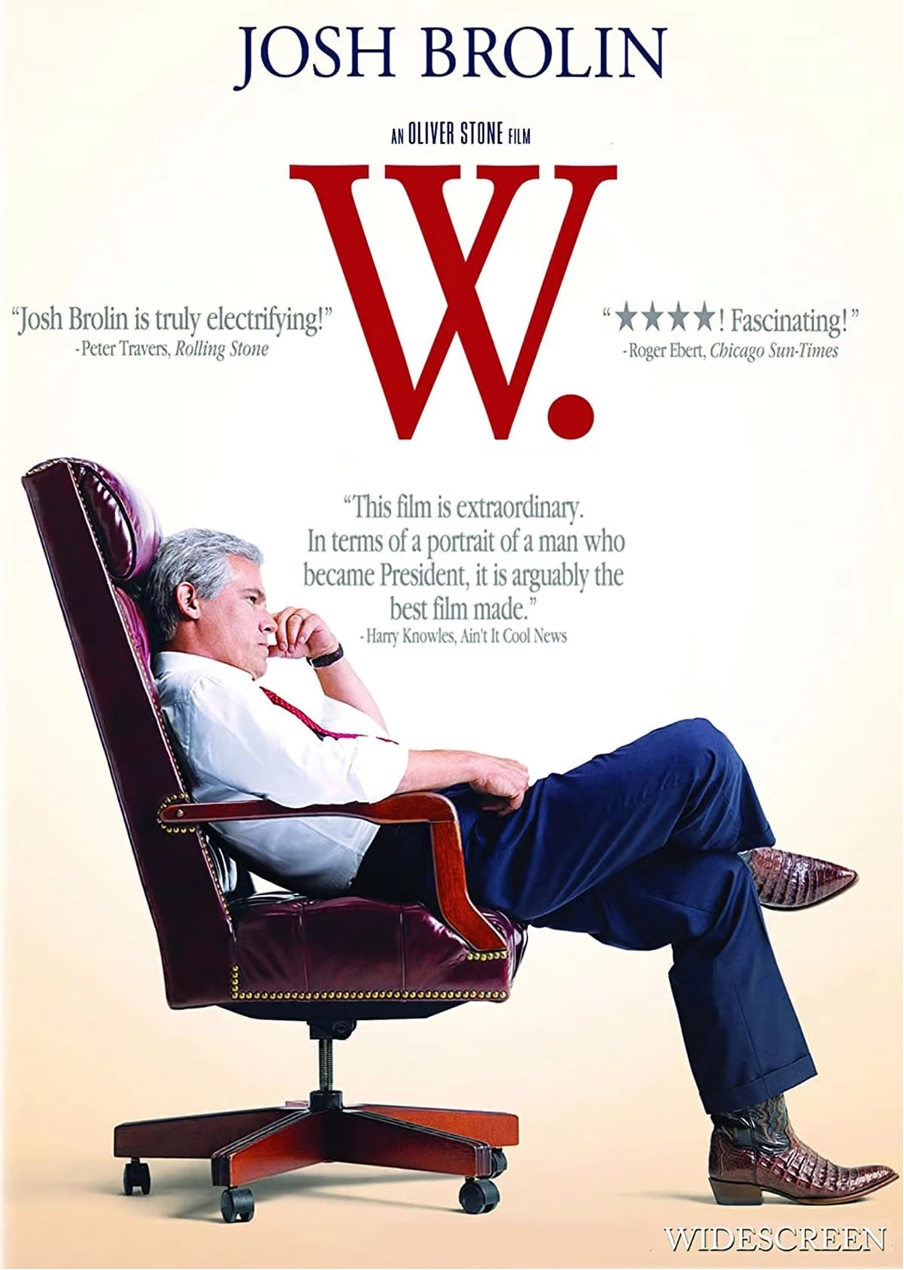
You may also want to read
![Islamic finance at the first African G20 [+video]](https://muslimviews.co.za/wp-content/uploads/2025/11/B20-Part-1-120x86.webp)


Why W.? My primary focus here, however, is the film W. One specific scene in W. outlines US strategic thinking regarding oil and gas (a strategy now updated to include critical raw materials). Directed by Oliver Stone and written by Stanley Weiser, the film stars Josh Brolin as President George W. Bush and Richard Dreyfuss as Vice President Dick Cheney. The plot follows Bush’s political ascent and delves into the invasion of Iraq, the ‘WMD’ myth, and the demonisation of Saddam Hussein.
A brief diversion: In 2000, the younger Bush—whom I nicknamed ‘Shrub’—successfully ran for president. After the 9/11 attacks in 2001, he labelled Iran, Iraq, and North Korea the ‘Axis of Evil’. In 2002, his administration sought evidence that Saddam Hussein was building nuclear weapons. When no evidence was found, they manufactured it, using a decorated Black general to sell their falsehoods to the world. Colin Powell became the fall guy.
The film depicts a White House staff largely in lockstep, with the exception of Secretary of State Powell, who warns that invading Iraq would destabilise the region. Cheney and Defence Secretary Donald Rumsfeld overrule him, arguing that war would secure US dominance and spread ‘democracy’ in the Middle East. It was around this time that Samuel Huntington’s ‘clash of civilisations’ narrative gained its dangerous traction.
The focus eventually shifts to Iran. Oliver Stone recently reflected on his film on Facebook, writing: ‘In our film “W.” (2008), we tracked the US-Iran problem in this scene, inspired by Dick Cheney’s prophetic presentation in the War Room to Bush’s war cabinet.’
The dialogue:
Setting: The White House Situation Room. Dick Cheney gives a PowerPoint-style briefing to President George W. Bush, Colin Powell, Donald Rumsfeld, Condoleezza Rice, and others.
Dick Cheney (pointing to a map):
‘Where do you see a lack of American presence? What’s missing?
Iran. The motherlode.
Third largest oil reserve in the world. Forty per cent of the world’s oil goes right through here—through the Strait of Hormuz.
Control Iran, control Eurasia, control the world.
Empire. Real empire.’
To conclude, we work and pray that the ceasefire announced yesterday (April 8) holds to bring a just end to this unjust and illegal war. We must commit to becoming critical consumers of the overwhelming media designed to confuse us. Information is too important to consume in isolation—discuss what you read and watch with your friends and comrades.
Hassen Lorgat has worked in the trade union movement, civic associations, and anti-apartheid sports movement led by the South African Council on Sports (SACOS), as well as NGOs for the past while. He has worked with civil society groups opposing harmful and exploitative mining and extraction practices. Hassen is active with the SA BDS Coalition. As a media activist, he recently exposed journalists and media houses that did not disclose trips to Israel that were paid for by lobby groups for the Zionist regime.