










![Does ta’wīl mean interpretation or fulfilment? A Quranic reassessment [+video]](https://muslimviews.co.za/wp-content/uploads/2026/10/Tawil-Kaskas-360x180.webp)
















![Why becoming a wealthy Muslim is commendable in Islam [+videos]](https://muslimviews.co.za/wp-content/uploads/2026/09/Muslim-Trade-Business-1-360x180.webp)






![Islamic finance at the first African G20 [+video]](https://muslimviews.co.za/wp-content/uploads/2025/11/B20-Part-1.webp)

South Africa’s hosting of the G20 and B20 Summits for the first time on African soil in this month marks a historic moment, placing the continent at the centre of global political and economic deliberations. In this first of a two-part series MAHMOOD SANGLAY explores how Africa’s demographic century meets an ethical finance moment.
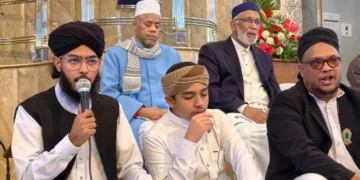
South Africa’s hosting of the G20 and B20 Summits on African soil positions Africa at the centre of global political and economic deliberations. Against this backdrop, Awqaf South Africa and Standard Bank Shariah Banking convened the inaugural B20 Islamic Finance Forum on 19 November. The forum hosted policymakers, development financiers, bankers, diplomats, asset managers, labour leaders and industrialists into a wide-ranging conversation on how Islamic finance can anchor Africa’s economic future.
What emerged from the forum was a bold and focused attempt to reposition Islamic finance as a catalytic developmental tool, capable of reshaping Africa’s horizon of possibilities. The engagments linked infrastructure, industrialisation, ethical capital and social equity within a single strategic frame.

Photo B20 Media
Yet while the forum was rich in ideas and enthusiasm, the absence of formal resolutions, declarations or commitments was noticeable. Several delegates remarked privately that such a historic gathering needed more than goodwill—it needed a roadmap. Still, given the short notice and the symbolic weight of Africa’s first G20, the forum succeeded in a historic first: placing Islamic finance at the centre of a vision for Africa’s economic future.
Africa’s demographic explosion
You may also want to read


![The ethics and barriers for Islamic finance in Africa’s economic development [+video]](https://muslimviews.co.za/wp-content/uploads/2025/11/B20-Part-2-120x86.webp)

The forum opened with a macro-level framing by former Minister of Trade, Industry and Competition, Ebrahim Patel, whose intervention provided the demographic and geopolitical context for Islamic finance’s relevance. His remarks highlight the unprecedented demographic shift placing Africa at the heart of global population growth.
Patel’s framing is crucial because demographic expansion, without a financial architecture that can convert people and resources into productive assets, becomes a liability. Islamic finance’s asset-backed, long-term orientation is well suited to transforming demographic potential into economic capability. Moreover, Patel’s point that Africa will supply both the workforce and the consumers of the future underscores the urgency of building infrastructure, energy systems and industrial capacity now, not decades later. Islamic finance is not a substitute for public finance, but it can become a strategic complement that addresses Africa’s chronic underinvestment.
A time of global volatility and eroding trust
Economist and policy advisor Fuad Cassim, contextualised Africa’s developmental aspirations within a global environment marked by political fragmentation, populism and declining trust.
Cassim’s intervention is observations because it reveals a blind spot in conventional economic discussions. Finance does not operate in a vacuum; it is embedded in political legitimacy. Islamic finance’s ethical principles—risk sharing, transparency, fairness—may offer financial alternatives, but they also offer a moral narrative at a time when global electorates distrust financial elites.
The question Cassim poses—whether Islamic finance can become a compelling vision to global publics—raises questions of technical design. However, it also challenges practitioners to articulate Islamic finance as a broader civilisational project grounded in justice, responsibility and social cohesion.
Africa and Islamic finance as a modern Asabiyya
Mohammed Ameen Hassen, head of Standard Bank’s Shariah Banking division, offered perhaps the most philosophically charged reflections of the day, invoking Ibn Khaldun’s concept of Asabiyya. Hassen explained why Africa and Islamic finance may be rising together.
Hassen’s conceptualisation was intellectually stimulating. By invoking Asabiyya, he positions Africa and Islamic finance as forces that have long operated at the margins of global finance but now stand poised to shape its future. This is strategically important because it reframes Islamic finance not as a reactive tool but as a proactive force aligned with global economic rebalancing.
His argument situates Africa not as a passive recipient of external funding but as an emerging pole of global economic gravity. Africa’s development trajectory and the global rise of Islamic finance are not parallel lines—they are interdependent forces, capable of reinforcing one another. For him, the continent is entering its ‘economic century’, and Islamic finance must rise with it as a partner, not a donor.
Infrastructure, industrialisation and scale
Across the forum, speakers repeatedly referred to Africa’s vast infrastructure deficit, estimated at US$130–$170 billion annually. This deficit depresses GDP growth by up to two percentage points, limiting Africa’s ability to absorb its rapidly growing population. Islamic finance offers distinctive tools for infrastructure development:
- Sukuk for large-scale energy, logistics, and transport systems
- Green sukuk for climate-aligned development
- Diaspora sukuk for mobilising African transnational communities
- Waqf-linked instruments for social infrastructure such as health and education
- Blended Islamic finance for SMEs and township economies
Indonesia’s experience, presented by Dr Irfan Beik, demonstrates that such instruments are both viable and scalable when supported by regulatory clarity and political will.
However, the stumbling block remains scale. South Africa’s Islamic banking deposits exceed R103 billion, yet only a quarter is deployed. For Islamic finance to shape Africa’s development path, it must expand beyond retail offerings and engage institutional capital—pension funds, sovereign entities, and development banks.
This analysis shows that the geopolitical, demographic and philosophical foundations that make Islamic finance a timely tool for Africa’s development agenda. Yet beneath the optimism lies a quiet tension: can Islamic finance, still marginal in global markets, meaningfully shift Africa’s economic trajectory?
The second and final part of this series interrogates the challenging questions of inequality, regulatory bottlenecks, capital-market barriers, and the systemic shifts required to unlock Islamic finance at continental scale. These must be confronted before Islamic finance can become a mainstream driver of the African century.