












![Does ta’wīl mean interpretation or fulfilment? A Quranic reassessment [+video]](https://muslimviews.co.za/wp-content/uploads/2026/10/Tawil-Kaskas-360x180.webp)


















![Why becoming a wealthy Muslim is commendable in Islam [+videos]](https://muslimviews.co.za/wp-content/uploads/2026/09/Muslim-Trade-Business-1-360x180.webp)




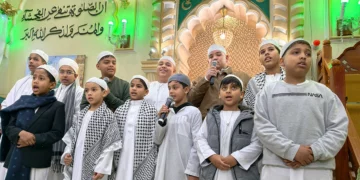



Born in the Kabah and martyred in Kufa, Sayyiduna Ali’s (RA) life reflects devotion, courage and true success through submission to Allah ta‘ala.
By SALEEMAH JAFFER
Rajab is a special month — a month of forgiveness, a month in which to begin preparing for Ramadan, and a month described in the Holy Quran as sacred.
Rajab is also the birth month of Sayyiduna Ali ibn Abi Talib (RA), the cousin of the Messenger ﷺ.
The birth of Sayyiduna Ali (RA) is unique. His mother, Lady Fatima bint Asad, went into labour on the mataaf within the precincts of the Kabah. As the wife of the chief of Bani Hashim, she was taken inside the Kabah to ensure privacy and shelter. It is reported that Sayyiduna Ali (RA) was born inside the Kabah on the 13th of Rajab.
His father, Abu Talib, later entrusted him to the care of the Messenger ﷺ. Sayyiduna Ali (RA) was raised in the household of the Messenger ﷺ and Sayyidah Khadijah (RA), accepting Islam while still a boy. His formative years were shaped directly by the Messenger ﷺ.
Countless narrations attest to the virtue, nobility and bravery of Sayyiduna Ali (RA).
He was the one who remained in Makkah when the Messenger ﷺ migrated to Madina tul Munowwarah, sleeping in the Messenger’s ﷺ bed. The Messenger ﷺ entrusted him with returning the belongings of the people of Makkah — many of whom had deposited their valuables with him — as well as safeguarding his most precious trust: his family. Sayyiduna Ali (RA) migrated carrying this amanah, and the Messenger ﷺ waited for them in Quba so that they could enter Madina tul Munowwarah together.
There are many intimate moments recorded between the Messenger ﷺ and Sayyiduna Ali (RA). One of the most profound occurred during the Battle of Khaybar. A hadith found in Sahih Bukhari, narrated by Salama (RA), recounts:
‘Ali remained behind the Prophet ﷺ during the expedition of Khaybar because he was suffering from eye trouble. He later said, “How can I remain behind the Prophet ﷺ?” and followed him. On the night before the conquest of Khaybar, the Prophet ﷺ said: “Tomorrow I will give the flag to a man who is loved by Allah and His Messenger, and Allah will grant victory at his hands.” Everyone hoped to be chosen. It was then said, “Here is Ali,” and the Prophet ﷺ gave him the flag, and Khaybar was conquered through him.’
This narration highlights not only Sayyiduna Ali’s (RA) love for Allah ta‘ala and His Messenger ﷺ, but also that Allah ta‘ala and His Messenger ﷺ loved him. The Sahabah (RA) who hoped to be chosen recognised that the true honour lay not in bearing the flag, but in attaining the love of Allah ta‘ala and His Messenger ﷺ. Sayyiduna Ali’s (RA) courage and strength at Khaybar remain enduring lessons in devotion and faith.
During the expedition of Tabuk, Sayyiduna Ali (RA), who was accustomed to accompanying the Messenger ﷺ, was appointed as his deputy in Madina tul Munowwarah. Sa’d (RA) narrates that Sayyiduna Ali (RA) expressed sadness at being left behind. The Messenger ﷺ responded: ‘Will you not be pleased that you are to me as Harun was to Musa? Except that there is no prophet after me.’ (Sahih Bukhari) This hadith illustrates the deep bond between them and affirms Sayyiduna Ali’s (RA) leadership and trustworthiness.
Sayyiduna Ali (RA) was honoured with marriage to Lady Fatima bint Muhammad (RA). Their sons, Imam Hasan (RA) and Imam Husayn (RA), are described as the leaders of the youth of Jannah. Later, Sayyiduna Ali (RA) became the fourth of the rightly guided caliphs.
Due to political necessity, he relocated to Kufa, where he attained martyrdom. He was stabbed while in sujud during the Fajr prayer in the Great Mosque of Kufa on the 17th of Ramadan. As he realised that martyrdom had been decreed for him, he uttered the immortal words: ‘I have succeeded by the Lord of the Kabah.’
These words — perfectly befitting one who was born in the Kabah — reflect surrender, gratitude and humility before Allah ta‘ala. They have been preserved on the mimbar of the Great Mosque of Kufa as a reminder to all who visit and pray there.
You may also want to read




They remind us not only of Sayyiduna Ali’s (RA) final moments, but of how he lived. And they affirm that true success comes only from Allah ta‘ala, and by His Will alone.
Saleemah Jaffer is a student of the Alawi Husayni Ninowi Zawiyah and Women’s Spiritual Development Programme Coordinator at Madina Institute.