

















![Does ta’wīl mean interpretation or fulfilment? A Quranic reassessment [+video]](https://muslimviews.co.za/wp-content/uploads/2026/10/Tawil-Kaskas-360x180.webp)
























![Why becoming a wealthy Muslim is commendable in Islam [+videos]](https://muslimviews.co.za/wp-content/uploads/2026/09/Muslim-Trade-Business-1-360x180.webp)









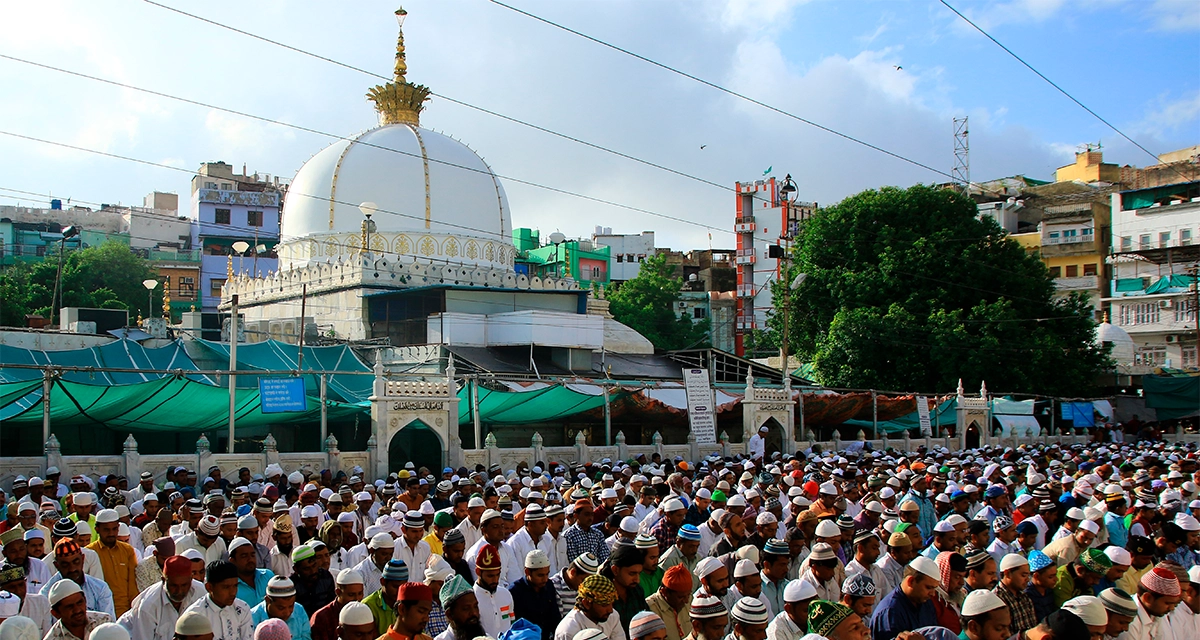

The Chishtiyah Sufi Order transformed South Asia by introducing Islam through compassion, spirituality and service. AMENA HAYAT explores its origins and enduring legacy in the sub-continent – and beyond – under Khwaja Mu’in al-Din Chishti (RA) who passed away on 6 Rajab 627 AH.
KHWAJA MU’IN al-Din Hasan Chishti (RA) (1141–1236), also known as Khwaja Gharib Nawaz (the benefactor of the poor), was born in Sistan, Persia, then ruled by the last of the Seljuk dynasty.
He traced both his paternal and maternal lineage to Sayyidina Ali (RA). Orphaned at the age of fourteen, he relinquished his substantial inheritance and set out in pursuit of knowledge and spiritual insight. He studied at the great Islamic centres of Bokhara and Samarqand.
In Baghdad, he found his shaykh, Khwaja Uthman Harooni (RA), whom he served with devotion for 20 years, travelling extensively in his company. Before parting ways, he was appointed khalifah (spiritual successor). During his time in Baghdad, he also met the renowned Shaikh Abd al-Qadir Jilani (RA), from whom he sought spiritual counsel.
Resuming his travels independently, Khwaja Mu’in al-Din was directed in a dream by the Prophet (SAW) to proceed to Ajmer in India. There, he settled and established the Chishti Order. Along the journey, he paid homage to the revered Data Ganj Baksh (RA) in Lahore.
His arrival in Ajmer marked the beginning of a cultural and spiritual transformation. He entered the region at a time of hostility and Hindu political dominance. The subsequent defeat of local rulers by Muhammad Ghori of Afghanistan facilitated the spread of Islam and allowed the Chishti message of ‘love all and hate none’ to resonate throughout the subcontinent.
In a society burdened by social injustice, caste hierarchy and exclusion, this message offered renewed dignity and hope. Its emphasis on unity and equality stood in stark contrast to entrenched discrimination. Many perceived it as divinely inspired.
Miracles formed part of the saint’s mission, though in Sufi tradition they are regarded as a last resort, employed only to affirm spiritual truth when other means fail.
Historically, the presence of Sufis in the subcontinent dates back to the tenth century, with the travels of Mansoor al-Hallaj (RA) through Gujarat and Sind (present-day Pakistan). Other Sufi orders emerged during this period. In the eleventh century, Data Ganj Baksh (RA) settled in Lahore. While some traditions suggest an even earlier Sufi presence, it was with the advent of the Chishtiyah Order that Sufism evolved into a mass movement.
The Chishtiyah Order originated in the town of Chisht in Afghanistan in the ninth century, tracing its spiritual lineage to Hasan al-Basri (RA).
Khwaja Mu’in al-Din’s spiritual discipline was marked by strict adherence to shariah, complete reliance on Allah, and a deep aversion to hoarding. Surplus food, money or clothing was never kept beyond a day. His teachings emphasised responding to evil with good, praying for one’s adversaries, limiting speech to the remembrance of Allah (SWT), guarding against sin, engaging in night prayer and regular fasting, and avoiding patronage from rulers or the state.
You may also want to read


Even religious offices were discouraged. His successor, Khwaja Bakhtiyar Kaki (RA) (1173–1235), famously warned: ‘How long will you go to the doors of emirs and sultans? This is nothing else but walking in the tracks of Satan!’
Prospective disciples were required to possess a sound understanding of the shariah and to undergo sincere tawbah, which included restitution, apology and a firm resolve to abstain from wrongdoing.
Dhikr, introspection, contemplation and forty-day spiritual retreats were integral to Chishti practice. Livelihoods such as agriculture, trade and craftsmanship were encouraged, while government service was viewed with caution by the austere and God-conscious Chishtis.
The Chishtiyah way of life had a profound social impact. Its adherents mixed freely with ordinary people, embodying humility and self-effacement. Khwaja Mu’in al-Din’s devotion to the poor became the defining feature of the order. He is reported to have said: ‘The highest form of devotion is to redress the misery of those in distress, to fulfil the needs of the helpless, and to feed the hungry.’
Hospitality was central to Chishti life. Their open kitchens symbolised generosity and service, while social and spiritual affairs were conducted in the khaanqah, a modest structure that served as a gathering space for people of all backgrounds.
One of the most debated practices in Sufism is sama’. Within the Chishti tradition, sama’ refers to devotional poetry accompanied by music, regarded as nourishment for the soul. For those spiritually inclined, it often led to wajd (ecstatic states). Khwaja Bakhtiyar Kaki (RA) is said to have remained in ecstasy for three consecutive days after hearing a verse and subsequently passed away:
‘Those slain by the dagger of surrender (taslim)
Receive every moment a new life from the Unseen.’
Given music’s central role in Hindu religious culture, sama’ incorporated elements of India’s rich musical heritage, a practice initiated by Khwaja Mu’in al-Din (RA) and later refined by Amir Khusrau (RA). This fusion contributed significantly to conversions to Islam and enriched the subcontinent’s musical traditions. Khwaja Farid ad-Din (RA) (1175–1265) also introduced a Hindi form of dhikr.
On the permissibility of sama’, Maulana Rumi (RA) wrote: ‘Indeed sama’ is indispensable, as salaah and fasting, for the mature shaikh; lawful for the sincere disciple; but unlawful for those not of them.’
The Chishti tradition of expressing teachings through poetry in local languages played a pivotal role in making Sufism accessible to the masses. Under the guidance of Khwaja Nizam ad-Din Awliya (RA) (1242–1325), prose entered Chishti literature. By the eighteenth century, with the development of standardised Urdu, the language became dominant.
His successor, Khwaja Nasir ad-Din Chiragh (RA) (1274–1337), was a contemporary of Khwaja Ala ad-Din Sabir of Kalyar (RA) (1196–1291), another prominent Chishti figure.
The legacy of the early Chishtis — reliance on God, perseverance, gratitude and adab — continues to inspire generations who never encountered them directly.
More than eight centuries later, the teachings of Khwaja Mu’in al-Din Chishti (RA) still echo across the land of the mystics. Each year, growing numbers of pilgrims, both Muslim and Hindu, visit his shrine in Ajmer.
Pilgrims come in times of hardship, to seek spiritual solace, fulfil vows — whether for healing, restored sight or the blessing of a child — or simply to honour a remarkable human being.
The urs, commemorating the saint’s passing at the age of ninety-five on the 6th of Rajab, is observed globally, with sama’ remaining an essential feature.
The veneration that has endured since medieval India remains a living reality. Some believe the shrine is a place over which angels pass in flight; the ashiq (lover), however, believes Ajmer is where they descend — and longs to descend upon its soil. Such was the whispered prayer I heard as I departed from the shrine one luminous Friday afternoon.
That yearning feels instinctive, for Khwaja Mu’in al-Din Chishti (RA) was a soul so beloved that, according to tradition, he was blessed in death with the inscription: ‘He is Allah’s beloved and he died in His love.’