






















![The market-builder who restrained the market [Part 2]](https://muslimviews.co.za/wp-content/uploads/2026/08/PHOTO-2026-08-25-17-16-32-360x180.jpg)
![The merchant preceding the Prophetic mission [Part 1]](https://muslimviews.co.za/wp-content/uploads/2026/08/01-360x180.jpg)



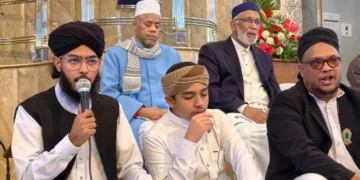








As Palestine Action detainees approach 50 days on hunger strike, concerns are mounting over medical neglect, prolonged remand and political silence. Their protest, supporters argue, exposes the UK’s complicity in injustice and a wider moral collapse.
By REDERWAAN CRAAYENSTEIN
A Palestine Action detainee on hunger strike calls for assistance. Grasping her chest, she asks for an ambulance to take her to hospital. A nurse arrives and scolds her, saying she is in prison and cannot decide when to call an ambulance or go to hospital. The nurse, as the responsible medical officer, performs an ECG and promises to return in ten minutes. Many hours later, the detainee is finally taken by ambulance. Staff are overheard making troubling remarks about the ECG results.
This scene evokes memories of Irish hunger strikers in the H-Blocks, detainees at Guantanamo Bay and Bagram Air Base, prisoners abused at Abu Ghraib in Iraq in 2003, victims of extraordinary rendition held in black sites during the so-called ‘war on terror’, and ultimately the Nazi Holocaust. I am also reminded of Palestinian detainees held without trial, and prisoners released from Israeli jails.
The Palestine Action hunger strikers are demanding the right to bail, an end to the proscription of Palestine Action, and the ability to communicate freely with their lawyers and families.
They are accused of taking action against an arms manufacturer supplying weapons to an apartheid regime that is also committing genocide.
The hunger strikers are Qesser Zurah, Amu Gib, Heba Muraisi, Jon Cink, Teuta Hoxha, Kamran Ahmed, Lewie Chiaramello and Muhammed Unmer Khalid.
Some are now approaching 50 days without food. In 1981, Bobby Sands of the Irish Republican Army died after 66 days on hunger strike.
My concern extends to prison officials who are detaining remanded prisoners until their next court appearances without ensuring their welfare. Medical professionals, though employed by the prison service, are bound by a professional duty to ‘do no harm’. Politicians are meant to hold the Secretary of State — the responsible political authority — to account. Instead, we are witnessing elected officials, prison governors and medical professionals losing sight of their moral responsibilities.
These hunger strikers are putting their lives on the line in defence of a people being genocidally wiped off the map and ethnically cleansed from their land. The UK government is complicit in these war crimes and crimes against humanity.
Lawyers representing detainees who have been on remand for two years, supported by human rights organisations, have appealed to the Secretary of State for Justice and the Prime Minister to intervene. They are calling for humane treatment and compliance with the law. History offers a chilling parallel. Margaret Thatcher’s response to Irish hunger strikers was silence. In apartheid South Africa, Justice Minister Jimmy Kruger said the death of Steve Biko in detention left him ‘cold and unmoved’. Today, Keir Starmer and David Lammy claim Nelson Mandela as their hero.
During the 1980s, the IRA hunger strikers dominated headlines. Today, the mainstream media is largely silent about the Palestine Action hunger strikers. This silence represents a systemic moral collapse. It is not independent journalism; it is the manufacture of silence around hunger strikers and the apartheid and genocide inflicted on the people of Gaza. Silence, in this context, is complicity.
The reason is clear. The arms manufacturer is Israeli. The apartheid and genocidal regime is Israel.
I come from apartheid South Africa. I owe the anti-apartheid solidarity movement a debt I can never repay. Writing on this issue is my attempt to repay it in part.
You may also want to read






Government ministers, prison wardens and medical professionals once collaborated in apartheid-era detention without trial and torture simply because prisoners dared to challenge the regime. The parallels are stark.
When activists engage in non-violent action to oppose genocide, they are following their innate moral compass, even before the dictates of national or international law. If an arms manufacturer supplied weapons to those committing systematic cruelty to animals, it would be shut down and prosecuted. Yet these activists are criminalised for disrupting a company supplying weapons used in war crimes and crimes against humanity.
There is now broad consensus that the government is overreaching in its attempt to ban this direct-action solidarity group. Thousands of older activists who lived through struggles against fascism and racism oppose the ban. Taking a stand against Israeli apartheid and genocide, however, remains a poor career move — and an even worse financial one.
The UK often portrays itself as a beacon of humane values. There was a time when Keir Starmer was a human rights lawyer. He once called for Israel to be expelled from FIFA. David Lammy, a Harvard-trained lawyer, has also fallen silent.
When Steve Biko died in detention, the UK Labour Party was outraged. MPs tabled Early Day Motions condemning apartheid and demanding accountability. More than 40 people died in detention in apartheid South Africa. Labour activists were deeply involved in the Anti-Apartheid Movement, with Trafalgar Square a constant site of protest.
In the Black anti-racism struggles in the UK, Ambalavaner Sivanandan famously observed that ‘what the Tories debate, Labour legislates’.
I pray that the hunger strikers do not die in prison. My political tradition teaches: if you see something wrong, change it with your hands. The hunger strikers tried to do so by disrupting the arms manufacturer. If you cannot act, then speak out. Hundreds have been arrested for doing exactly that. If you cannot even speak, then at least pray in your heart. Many are doing so now, as thought-crimes legislation looms.
This issue is not only about the hunger strikers. It is about a government complicit in Israeli apartheid and genocide, including the starvation of Palestinians in Gaza. I hope prison officials, politicians and medical professionals rediscover a functioning moral compass.
If these hunger strikers die in custody, their blood will be on the hands of those who remained silent — Starmer, Lammy, prison authorities, medical staff and the media. They symbolise our spiritual and moral collapse.
In post-apartheid South Africa, those responsible for deaths in detention are still being pursued decades later. Records were kept. Justice was delayed but not abandoned. We must do the same now — urgently building the case, intervening where possible, and seeking justice for the hunger strikers before it is too late.