




























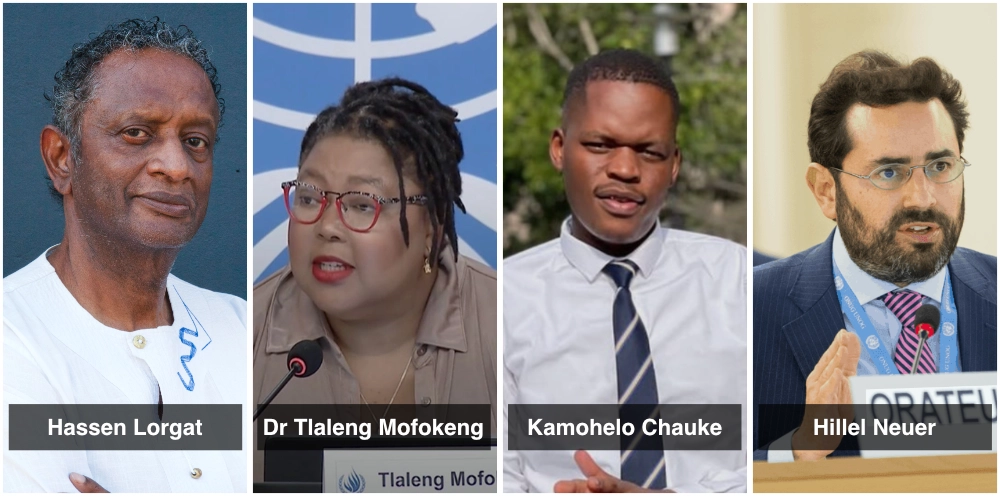

By HASSEN LORGAT
Kamohelo Chauke questions Section27’s defence of Dr Tlaleng Mofokeng. Yet the timing of his intervention, the chronology of the dispute and the court outcome reveal an effort to discredit a leading health-rights advocate in South Africa.
The recent opinion piece by Kamohelo Chauke is an attempt to be proactive by muddying the waters.
The question he asks – why donor funds are being used to defend the Economic Freedom Fighters’ (EFF) mayoral candidate for Johannesburg – reveals ignorance of the chronology. When the case began more than a year ago, Dr Tlaleng Mofokeng was only the United Nations (UN) Special Rapporteur on the right to health.
That Chauke’s article appeared on September 8, 2026, is significant. The timing suggests that he is operating as an intellectual sleeper or opinion writer for hire. He is, after all, in the service of Zionism and has been called into action to sully Dr Mofokeng’s victory by questioning the role of a public-interest law firm in defending the then UN Special Rapporteur on the right to health.
He is wrong to state that Section27 was sponsoring a mayoral candidate. What the organisation did was support Mofokeng while she was still the UN Special Rapporteur.
It was in January 2025, when Benjamin Netanyahu announced a brief delay in the Gaza ceasefire – the subject of the South African Zionist Federation’s (SAZF) complaint to the Health Professions Council of South Africa (HPCSA) – that Mofokeng wrote the post.
On January 19, 2025, she responded to an Al Jazeera report about the delay with: “F*ck him.” The post has since been deleted. The SAZF complaint also cited a reply she posted to UN Watch executive director Hillel Neuer, who had pressured the UN to act against her: “You white man. Evil scum. Voetsek.”
Section27 did not support a mayoral candidate; it supported a health professional and health-rights advocate. On its website, Section27 clearly sets out its principles and working methods:
“Section27 uses law and activism with partners to create systemic change in South Africa’s health and education systems. We use strategic court cases and community action to help people access healthcare and education. We run campaigns to teach the public about the Constitution and take part in human rights discussions. We also do high-quality research to support our work with evidence.”
In October 2025, the public-interest law firm made a submission to the UN Special Rapporteur on the right to health concerning the continuing denial of healthcare services to migrants in South Africa.
Section27 highlighted the “increasing intimidation and exclusion of migrants from public healthcare facilities”, the role of the anti-African migrant organisation Operation Dudula and the government’s failure to ensure equitable access to healthcare.
It was an obvious institution to approach because this issue touched on violations of domestic and international human rights law. Through Mofokeng’s office, Section27 sought to compel the South African government to provide healthcare to migrant communities without discrimination.
You may also want to read



This preceded the case against Dr T, who was attacked for telling fugitive from international law B Netanyahu to “FU”.
The second case that Chauke revives in Business Day was equally strategic in its timing and sought to deflect attention. It originated with the same source: what he describes as “Geneva-based UN Watch”.
This phraseology is intended to lend the organisation a sense of authenticity. However, UN Watch is a bogus non-governmental organisation (NGO) that Spinwatch has identified as a front for the Israeli government. At the end of July 2026, its director, Hillel Neuer, wrote to UN Secretary-General António Guterres to complain.
The NGO acted strategically and sought to blunt the impact of Mofokeng’s final report. Its intervention focused on a groundbreaking report that concluded her term at the UN.
Dr T officially ended her UN mandate on July 31, 2026 – a moment of which South Africans should be proud. Yet, about two days earlier, Israel’s supporters attempted to create a scandal to smear her work.
The July complaint against Mofokeng arose from her acceptance of the EFF’s nomination as its Johannesburg mayoral candidate for the November 2026 elections.
The complainants claimed that, by accepting the nomination, she had violated her duties as UN Special Rapporteur on the right to health. They incorrectly stated that her UN mandate continued until August 2026 and questioned her impartiality. But I believe they were running from her explosive report.
Her final report was released under the title “A compendium on medicide: A sub-text to reproductive genocide – A public health crisis”.
The Special Rapporteur’s report draws together the other reports she produced during her mandate in a 22-page document. As Mofokeng explains in the compendium, her perspective applies an anti-racist and anti-colonial approach to demonstrate how health violations are profoundly gendered.
She argues that “structural racism, coloniality and gender-based discrimination function as determinants of health inequities”. In other words, these forces directly produce unjust health outcomes. Her objective is to “contribute to new knowledge sharing” by connecting the right to health with broader systems of oppression.
In his article, Chauke attempts to distract readers by attacking Section27. He does this by referring again to UN Watch, the Israeli front organisation, and its ally, the SAZF, which lodged a complaint with the HPCSA.
The HPCSA allegedly found Mofokeng guilty of misconduct over her social-media comments about the Israeli prime minister and a UN Watch official.
But timing is everything. Chauke’s article appeared a day before the uncontested court order, and it was an open secret that Dr T had won.
The parties – the HPCSA and Mofokeng – agreed that the Health Professions Council and its disciplinary committee’s finding of unprofessional conduct against her should be reviewed and set aside. In law, it is as though that decision never existed.
The First Medical Committee’s September 2025 finding that Mofokeng was guilty of unprofessional conduct for “using inappropriate language on social media”, together with the R10 000 fine imposed on her, was reviewed and set aside.
It was further recorded that all subsequent steps were void. The court ruled that there were no grounds to continue investigating or prosecuting the complaint.
Put simply, the original complaint lodged by the SAZF in March 2025 was formally dismissed. Each party will pay its own costs.
Chauke is a great friend of Israel and has visited the country several times, with the identity of whoever paid for the visits remaining unknown.
On May 6, 2025, in full imbongi mode, he wrote an article titled “Israel’s innovation model, a blueprint for SA’s future”.
The article did not address the surveillance systems and drones used to perpetrate a genocide that has killed more than 75 000 Palestinians and injured thousands more, with many hundreds presumed dead beneath the rubble.
An estimate of 12 200 missing persons published in The Lancet provides a primary reference point in this context.
Therefore, when Chauke attacks Section27 for using public funds to defend Dr Tlaleng, it smacks of desperation. Section27 has worked with her, and the court has vindicated her case.