









![Does ta’wīl mean interpretation or fulfilment? A Quranic reassessment [+video]](https://muslimviews.co.za/wp-content/uploads/2026/10/Tawil-Kaskas-360x180.webp)









![Why becoming a wealthy Muslim is commendable in Islam [+videos]](https://muslimviews.co.za/wp-content/uploads/2026/09/Muslim-Trade-Business-1-360x180.webp)





Dozens of protesters gathered outside the British Consulate in Cape Town demanding the release of Palestine Action hunger strikers jailed in the UK without bail.
By MATTHEW HIRSCH
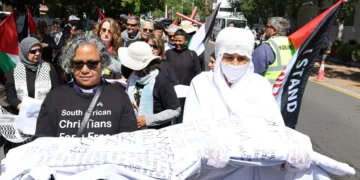
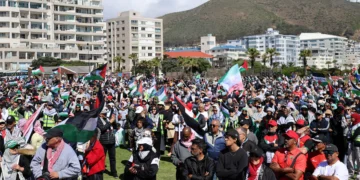
Dozens of protesters gathered outside the British Consulate in Cape Town on Tuesday afternoon, January 6, calling for the immediate release of jailed Palestine Action members in the United Kingdom.
For more than 60 days, some members of Palestine Action have been on hunger strike in prisons across the UK. They were jailed for their alleged involvement in break-ins at the UK subsidiary of Elbit Systems near Bristol in 2024. Others are being held in connection with an alleged break-in at a Royal Air Force base in Oxfordshire.
The prisoners have been denied bail and have been held on remand since at least August. They are not expected to go on trial for several months. (Read a detailed description of the situation on Wikipedia.)
Eight prisoners began a hunger strike on November 2, 2024. Reports indicate that some now require urgent medical care.
At the time of writing, three prisoners — Heba Muraisi, Teuta Hoxha and Kamran Ahmad — remain on hunger strike. A fourth, Lewie Chiaramello, is reportedly on an intermittent hunger strike.
Protesters in Cape Town chanted slogans such as ‘Blood on your hands, not your country, not your land’ and ‘Keir Starmer, you can’t hide, you’re committing genocide’. Placards read ‘I support Palestine Action prisoners, I oppose the genocide’ and ‘Free the hunger strikers’.

Demonstrations were also held in Johannesburg and Durban on Tuesday.
Activists called for bail and a fair, urgent trial for the accused, an end to censorship, the de-proscription of Palestine Action as a terrorist organisation, and the immediate withdrawal of terror-related charges against activists linked to the group.
One of the protesters, Dr Feroza Amien, told GroundUp that the hunger strike prisoners would have suffered ‘significant muscle mass loss, which can damage internal organs’.
‘They’ve embarked on this hunger strike in a last-ditch effort to be heard,’ she said.
In a statement, South African Jews for a Free Palestine called for the immediate release of the prisoners and urged the South African government to intervene.
‘We know the history of anti-apartheid hunger strikes in South Africa, and cannot sit idly by as humans are effectively sentenced to death for opposing a genocide in which their country is complicit,’ the statement read.
The organisation criticised the use of UK security legislation to prosecute the activists, noting that the legislation had resulted in Palestine Action being banned as a ‘terrorist organisation’.
You may also want to read




‘It is a grotesque irony that the law should be used to criminalise opposition to genocide rather than genocide itself,’ the statement said.
The United Nations expressed ‘grave concern for the lives and fundamental rights’ of the pro-Palestinian activists in a statement issued last month.
According to The Guardian, Lord Timpson, the UK Minister of State for Prisons, Probation and Reducing Reoffending, said: ‘While very concerning, hunger strikes are not a new issue for our prisons. Over the last five years, we’ve averaged over 200 a year, and we have longstanding procedures in place to ensure prisoner safety.’
This article was originally published on GroundUp.