


![Does ta’wīl mean interpretation or fulfilment? A Quranic reassessment [+video]](https://muslimviews.co.za/wp-content/uploads/2026/10/Tawil-Kaskas-360x180.webp)







![Why becoming a wealthy Muslim is commendable in Islam [+videos]](https://muslimviews.co.za/wp-content/uploads/2026/09/Muslim-Trade-Business-1-360x180.webp)



![The Prophet’s legacy beyond nostalgia and ritual [+ videos]](https://muslimviews.co.za/wp-content/uploads/2026/05/awqaf-photo.webp)

MAHMOOD SANGLAY
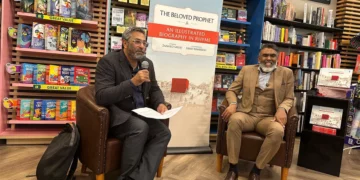
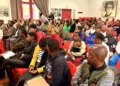
The launch of Prophet Muhammad ﷺ at 1500: His Prophetic Legacy, Ethical Vision and Contemporary Resonance, edited by Professor Aslam Fataar was hosted on May 9 at the at the Islamia Auditorium in Cape Town.
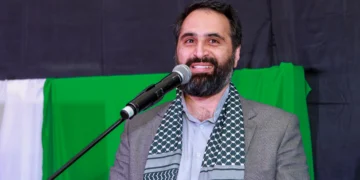
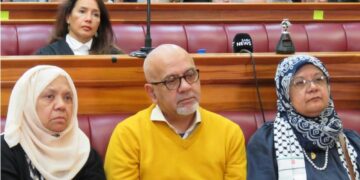
 The launch was not a conventional literary event. Rather, it was a searching public conversation on the role of prophetic ethics in an age marked by war, dispossession, inequality, technological disruption and spiritual fragmentation. The programme centred on a panel discussion titled: “What Do Prophetic Legacies Offer for Ethical Agency in Complex Times?”, featuring Ambassador Ebrahim Rasool, Rev Canon Michael Weeder and Prof Xolile Simon.
The book, comprising an introduction and twenty essays, emerges from the broader 1500 Prophetic Legacy Project, marking approximately 1500 lunar years since the birth of Prophet Muhammad ﷺ. In the preface, Fataar describes the project not as an exercise in nostalgia, but as an effort to recover the Prophetic legacy as a living moral and intellectual resource capable of speaking meaningfully to contemporary crises.
Fataar explained that the book was commissioned by the Prophetic Legacy 1500 Commission and produced over a demanding 10-month process involving 23 contributors. The contributors engage questions ranging from spirituality, race and interfaith coexistence to journalism, artificial intelligence, economics, pedagogy and statecraft.
A defining feature of the launch was its insistence that the Prophetic legacy cannot remain confined to devotional remembrance alone. Fataar argued that Muslims often approach the Prophet ﷺ emotionally and spiritually, but hesitate to engage his legacy intellectually and ethically in relation to present-day realities. Drawing on Professor Ebrahim Moosa’s chapter, he described the Prophet as “performative” — meaning that Prophetic teachings cannot be understood merely through text, but through how they were embodied in lived action.
This framing transformed the event from commemoration into critique. The central question became whether Muslims today are adequately translating reverence into ethical agency. Rasool sharpened this challenge by asking whether repeated devotional practices alone can respond to the deep crises confronting both the ummah and humanity. He situated these crises within what he called a “70 by 70” condition: in the roughly 70 years since World War II, Muslims have found themselves in the centre of the overwhelming majority of global conflicts, whether through colonial intervention, dispossession, occupation or authoritarianism.
From the partition of India and the establishment of Israel to the coup against Iran’s Mohammad Mossadegh and the continuing wars across the Muslim world, Rasool argued that Muslims must confront the question of whether their ethical and intellectual traditions are being mobilised meaningfully enough to address contemporary realities. He warned against reducing Islam either to rigid literalism or to empty ritual detached from social responsibility. Instead, he called for reclaiming the Qur’an and Prophetic tradition through the higher objectives of mercy, justice, wisdom and the common good.
The launch’s strongest emotional and interfaith moment came through Rev Canon Michael Weeder, former dean of St George’s Cathedral. Speaking through memory rather than formal theology, Weeder narrated how his devout Anglican mother sought spiritual protection for her children through both Christian prayer and a Muslim taweez (amulet) obtained from a Muslim community in Bonteheuwel.
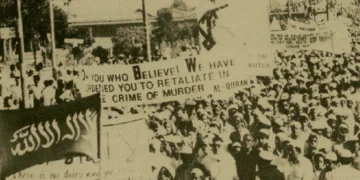
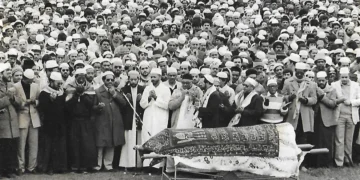
The story became a profound meditation on the Cape’s layered spiritual history. Weeder described how oppressed communities often crossed formal doctrinal boundaries in pursuit of dignity, healing and survival. He linked this lived spirituality to Cape histories of slavery, forced removals and anti-apartheid resistance, invoking the memory of Imam Abdullah Haron and Anglican priest Bernard Wrankmore’s 1969 fast at the kramat on Signal Hill in protest against Imam Haron’s death in detention.
Prof Xolile Simon extended this conversation by arguing that prophetic engagement must become embodied social practice rather than remain abstract theological discourse. Reflecting on moments of shared song and spiritual expression between black Christian and Muslim communities, Simon argued that prophetic ethics can create “deep bridges” across faith and cultural traditions.
He emphasised that authentic pluralism does not require abandoning one’s faith identity. Rather, it requires people deeply rooted in their own traditions while remaining capable of crossing boundaries to build an inclusive democratic society. For Simon, the Prophetic example provides resources not only for Muslim renewal, but also for interfaith solidarity and social cohesion in fractured societies.
The significance of the launch ultimately lay in its refusal to reduce Islam to either victimhood or reaction. Instead, the speakers repeatedly returned to the need for intellectual courage, ethical imagination and institutional renewal. Fataar described the book as offering an “ethical grammar in motion” — a framework for thinking through contemporary problems without imprisoning the Prophetic legacy in the seventh century.
At a moment when religion is frequently manipulated for polarisation, exclusion and power, the launch presented a markedly different vision: one in which the Prophetic tradition becomes a resource for justice, coexistence, moral responsibility and human dignity. In doing so, the event demonstrated why the 1500 Prophetic Legacy Project carries significance beyond the Muslim community itself. It seeks to recover the ethical possibilities of faith traditions within a wounded and deeply uncertain world.
The full video of the launch may be viewed here: https://www.youtube.com/watch?v=aZqf2iTGhBY
Copies of the book Prophet Muhammad at 1500 – His Prophetic Legacy, Ethical Vision and Contemporary Resonance are available at:
You may also want to read



Al-Ikhlaas Library (021 697 1508)
Darul Latif (079 097 8998)
Exclusive Books (021 674 3030)
Chapter 96 (076 985 0956)
Sawants (021 699 1200)
https://www.loot.co.za/product/prophet-muhammad-at-1500/tlrh-8565-g080