





![Does ta’wīl mean interpretation or fulfilment? A Quranic reassessment [+video]](https://muslimviews.co.za/wp-content/uploads/2026/10/Tawil-Kaskas-360x180.webp)













![Why becoming a wealthy Muslim is commendable in Islam [+videos]](https://muslimviews.co.za/wp-content/uploads/2026/09/Muslim-Trade-Business-1-360x180.webp)





A response to Qibla’s June 16 reflection – which was published on this site – challenging certain accounts by the movement of events in the seventies and its portrayal of that period’s liberation history.
By ALI RIDHA KHAN
Frantz Fanon writes, in Black Skin, White Masks: ‘There are too many idiots in this world. And having said it, I have the burden of proving it.’
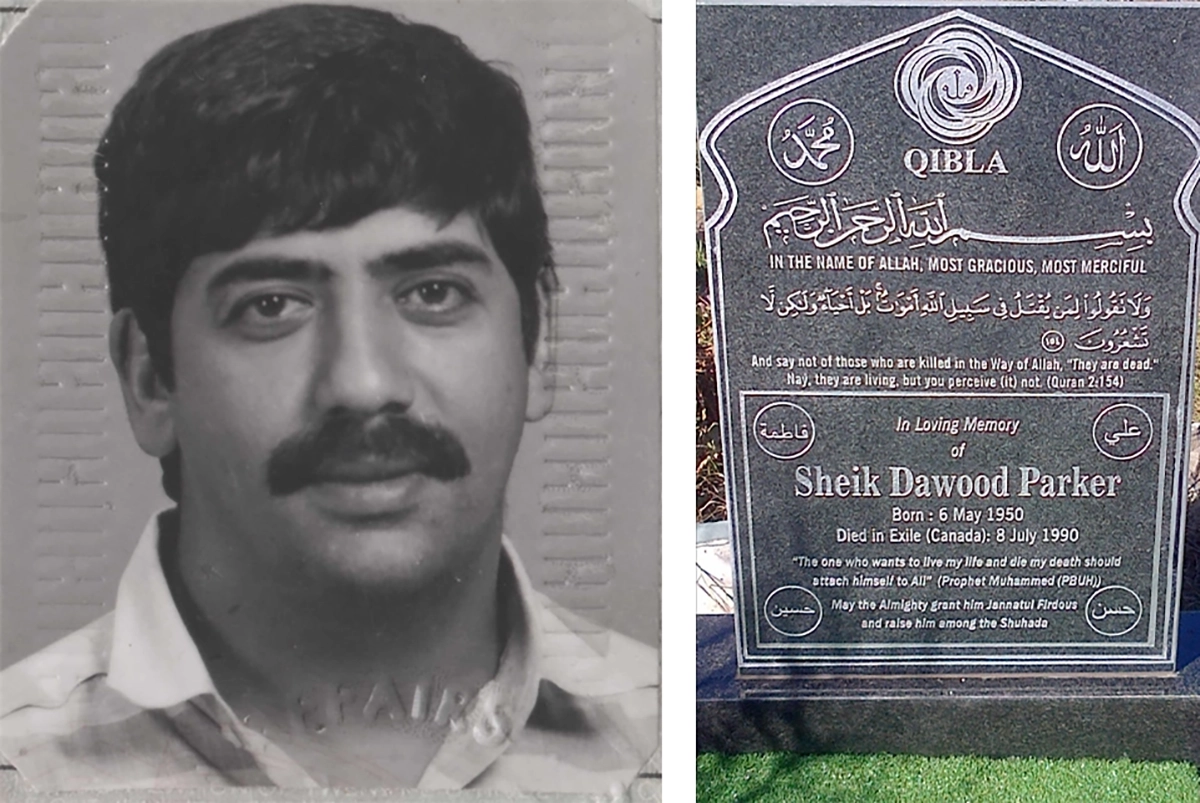
I am the eldest grandchild of Dawood Parker, who died in Canada in 1990. I have spent years making Mum’s Dad, a feature documentary about his life, and The Athens Group, a short film about the Qibla members intercepted in Athens en route to Libya for military training. When I approached two of the organisation’s current members – Reederwaan Craayenstein and Aziz Kader, both listed as Qibla contacts at the foot of the very article I am responding to – they declined to be interviewed. They have, however, found occasion to publish his name.
The organisation’s commemorative statement, published on this site on June 10, 2026, is presented as a historical reflection. It is not. It is institutional self-mythologisation dressed in the language of resistance – a 50-year anniversary piece that, with impressive consistency, makes every moment of South African liberation history somehow about Qibla. The students of Soweto would have found this instructive, had more of them survived long enough to read it.
Let me be precise about what the article gets wrong, and why it matters.
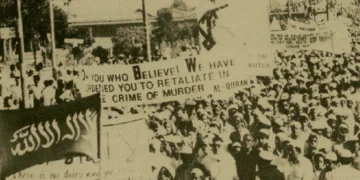
On June 16, 1976
Qibla was founded in 1979. The students who rose on June 16, 1976 – organised through (South Africa Students’ Movement (SASM), shaped by the Black Consciousness Movement, theorised by Biko – had no relationship to an organisation that did not yet exist. The article knows this. It gestures toward it in the passive voice, speaking of what the uprising meant, quietly positioning Qibla as the inheritor of its correct interpretation.
But the students did not require interpretation. SASM’s own minutes from May 1976 record their analysis in plain language: the Afrikaans decree was ‘a sign of demonstration against systematised schools to produce “good industrial boys” for the powers that be.’ They understood racial capitalism. They understood settler colonialism. They said so, in writing, three years before Qibla existed, to explain it to them.
The article describes these students as people who ‘lacked in many things, save for courage and the audacity to stand up.’ Read that sentence carefully. It is praise that functions as condescension – brave children who implicitly needed the ideological scaffolding that only a mature organisation could supply. This is not how you honour the dead. This is how you conscript them.
On the factual record
You may also want to read



The article states that ‘Dawood Parker and Yusuf Patel stepped forward as key figures’ in the operation to free detained PAC members from prison in Botswana. Dawood Parker is my grandfather. His role in that operation was real, dangerous, and carried out under conditions of exile in Zimbabwe – and it is documented in the court record of S v Cassiem (ZASCA 136/1993).
But the article cannot tell this story accurately because it does not understand what it is describing. There is a structural error at the heart of its account. The PAC did not have an ‘external High Command’ – the article’s term – for a separate political body. What existed was the APLA High Command: an internal military command structure operating as part of the PAC’s armed wing. My grandfather was operating across organisational lines simultaneously – as a member of Qibla working with the PAC and APLA. The operation in Zimbabwe was not a Qibla initiative that happened to involve PAC men. It was a convergence of liberation praxis across those structures, in which individual comrades held multiple commitments and acted accordingly. Flattening that complexity into a Qibla success story is not only inaccurate; it erases the very political intelligence that made such operations possible.
As for Yusuf Patel, he was the second appellant in S v Cassiem – arrested alongside Achmad Cassiem on terrorism charges and engaged with the apartheid courts throughout the relevant period. The article presents him as simultaneously detained and operationally active in Zimbabwe. These things cannot both be true. Either the article does not know this, or it has chosen not to say it.
On Qibla’s political isolation
The article complains that ‘Qibla never had the masses’ and attributes this to obstruction by ‘other oppressed organisations’. This claim is offered without a single name, date, or piece of evidence.
The historical record suggests a more straightforward explanation. Of the three main Muslim anti-apartheid tendencies of the period – the Muslim Youth Movement, Qibla, and the Call of Islam – only the Call of Islam directly engaged the UDF, Cosatu and the civic associations that constituted the actual mass movement of black South Africans. Qibla’s framework – Khomeinist in inspiration, organised around the slogan ‘One Solution, Islamic Revolution’ – had limited appeal in a country whose oppressed majority was neither Muslim nor particularly interested in theocratic governance. That is a political observation, not a slander. Qibla made ideological choices; those choices had political consequences. Blaming other organisations for those consequences is not history. It is a grievance with footnotes removed.
A final word
My grandfather’s name appears in this article without his family’s consultation, in service of a narrative he did not author. He was a man who operated across organisational lines – Qibla, PAC, APLA – precisely because he understood that liberation was not the property of any single formation. He was exiled with his family in Zimbabwe, operating under genuine danger, and he did so with a political sophistication that resists the kind of institutional capture this article represents.
The least Qibla owes him – and the students of 1976, and the readers of this publication – is accuracy. Failing that, it owes them silence.
What it has offered instead is a document that begins with the martyrs of Soweto and ends with a contact list.
Fanon’s burden, in this case, is not heavy.
Ali Ridha Khan is a political theorist and writer based in Cape Town. He holds an MA in Political Studies from the University of the Western Cape, and he is an incoming doctoral candidate at the University of Leeds School of Fine Art, History of Art and Cultural Studies. His research sits at the intersection of critical political theory, affect studies, and postcolonial urban humanities, with a sustained focus on the politics of Cape Town as both a site of inquiry and a condition of thought. He is the author of The Ledger and the Body.