







































![The market-builder who restrained the market [Part 2]](https://muslimviews.co.za/wp-content/uploads/2026/08/PHOTO-2026-08-25-17-16-32-360x180.jpg)
![The merchant preceding the Prophetic mission [Part 1]](https://muslimviews.co.za/wp-content/uploads/2026/08/01-360x180.jpg)











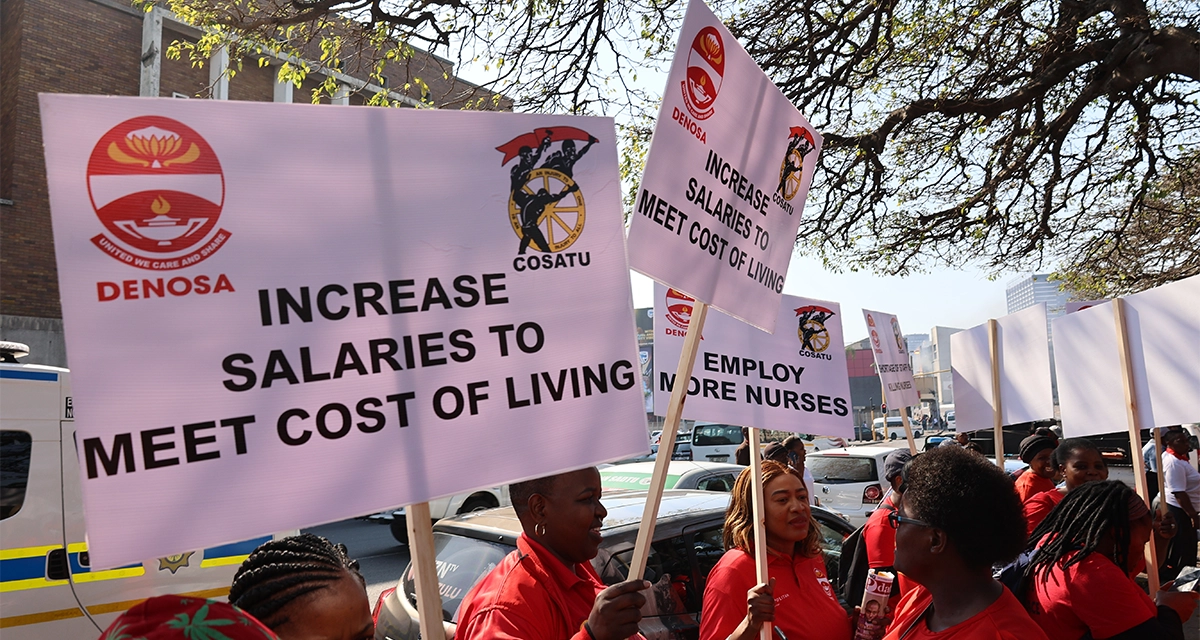

South Africa’s class struggle increasingly unfolds beyond workplaces. This analysis examines organised labour, unemployment and community movements, arguing that leadership must unite workers across production and social reproduction.
By DR MPHUTLANE WA BOFELO
While correctly emphasising the need for workers and revolutionaries to identify their class interests and act in accordance with those interests, the General Secretary of the SACP, Solly Mapaila, argues that organised workers — those organised in trade unions — constitute the leading detachment of the working class because they stand at the coalface of capitalist exploitation.
This formulation reflects a classical Marxist understanding of the industrial proletariat as the decisive revolutionary force by virtue of its strategic location within the capitalist production process. However, this proposition requires critical reconsideration in the context of contemporary South African capitalism.
The structural transformation of the economy under neoliberalism, marked by deindustrialisation, casualisation, labour market flexibilisation, and persistent mass unemployment, has fundamentally altered the composition of the working class.
South Africa is characterised not simply by the exploitation of wage labour but also by the systematic exclusion of millions from formal employment. Consequently, class struggle extends beyond the workplace and increasingly unfolds within communities where the contradictions of capitalist accumulation are experienced through poverty, unemployment, inadequate housing, failing public services, insecure livelihoods, and spatial exclusion.
It is precisely beyond the factory gates that many of the most militant forms of class struggle are taking place.
Across the country, unemployed workers constitute the backbone of community protests, land occupations, housing movements, and campaigns for water, electricity, sanitation, healthcare, and other social goods. These struggles directly confront the consequences of neoliberal restructuring and the commodification of basic human needs. They are not secondary or “non-class” struggles but are expressions of the contradictions of capitalist social reproduction itself.
Marx’s concept of the reserve army of labour remains highly relevant in understanding this reality. The unemployed are not external to the working class; they are an integral component of it. Capital continuously reproduces a surplus labour population to discipline employed workers, depress wages, weaken labour’s bargaining power, and facilitate flexible accumulation. The unemployed therefore occupy a contradictory but central position within capitalist social relations. Their struggles against exclusion, dispossession, and state neglect are inseparable from the broader struggle against capital.
From this perspective, defining organised workers as the sole or primary “leading detachment” of the working class risks reducing revolutionary agency to those located within formal employment. Such a formulation underestimates the political significance of those sections of the working class whose relationship to capital is increasingly mediated through unemployment, informality, precarious labour, and dependence on public services.
The locus of class struggle has expanded beyond the factory gates into communities, informal settlements, and sites of social reproduction. At the same time, much of the contemporary trade union movement has become increasingly confined to workplace bargaining and wage negotiations.
While struggles over wages and conditions of employment remain indispensable, many unions have become trapped in what may be described as economism or wage-ism—a tendency to reduce class struggle to collective bargaining while failing to integrate workplace struggles with wider social and political struggles. Consequently, labour struggles are often disconnected from campaigns around land redistribution, housing, public transport, education, healthcare, and the broader crisis of social reproduction affecting the majority of the working class.
Furthermore, many shop stewards and trade union leaders have become organisationally detached from the communities in which they live.
The historic tradition of worker-intellectuals and worker-organisers linking factory struggles with township struggles has weakened considerably. Organisationally, many unions have become increasingly bureaucratised and corporatised, characterised by professional leaderships, institutional hierarchies, and administrative routines that often prioritise organisational survival, legal compliance, and negotiated compromise over militant mass mobilisation. Rather than heightening class contradictions and building working-class political power, they frequently function to institutionalise and manage conflict within the framework of capitalist industrial relations.
This critique should not be interpreted as dismissing the strategic importance of organised labour. Workers located at the point of production retain significant structural power because of their capacity to disrupt production and capital accumulation through strikes and other forms of industrial action. However, structural power at the point of production does not automatically translate into political leadership of the working class as a whole. Political leadership must be earned through active engagement with the full spectrum of working-class struggles, including those taking place outside the workplace.
The strategic challenge, therefore, is not to privilege organised workers over the unemployed, or vice versa, but to forge organic unity between workers in production and workers in the sphere of social reproduction. A genuinely revolutionary movement must unite employed workers, the unemployed, informal workers, rural labourers, women engaged in unpaid reproductive labour, youth, and community movements into a broad anti-capitalist bloc. Such an alliance would overcome the artificial separation between workplace and community struggles and reconnect the labour movement to the broader aspirations of the working class.
In contemporary South Africa, the leading detachment of the working class cannot be defined solely by organisational membership in trade unions. Rather, it must be understood as those organised social forces capable of unifying the diverse sections of the working class into a coherent political project directed against capitalist exploitation, social exclusion, and neoliberal accumulation.
You may also want to read



Revolutionary leadership today depends not merely on location within production but on the capacity to articulate and organise the totality of working-class struggles. The future of socialist politics in South Africa therefore lies not only in the factories, mines and workplaces where surplus value is extracted, but also beyond the factory gates, where millions of unemployed and precarious workers confront the everyday realities of capitalist dispossession and struggle to reproduce life itself.
Dr Mphutlane wa Bofelo is a scholar and researcher in Governance and Political Transformation, with a focus on political development, public leadership, popular politics, and worker education.


