


![Does ta’wīl mean interpretation or fulfilment? A Quranic reassessment [+video]](https://muslimviews.co.za/wp-content/uploads/2026/10/Tawil-Kaskas-360x180.webp)







![Why becoming a wealthy Muslim is commendable in Islam [+videos]](https://muslimviews.co.za/wp-content/uploads/2026/09/Muslim-Trade-Business-1-360x180.webp)

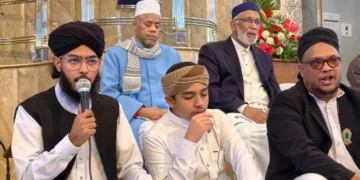


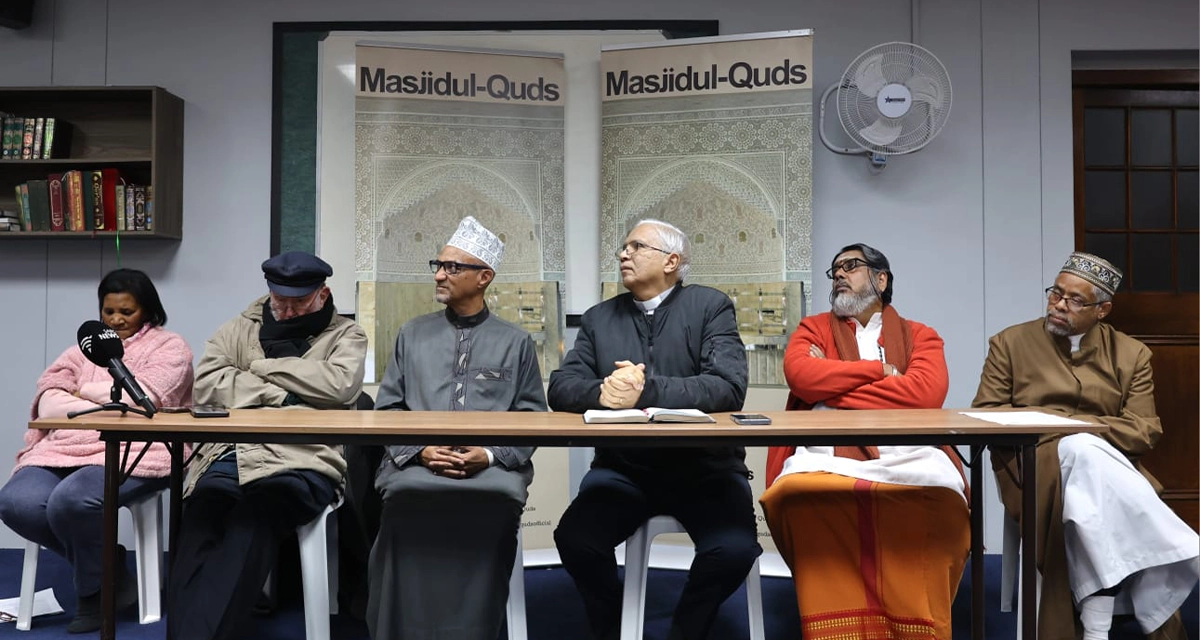

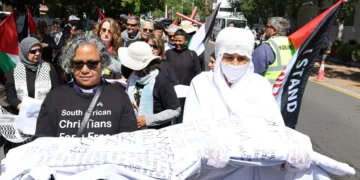
Muslim, Christian, Hindu and other faith leaders gathered in Cape Town ahead of planned national demonstrations to call for peace, reject violence against migrants and coordinate humanitarian support for vulnerable communities.
By ANWAR OMAR
On the eve of planned national demonstrations by the ‘March and March’ movement, some of South Africa’s most prominent faith leaders gathered in an emergency interfaith meeting in Gatesville, Cape Town, on Monday evening (June 29), issuing a unified, non-sectarian call for peace, protection of the vulnerable, and rejection of xenophobic violence.
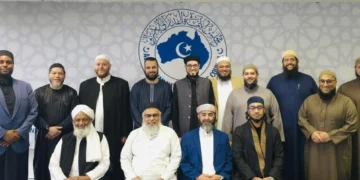
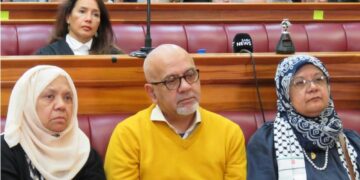
The meeting, held at Masjid al-Quds, brought together senior representatives from the Muslim Judicial Council (MJC), the Provincial Council of Churches, the Institute for the Healing of Memories, and other faith and civil society organisations. Speaking with one voice across religious traditions, they urged South Africans to approach the following day’s events, and the communities at the centre of them, with conscience, compassion and respect for the law.
A humanitarian emergency
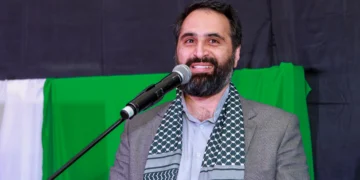
The gathering was co-chaired by Reverend Rodney Whiteman, Anglican priest and chairman of the Western Cape Provincial Council of Churches, and Imam A Rashied Omar of the Claremont Main Road Mosque, who framed the evening not as a religious event but as a moral intervention at a moment of national crisis.
Representatives speaking on behalf of their organisations included:
- Shaikh Riyad Fataar, represented by a delegate of the Muslim Judicial Council, one of the country’s most authoritative Islamic bodies.
- Reverend Dr Ruth Jonas of the Provincial Council of Churches, speaking for the ecumenical Christian community.
- Father Michael Lapsley, founder of the Institute for the Healing of Memories, an institution whose entire mission is grounded in confronting the wounds that fear and hatred leave behind.
- Father Peter-John Pearson, veteran priest from the Archdiocese of Cape Town and director of the Southern African Bishops’ Catholic Parliamentary Liaison Office, representing the Catholic community.
- Several other civil society organisations, including Gift of the Givers and the Inspire Network.
Each speaker was given five minutes. The cumulative message was consistent and clear: whatever one’s faith tradition, whatever one’s view on immigration policy, the targeting of vulnerable human beings – women, children and families stranded without shelter or recourse – is not acceptable and cannot be sanctioned in silence.
A non-sectarian appeal
What distinguished the gathering was its deliberate non-sectarian character. This was not a Muslim response, or a Christian response, or the response of any single community. It was a conscious act of moral solidarity across religious lines, represented in the same room, at the same table, with the same concern. The message was directed not only at faith communities but at all South Africans, regardless of religious affiliation: the approaching demonstrations require a principled, peaceful and humane response. Those who march do so within a constitutional framework that protects the right to protest, but that same framework equally protects the dignity and safety of every person on South African soil, documented or not.
Father Michael Lapsley, from the Institute for the Healing of Memories, has spent decades working with survivors of trauma, from apartheid violence to more recent cycles of communal conflict. His participation in the meeting was a reminder that xenophobic violence does not end when the marches do. It leaves wounds that last for generations.
Veteran Catholic priest Father Peter-John Pearce’s presence added particular resonance. According to him, this is not an isolated outburst, but part of a programme by the political elite of the world to suppress and encourage division, allowing it to segue into retaining power, robbing people of dignity, taking land, and taking away the dreams of generations of people.
The Muslim Judicial Council statement, read by media spokesperson Faizel Sayed on behalf of its president, Shaikh Riyad Fataar, took a balanced approach by rejecting both unlawful migration and unlawful responses to migration. According to the MJC, no person may be permitted to remain outside the ambit of the law, and no person should be deprived of their dignity, safety or fundamental rights by reason of their nationality, ethnicity or migration status. The MJC implored South Africa to adopt a balanced, evidence-based and future-orientated approach that shifts the nation beyond reactionary measures and political expediency.
A plan, not just a statement
The evening moved beyond words. After the press conference, participants convened a closed planning meeting with a concrete agenda to assess the scale of the humanitarian emergency facing foreign nationals in Cape Town and beyond, and to mandate an ad hoc steering committee charged with developing and implementing a coordinated emergency relief plan starting immediately.
Organisations are expected to begin deploying resources for shelter, food and protection of displaced and at-risk individuals in the hours and days ahead.
The national context
The interfaith meeting was convened against a backdrop of rapidly escalating national tension. The ‘March and March’ movement, founded by Jacinta Ngobese-Zuma, issued a public ultimatum setting June 30, 2026, as the deadline for undocumented migrants to leave South Africa, with marches and strikes planned across Gauteng, KwaZulu-Natal, the Western Cape, the Eastern Cape and beyond.
Operational risk assessments have identified high-risk flashpoints in major urban centres, including Johannesburg CBD, Durban’s Warwick Junction, and Mossel Bay’s Asla Park informal settlement, where risks include road blockades, business intimidation, arson and the displacement of foreign-national communities.
The government has confirmed that the day is not a national shutdown and has warned against vigilantism and incitement to violence, with law enforcement expected to be deployed across identified hotspot areas.
A counter-protest is also planned. On Tuesday at 1pm, Community House and a coalition of approximately 20 organisations will form a human chain at Salt River Circle in Cape Town under the banner ‘Workers of Africa Unite – Immigrants Welcome.’
You may also want to read


The longer moral arc
South Africa has been through this before. The xenophobic violence of 2008 and 2015 left dozens dead and tens of thousands displaced. In the aftermath of both episodes, the same questions were asked: where were the institutions, the leaders and the voices that might have intervened earlier?
Tonight, in Gatesville, some of those voices answered.
The Sermon on the Mount was invoked in closing: ‘Blessed are the peacemakers.’ It served both as a benediction and as a challenge to those in the room, and to those who would be on the streets the following day.