




![Does ta’wīl mean interpretation or fulfilment? A Quranic reassessment [+video]](https://muslimviews.co.za/wp-content/uploads/2026/10/Tawil-Kaskas-360x180.webp)








![Why becoming a wealthy Muslim is commendable in Islam [+videos]](https://muslimviews.co.za/wp-content/uploads/2026/09/Muslim-Trade-Business-1-360x180.webp)



Cape Town’s 2025 MEMOrients Conference brings global scholars, educators and artists together to explore Shakespeare’s deep connections with the Muslim world, decolonial histories and contemporary struggles such as Gaza—inviting the public into a vital, inclusive conversation.
By MAHMOOD SANGLAY
In mid-December 2025, Cape Town will be host to a fascinating convergence of scholarship, performance, history and public conversation on Shakespeare and the Muslim world.
This encounter is centred on questions that have both ancient origins and current relevance: What do Shakespeare’s worlds reveal about early contact between Europe and the Muslim world? And why does this matter in an age of decolonial thought and genocide?
In addressing these questions, Medieval and Early Modern Orients (MEMOs) is co-hosting an exciting series of public events with the Department of English Literary Studies at UCT, the Shakespeare Society of Southern Africa, and the Tsikinya-Chaka Centre at WITS University. The programme, called the MEMOrients Conference, runs from December 11 to 14, 2025 in Cape Town. It gathers leading international scholars to explore the cultural, political and literary intersections between Europe and Muslim societies from 500 to 1750 CE.
The programme includes academic keynotes, a workshop for teachers of Shakespeare, a panel discussion and a powerful theatre production titled Shakespeare to Gaza. These events are all open to the public and are advocated by Dr Hassana Moosa who teaches English Literature at UCT.
MEMOrients is a step toward re-storying the past, reclaiming erased histories, and drawing lines of solidarity from the Ottoman courts and Moroccan embassies of Shakespeare’s time to the rubble of Gaza today. For many people educated in conventional English literature syllabi, Shakespeare is often presented as a writer concerned only with Europe – white, Christian, and insulated from the wider world. But this has always been a myth. The Elizabethan and Jacobean worlds were deeply entangled with Muslim empires.
Shakespeare drew from this material, sometimes reproducing stereotypes, sometimes complicating them. Scholars like Ambereen Dadabhoy and Lubaaba Al-Azami, both headlining the Cape Town MEMOrients programme, have shown how characters such as Othello and the Prince of Morocco reveal early modern England’s fascination with Muslim cultures, even as they betray its fears and fantasies.
Public programmes for a broader local audience

The Cape Town events deliberately break the boundaries of academia to invite schoolteachers, learners, artists and the broader community into the conversation.
Thursday December 11, 2025: Opening keynote

The New Encounters Conference opens on Thursday with a keynote lecture by Prof Su Fang Ng of Virginia Tech. Titled ‘Entertaining Asia in Midsummer Night’s Dream’, the lecture takes place at 9am at Tafel, The Homecoming Centre in Cape Town.
Friday December 12, 2025: Second keynote
On Friday the second public keynote will be delivered by Prof Ambereen Dadabhoy of Harvey Mudd College. Her lecture, ‘Turning Turk: The Image of Islam on the Early Modern Stage’, begins at 5.30pm at Tafel, The Homecoming Centre.
Saturday December 13, 2025: Shakespeare to Gaza

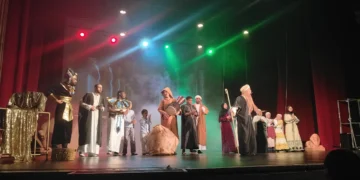
The programme continues on Saturday, with ‘Shakespeare to Gaza: A South African Response to the Gaza Monologues’, an ensemble performance scheduled for 6pm at P4 Studio, Hiddingh Campus, Orange Street, Cape Town. Tickets may be obtained via Quicket at R110. All proceeds will be donated to the Gift of the Givers Foundation. The visual motif of Shakespeare against the backdrop of destruction positions the performance as a creative act of solidarity with Gaza.
Sunday December 14, 2025: Teaching Shakespeare in Schools

The morning of Sunday December 14 from 10am till 12.30pm features a specialised teachers’ workshop titled ‘Breakfast and Brainstorm: Teaching Shakespeare with Inclusive Histories,’ at the Academia Auditorium, Islamia College, Lansdowne. This session is free but registration via Eventbrite is required. It is aimed at school educators who teach Shakespeare and it focuses on practical approaches to incorporating the early modern histories of Africa and the Muslim world into the classroom.
Sunday December 14, 2025: Muslims in Shakespeare’s Wor(l)ds

Later in the day, the programme continues with the public panel ‘Muslims in Shakespeare’s Wor(l)ds’ at 1pm, also at the Academia Auditorium, Islamia College, Lansdowne. Bringing together Prof Ambereen Dadabhoy, Dr Lubaaba Al-Azami, and Dr Hassana Moosa, the discussion examines Shakespeare’s engagement with Islam, Muslim characters, and the political and cultural exchanges between Europe and Muslim empires. The event is free but registration via Eventbrite is required. The session offers a rare opportunity for the public to engage directly with leading international scholars on the global dimensions of Shakespeare’s works.
Why this matters now
South African classrooms are still shaped by Eurocentric literary traditions that seldom acknowledge the place of Africa and Islam in world history. Events like these help to restore erased connections.
MEMOrients foregrounds the record of North African ambassadors that once walked the streets of London in Renaissance England. Muslim empires shaped global politics when England was still on the margins, and Shakespeare’s stage was a space where Europe imagined itself through its encounters with Muslims. This is not an ‘add-on’ to Shakespeare studies. It is the missing half of the story.
In important ways, MEMOrients also revives and extends the intellectual project initiated by Edward Said in Orientalism, which exposed how Western scholarship distorted, stereotyped and dominated its understanding of the ‘Orient.’ By returning to the early modern period and re-examining Shakespeare through the lens of Muslim presence, exchange and power, the initiative challenges the very foundations of those colonial narratives. At a moment when genocide unfolds in real time and the deconstruction of colonial thought becomes ever more urgent, MEMOs provides a vital scholarly and public platform to interrogate how these old structures of representation continue to shape political imagination today.
The inclusion of Shakespeare to Gaza also signals something profoundly political: art, history and performance carry moral responsibility. In a year when Palestinian bodies, homes and heritage continue to be destroyed, this performance uses Shakespeare—the most canonical writer in English—as a vehicle for protest and human solidarity.
There is something quietly revolutionary about seeing world-class academics travel to Cape Town, speak in community spaces, and engage directly with teachers, students and the Muslim public. Shakespeare’s plays, often associated with empire, can also be reclaimed as tools for dissent, empathy and truthful storytelling.
You may also want to read




South Africa, with its own deep histories of struggle, dignity and resistance, is an appropriate space for that conversation.
More information about the programme of events may be obtained by contacting the organisers at memorientsconference@gmail.com