












![The market-builder who restrained the market [Part 2]](https://muslimviews.co.za/wp-content/uploads/2026/08/PHOTO-2026-08-25-17-16-32-360x180.jpg)
![The merchant preceding the Prophetic mission [Part 1]](https://muslimviews.co.za/wp-content/uploads/2026/08/01-360x180.jpg)






Thirteen Commonwealth soldiers from South Africa, West Africa and the Indian subcontinent lie buried at Mowbray Muslim Cemetery, revealing a little-known chapter of Cape Muslim and wartime history.
By ANWAR OMAR
I was born and raised in Salt River, less than a kilometre from the Mowbray Muslim Cemetery, where for generations we have carried our deceased to their final resting place. Both my parents, three of my grandparents and several of my family members are buried there, including an uncle who lived with us and shared firsthand experiences from his time as a soldier in World War II. As a result, when I recently became aware that Mowbray Cemetery holds the graves of Muslim Commonwealth soldiers, it piqued my interest.
This article examines who they were, where they came from, and how they came to be buried there. This is a story that reminds us of a legacy that is largely absent from official histories and public commemoration.
The thirteen Commonwealth War Graves
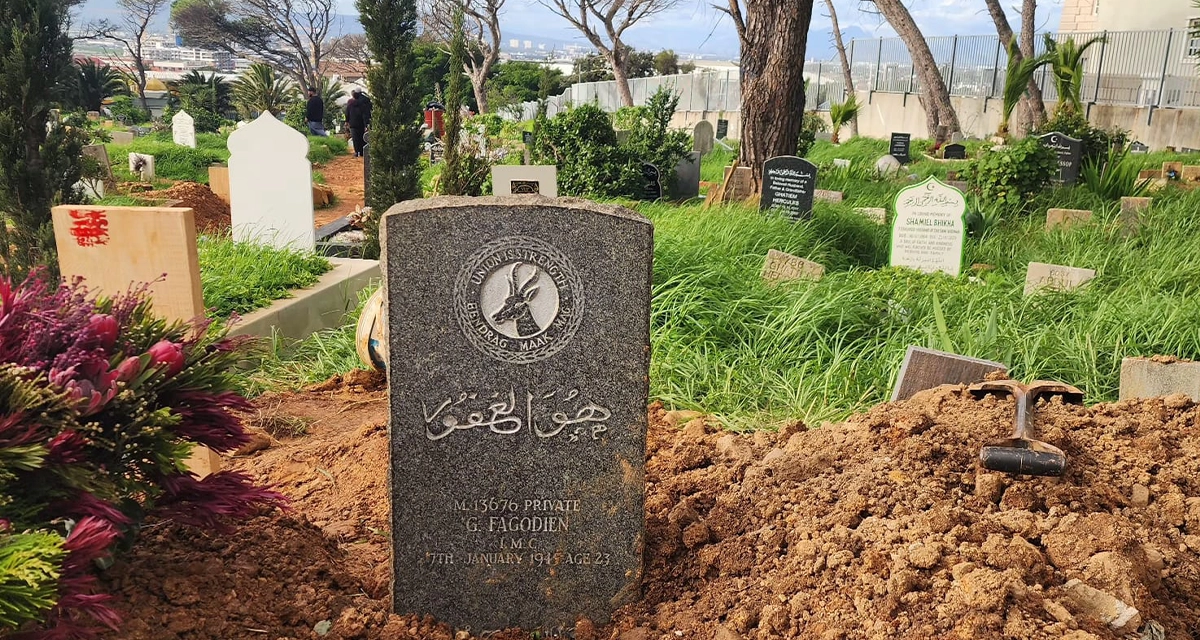
Initially, I thought there might be one or two of these graves at Mowbray, but on further investigation, I discovered that there are 13 of them, dispersed throughout the cemetery, among ordinary Cape Muslims on the slopes of Devil’s Peak. They were buried in the cemetery because they were Muslim, or presumed to be Muslim, and the Muslim community embraced them as believers who required a dignified burial in line with the requirements of Islam. Documenting these cases contributes to the preservation of a collective memory that has otherwise received limited public recognition.
The Commonwealth War Graves Commission (CWGC) notes on its public page that ‘it is extremely difficult to find the graves in this cemetery’ and that consultation with its South African Agency is required to locate them (CWGC, n.d.).
The 13 commemorations fall into three categories:
The South Africa’s Non-European Army Services
Seven were South African soldiers in the Non-European Army Services (NEAS) of the Union Defence Forces. Established in 1940, the NEAS comprised four racially distinct units: the Cape Corps for ‘Coloured’ or mixed-race recruits, the Indian and Malay Corps for Indian and Malay recruits, the Native Military Corps for Black Africans, and the Native Military Police. Five of them served in the Indian and Malay Corps (IMC), a unit comprising volunteers of Indian, Malay and Cape Coloured backgrounds. The IMC was integrated into the reorganised Cape Corps in 1942 (Yadav, 2022).
Approximately 40 000 non-White South Africans served in these units, officially categorised as unarmed non-combatants, throughout various campaigns in East Africa, North Africa, Madagascar, the Middle East and Italy (Yadav, 2022).
The CWGC lists these seven soldiers and the South African War Graves Project records the cause-of-death details as follows:
- Staff Sergeant Ismail Schroeder (M/11110, IMC), aged 43, d. March 9, 1946. He succumbed to ‘pulmonary tuberculosis after being discharged.’
- Sergeant Achmat Martin (C/166251V, Cape Corps), aged 39, d. June 24, 1946. His death is recorded as ‘died on active service’. His gravestone bears the inscription: ‘Only a Grave Still Needing Care. But Here Lies The One Whom We Loved So Dear’.
- Private Ismail Edries (M/13563, IMC), aged 27, labourer, d. April 14, 1946. His death is attributed to ‘malignant hypertension.’
- Private Gamet Fagodien (M/13676, IMC), aged 23, labourer born in Cape Province, d. January 7, 1945, of ‘pulmonary tuberculosis, after discharge.’
- Private Ismail S. Daniels (M/14367, IMC), d. September 7, 1943, ‘died after discharge’.
- Private Gamat Armien Harron (M/13460, IMC), aged 40, d. January 5, 1945, of ‘osteo chondro sarcoma of right ileum’, a type of pelvic bone cancer. The gravesite of Private Harron became untraceable over time, and as a result, the CWGC established a collective military plot with a special gravestone marker for such untraceable graves. I have not been able to locate this special gravestone dedicated to Private Harron yet.
- Private Sandy Mohamed (N/24223), d. July 12, 1945, while on active service. The CWGC lists him under the IMC, but his service number and the South Africa War Graves Project record suggest he was part of the Native Military Corps, an inconsistency that highlights how the NEAS distinctions were often blurred in both documentation and reality.
None of them died in battle. They succumbed to tuberculosis, post-discharge illness, hypertension, bone cancer, and vague classifications like ‘died on active service’ or ‘died after discharge’ – outcomes consistent with Yadav’s research on the medical consequences of non-combat service in situations where tuberculosis warranted its own pension category (Yadav, 2022). They are regarded as war casualties because the colonial government acknowledged their conditions were contracted during service and were buried with dignity by a community that embraced them. Their deaths were part of the lingering aftermath of the war, a reminder that its consequences did not end on May 8, 1945, for everyone.


The Royal West African Frontier Force
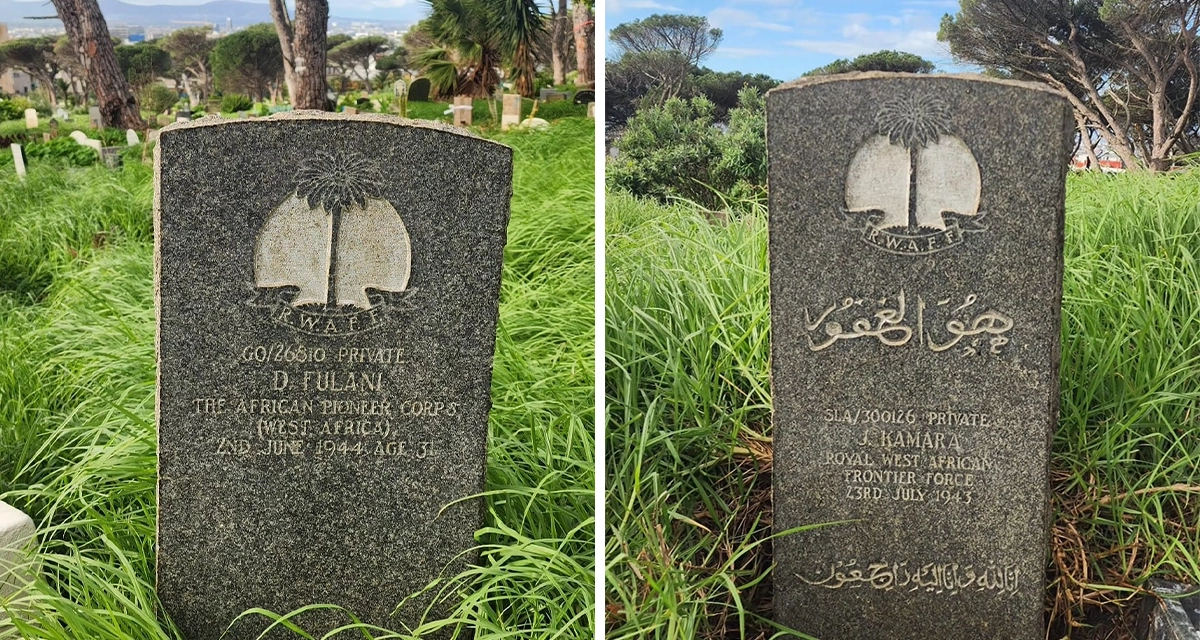
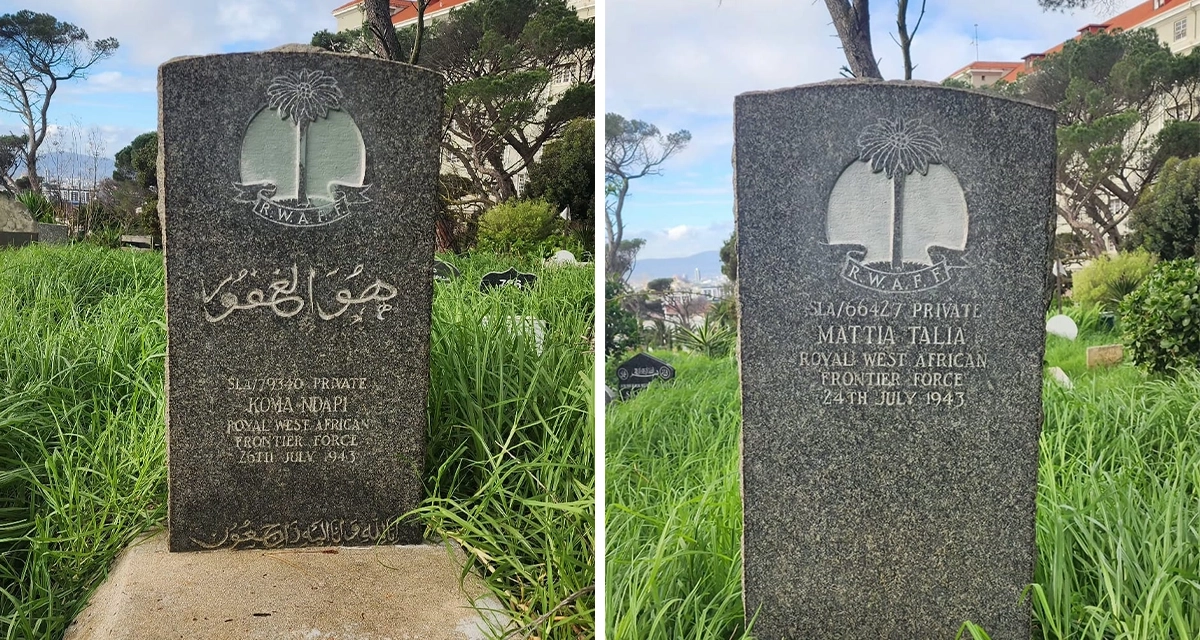
The five West African graves belong to soldiers from the Royal West African Frontier Force (RWAFF):
- Private M. Yamba (SLA/80041, RWAFF), d. July 25, 1943;
- Private Darbo Fulani, aged 31, d. June 2, 1944;
- Private J. Kamara, d. July 23, 1943;
- Private Koma Ndapi, d. July 26, 1943; and
- Private Mattia Talia, d. July 24, 1943.
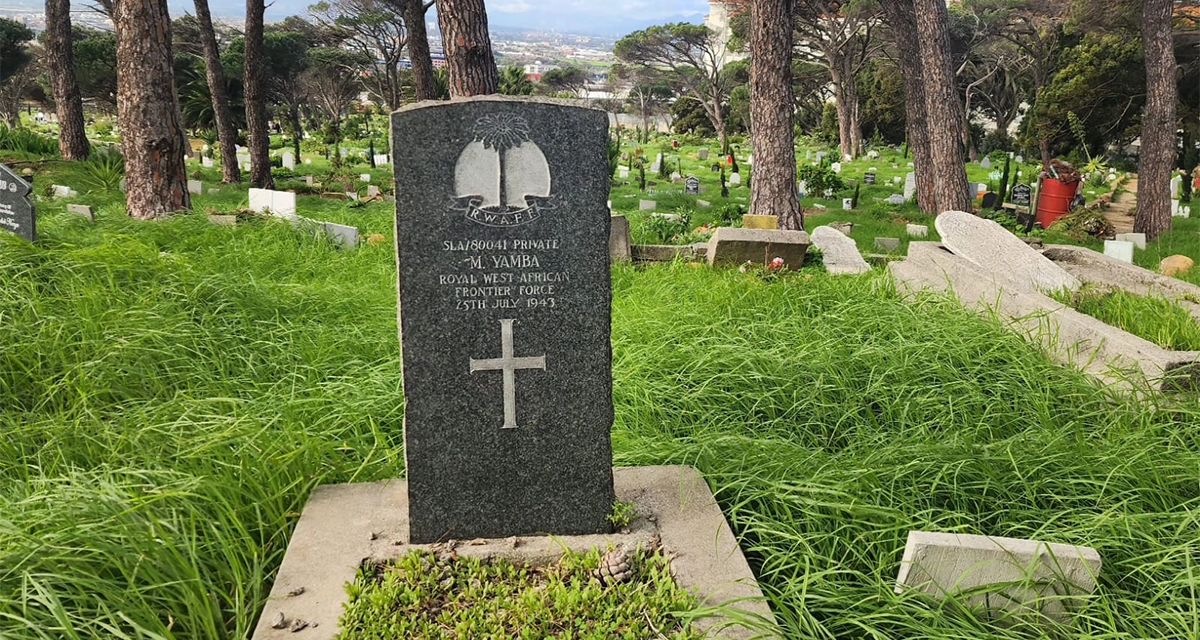
The ‘SLA’ prefix in Yamba’s number indicates a Sierra Leone connection and his headstone bears a Latin cross indicating he was Christian; whether this was known at the time of burial or established later is unclear from available records. There are two plausible possibilities, and the evidence does not clearly distinguish them:
- Mistaken-identity hypothesis: Yamba was assumed to be Muslim at the point of burial, perhaps because he arrived in a group alongside Muslim soldiers, or because ‘Yamba’ and a West African origin were taken as suggestive of being Muslim. The Christian identity was established only later, after which the CWGC headstone was cut with a cross, but the grave was not relocated.
- Pragmatic-burial hypothesis: His Christian identity was known at the time, but Mowbray was simply the cemetery where the other West African soldiers from the same convoy were being interred. Kamara, Ndapi and Talia all died within the same nine-day July 1943 window and therefore burying him separately would have been logistically awkward during wartime Cape Town. The Cape Muslim community’s willingness to accommodate the burial may have extended to a Christian comrade buried alongside his unit.
This strengthens the wider point that the community’s embrace of these soldiers was not narrowly sectarian; they also accepted soldiers presumed or known to be of other faiths into a Muslim sacred space.
The other soldiers were enlisted from various parts of West Africa, though the specific colonies are not in the CWGC’s public records. For these five, the records list only names and dates of death – no next-of-kin, no causes, no inscriptions. The only additional detail is Fulani’s age. This is not merely an oversight but reflects a significant issue the CWGC has faced throughout its existence.
The thirteenth soldier
The thirteenth grave is Driver Fateh Khan (175454), 32nd Mule Company, Royal Indian Army Service Corps, who died on July 31, 1943, aged 27. According to the CWGC, he was born to Ahmad Khan and Mehar Dhari, and married to Sais Bann of Danda Shah Bilawal in the Attock region of modern-day Pakistan (CWGC casualty record 2725788).
The 32nd Mule Company, part of 70 Brigade, provided animal transportation across East Africa and the Mediterranean where vehicle supply lines could not penetrate (70 Brigade History Project, n.d.). Details of his presence in Cape Town are absent from the sources I have consulted but, given the CWGC’s record that hospital ships frequently visited the Cape at the time, I can only speculate that it was during repatriation when he died.

The 2021 Special Committee Report
In December 2019, the CWGC appointed a Special Committee to examine the commemoration of non-White soldiers by what was then the Imperial War Graves Commission (IWGC). Its 2021 report (Hay & Burke, 2021) concluded that the IWGC, influenced by what it called ‘imperial ideology’, had diverged from its founding principle of equality in death.
The report estimates that 45 000–54 000 casualties, predominantly Indian, East African, West African, Egyptian and Somali, had been commemorated unequally, with as many as 350 000 either not commemorated by name or not at all. The lack of detailed records for Fulani, Kamara, Ndapi, Talia and Yamba reflects this legacy. The CWGC has since initiated a Non-Commemoration Programme to identify, name and honour those who had been missed. Efforts to recover the life stories of the five RWAFF men buried at Mowbray Cemetery are ongoing.
A cluster of deaths
Of the six recorded foreign fatalities, five fall within a nine-day window from late July to early August 1943. This strongly suggests they were off-loaded from a single convoy or hospital ship circumventing Cape Town and died within days of arrival, which is consistent with the CWGC’s record on hospital ships at the Cape and the well-documented role of the Cape sea route as a hospital staging point. However, verifying this will require further archival research at the SANDF Documentation Centre in Pretoria, the National Archives, and the admission logs of Wynberg Military Hospital, which I have not done thus far.
The heritage significance of the graves
What makes these graves significant is not only the global war they represent but the compassion of the community that embraced them. Having done a fair amount of research on this topic, they no longer feel distant to me. For me, they form part of the same sacred landscape through which generations of Cape Muslims have carried their dead with dignity, prayer and remembrance.
These 13 arrived from distant corners of the Empire – the Cape, West Africa and the Indian subcontinent – but in death they became part of the spiritual and communal fabric of the Cape Muslim community. There is a profound irony here. In life many served in racially segregated units where they were denied the right to bear arms alongside white comrades. In death, the records of some were reduced to little more than names and numbers, reflecting inequalities now acknowledged by the CWGC itself. Yet they were not treated as foreigners or colonial subjects but as Muslims worthy of a dignified janazah (funeral), buried among fellow believers. This is a subtle testimony of an ethic of equality in death that imperial structures themselves failed to uphold.
The Mowbray Muslim Cemetery is therefore not merely a local burial space but a site where slavery, colonialism, religion, segregation, war, migration and community memory intersect within a single sacred landscape. It embodies the evolution of the Cape Muslim community while preserving the memory of men from across the former British Empire whose lives and deaths became tied to the Muslim community through war. The presence of these Commonwealth graves strengthens the argument that the Mowbray Cemetery must be considered a heritage landscape of profound national historical significance.
Anwar Omar is a South African Heritage Resources Agency (SAHRA) councillor. A founding member of the Salt River Heritage Society, Omar holds a master’s degree in Conservation and the Built Environment from the University of Cape Town (UCT).
References
Commonwealth War Graves Commission (n.d.). Cape Town (Observatory) Muslim Cemetery: Cemetery Details. Available at:
https://www.cwgc.org/visit-us/find-cemeteries-memorials/cemetery-details/2074233/cape-town-observatory-muslim-cemetery/ [accessed May 13, 2026].
You may also want to read




Hay, Sir Tim & Burke, Kevin (2021). Report of the Special Committee to Review Historical Inequalities in Commemoration. Maidenhead: Commonwealth War Graves Commission.
South Africa War Graves Project (2014–2022). Casualty records, Cape Town (Observatory) Muslim Cemetery. Records consulted: Daniels, I.S. (id=4980); Edries, I. (id=6452); Fagodien, G. (id=6866); Harron, G.A. (id=9330); Martin, A. (id=15245); Mohamed, S. (id=17043); Schroeder, I. (id=22473). Available at:
https://www.southafricawargraves.org [accessed May 13, 2026].
Yadav, Rishika (2022). ‘The Boys Up North’: A History of South Africa’s Cape Corps and the Indian and Malay Corps in the Second World War 1940–1946. Unpublished doctoral thesis, London School of Economics and Political Science. DOI: 10.21953/lse.00004484.
70 Brigade History Project (n.d.). 32nd Mule Company, Royal Indian Army Service Corps. Available at:
https://70brigade.newmp.org.uk/wiki/32nd_Mule_Company,_Royal_Indian_Army_Service_Corps [accessed May 13, 2026].